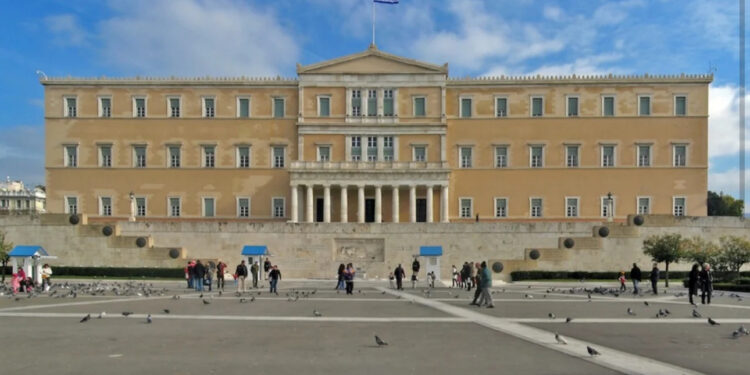
A fierce political debate took place yesterday in the Greek parliament after the government of Prime Minister Mitsotakis is significantly tightening its policy on illegal immigration, adopting a new law that accelerates the return of migrants.
The new law provides for the acceleration of deportation procedures for asylum seekers whose applications have been rejected, the extension of the period of administrative detention, and the limitation of opportunities for legalizing the stay of undocumented persons.
At the same time, as Greek media also point out, the Mitsotakis government aims to establish repatriation centers outside the EU, in cooperation with third countries, where migrants awaiting return to their countries of origin will be transferred.
This policy – Athens emphasizes – is part of the new European Union strategy to strengthen the return system. According to the Greek Minister of Immigration, Thanos Plevris, Athens is cooperating with the Netherlands, Denmark, Germany and Austria to set up joint return and transit centers, which are intended to be operational in 2027.
The Greek government has also initiated contacts with two African countries for this project, without revealing their identities.
The debate in Parliament took on a new dimension after the intervention of former Minister of Immigration, Makis Voridhis, one of the most well-known figures of the conservative wing of New Democracy, who was the drafter of most of this law.
During the discussion, Voridhis posed the rhetorical question: “Shall we sink the boat or not sink it?” – later clarifying that he was not proposing such an action, but that he wanted to show that there is a line that cannot be crossed and that the state must always act within the framework of international law.
His statement caused strong reactions from opposition parties.
According to analysts, the government’s toughening stance is also related to the pressure it is feeling from ultra-right parties, which are demanding even stronger measures for border and immigration control a few months before the country’s parliamentary elections.