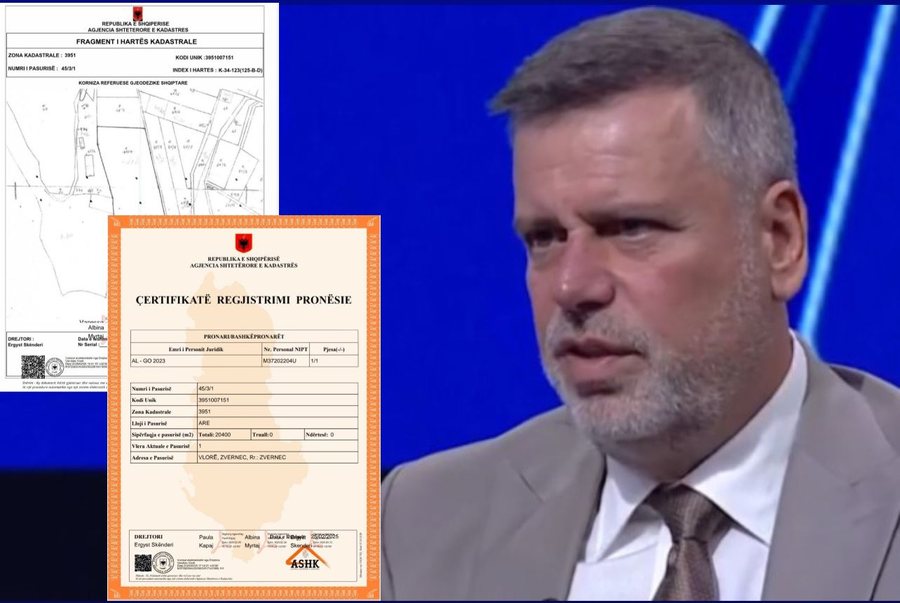
This is about Alaudin Malaj, former president of the Tirana Court of Appeal, who fled from justice for fear of facing Vetting, avoiding the exposure of his wealth and possible links to crime. Several facts and circumstances raise strong suspicions that Alaudin Malaj is part of Artur Shehu’s group.
SPAK yesterday finalized the first phase of the crackdown on the most powerful drug trafficking group, money laundering in construction and the alienation of properties on the coast, including the lands where the resort in Zvërnec is expected to be built. The Special Court approved 20 arrest warrants on Friday for the criminal offenses of money laundering, structured criminal group and international drug trafficking; including Artur Shehu, two major construction businessmen in Tirana, Ilir Shtufi and Orest Sota, as well as other persons related to drug trafficking or land transactions.
The seized assets so far amount to around 130 million euros, the largest figure in the history of SPAK and the prosecution in 35 years of pluralism. SPAK has raised the bar so high that with the crackdown on this group, there could be a construction crisis in Tirana. In addition to the 20 characters that SPAK has asked the GJKKO to arrest, an oligarch, who appears in SPAK’s main files, former ministers, deputies, former directors, former judges, etc., who could be criminally prosecuted in a second phase, are implicated.
In the file of the alienation of properties in Zvërnec, traces of a former judge, perceived as one of the symbols of corruption in the judiciary, also emerge. It is about Alaudin Malaj, former president of the Tirana Court of Appeal, who fled from justice for fear of facing Vetting, avoiding the exposure of his wealth and possible links to crime. Several facts and circumstances raise strong suspicions that Alaudin Malaj is part of Artur Shehu’s group.

As a judge, Alaudin Malaj has made two decisions in favor of Artur Shehur and his group regarding properties in Zvërnec, where in exchange he is suspected of receiving thousands of m2 of land, in the form of a donation or purchase at a symbolic price. More specifically, 20,400 m2 of land in Zvërnec is owned by the company AL – GO shpk, with the registration number M37202204U.

The company AL – GO shpk was founded by Agron Malaj in September 2023. Agron Malaj is the brother of former judge Alaudin Malaj. In March 2025, Agron Malaj donated 50% of the company’s shares to Alteo Malaj, who is the son of former judge Alaudin Malaj. Subsequently, Agron and Alteo Malaj increased the company’s capital from 100 euros to 670 thousand euros.

On June 2, 2026, after SPAK conducted further investigative actions for the alienation of properties in Zvërnec, Alaudin Malaj’s son leaves the company AL – GO shpk, donating 50% of the shares to Agron Malaj. There are strong suspicions that leaving the company is a move by Alaudin Malaj out of fear of SPAK to hide his traces in the alienation and profiteering of properties in Zvërnec.

AL – GO shpk is not the only company that Alaudin Malaj has acquired property in Zvërnec, while the acquisition of a villa worth hundreds of thousands of euros in the Uji i Ftohtë area in Vlora also remains a mystery. The AM-Invest shpk company owns 25 thousand m2 of land in the Zvërnec area, where it is planned to build a luxury resort. This company is owned by the family of Alaudin Malaj, the former president of the Tirana Court of Appeal. The former judge owns 25% of the shares, donated by his mother, while the rest is controlled by his father and brother.

Malaj has a history with properties in this area, having issued two decisions regarding them. A civil decision in 2013, which awarded the Shehu family 156 hectares of land in this area, overturning the decision of the First Instance; as well as a criminal decision in 2019, where he, in his capacity as rapporteur – in a panel that also included former judge Agim Bendo and former judge Shpresa Beçaj – dismissed the case for falsifying documents against Pëllumb Petritaj. Both of these decisions were returned for retrial by the High Court, which found problems in the reasoning. Both decisions are related to Artur Shehu and his group. Pëllumb Petritaj is Artur Shehu’s hand in the alienation of properties in Vlora.
There are strong suspicions that in exchange for these decisions, Alaudin Malaj received land from Artur Shehu. Malaj resigned in 2020 and was excluded from the justice system by the vetting process in February 2021. With around 1.7 million euros of declared assets, he was considered one of the richest judges in Albania. During the vetting process, Malaj claimed that he was becoming the victim of a conspiracy.
Aruba and Zvërnec ‘Summit’
Details of Artur Shehu’s meetings in Majorca, Germany, Aruba and Belgium were uncovered and monitored by a 2019 European investigation into the criminal activities of the “Osmani Clan”.
The documents state that between January 24 and 31, 2019, observations of several meetings between a group of Albanians involved in drug trafficking took place on the island of Aruba.
The purpose of these trips was twofold, according to the prosecution’s file. On the one hand, the logistics of the cartels were planned, with the investigative file sent by the Spanish authorities stating that the people involved planned to “purchase, transport and introduce large quantities of drugs into Europe.”
On the other hand, Aruba served as a starting point for investments in Albania, which according to Belgian investigators referred by SPAK had political support in Tirana.
The Belgian documents underline that “these meetings appear to be related to real estate projects in Albania, potentially financed with illicit funds, with the support of political authorities.”
To inject these staggering amounts of money earned from trafficking into the legitimate economy, the group set up a classic, but massive, money laundering scheme. The first phase, the “placement” phase, was carried out by transferring drug money through alternative systems such as physical routes or the “hawala” system.
Then came the manipulation of ownership. One of the most flagrant means was the use of falsified historical documents. For the lands in Zvërnec, the “Register of the Daim of 1318, serial number 47” was used, a document in the Ottoman language that allegedly made their ancestor, Seit Ahmet Shehu, the owner of thousands of square meters of forest and pasture. Court proceedings later proved that this document presented for the return of the properties was completely manipulated and deliberately mistranslated.
Once the properties were “acquired,” they were subjected to a lengthy process of stratification. The file explains that the cleansing was done through “multiple fragmentations and subsequent alienation, in the form of purchase, exchange or other forms, with the aim of making tracing more difficult.” The final step was to give these lands to “developing entities, in agreement between them, thus integrating and mixing illegal income with legal income.” This modus operandi, according to the Prosecution, has left its mark on giant projects such as the villas in Palasa and the multifunctional “Garden Building” on Kavaja Street in Tirana.
Investigations show that the so-called “Aruba summit” has decided the fates of dozens of projects, which are now a visible part or face of Tirana and the Albanian coast.
From Zvërnec to the towers of Tirana
In SPAK documents, meetings, coded conversations, and property transactions are linked into a single scheme, where assets suspected of being obtained through counterfeiting or trafficking money were then introduced into the construction cycle.
According to the Special Prosecution Office, the persons under investigation used “the falsification of property acquisition documents by creating false ownership or by increasing the areas of ownership.” They then carried out their numerous fragmentation and alienation, in the forms of purchase, exchange or donation, with the aim of making tracing difficult.
The lands were then given to development and construction entities, thus integrating and mixing illegal and legal income.
This modus operandi, according to the file, appears on the plot of land near the “Air Albania” stadium, on “Dervish Hima” street, where the prosecution says the actions were carried out by Adrian Rama, Artur Shehu, Elton Memeti, Alfredo Hamzai and Ardian Zykaj “at least from 2017 onwards”. The same scheme, according to SPAK, also extends to the villas of the “Green Coast” complex in Palasa, to the lands used for the construction of this complex, to construction projects in Tirana, as well as to construction companies or companies linked to the persons under investigation.
For the properties in Zvërnec, the prosecution is even more direct. In the request received by the GJKKO, it says that the investigations have revealed “reasonable suspicions based on evidence” that the assets there “were obtained illegally, through forgeries”. According to the file, these properties are suspected of having been obtained “using forged documents”, both for the recognition of ownership by state institutions, and for its registration for the purpose of inheritance.
The decision also mentions the much-discussed document known as the “Daimit Register,” which the High Court, according to the prosecution, confirmed in its reasoning that “it turned out to be falsified.” The prosecution adds that the land in Zvërnec is suspected of having been moved towards the coast and that the manner in which it was transferred to Artur Shehu through sales and exchanges shows “the manner in which this citizen acquired numerous lands,” with the subsequent intention of selling or investing.
For this reason, the GJKKO imposed a preventive seizure on the amounts generated from the transaction with the company “Albania Land Development” managed by Redi Struga and owned by two brothers from Qatar, Al Khayyat.
The amount seized in this decision is 128,354,437 euros, divided into three payments and the immediate freeze was approved by the court with the argument that: “there is a high and concrete risk that these assets will be alienated, destroyed or transferred to a third party.”/ Prapaskena