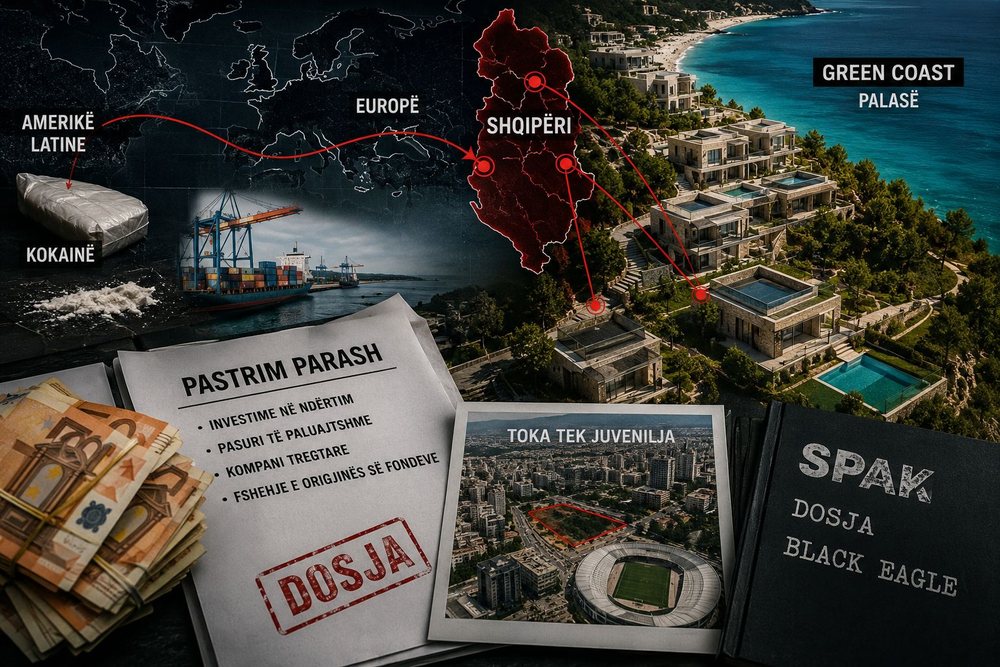
The “Black Eagle” case does not stop at international cocaine trafficking. In the final parts of the court decision, SPAK and the Court describe a suspected money laundering scheme, where narcotics profits are suspected to have been invested in real estate, villas, land and construction companies in Albania.
The file specifically mentions investments in Tirana and the southern coast, including Palasa, Vuno, Himara and Vlora. According to the Court’s reasoning, the suspected proceeds from criminal activity were invested in elite and high-value areas, where construction and tourism have created opportunities for the circulation of large sums of money.
One of the main episodes is related to the Green Coast complex in Palasa. The file mentions villas in Green Coast, land acquired for the construction of this complex, as well as actions related to the project identified as “Green Coast 4”. SPAK suspects that through these investments, money of criminal origin was used, passing through third parties and economic structures to hide the real ownership.
The list of episodes identified by SPAK mentions the actions carried out by Adrian Rama, Artur Shehu, Arben Ismailaj, Alfredo Hamzai and Ardian Zykaj in relation to the villas in Green Coast. In another point, Arben Ismailaj, Artur Shehu, Alfredo Hamzai and Ardian Zykaj are mentioned for land acquired to build the Green Coast complex, while another episode is related to the construction of “Green Coast 4”, where Arben Ismailaj, Alfredo Hamzai, Ardian Zykaj and Luciano Koçeku are mentioned.
The file also describes another important asset in Tirana: the land on “Dervish Hima” street, near the “Air Albania” stadium, known as “the land at Juvenilja”. According to SPAK, the actions carried out in relation to this property, by individuals such as Adrian Rama, Artur Shehu, Elton Memeti, Alfredo Hamzai, Ardian Zykaj and Besnik Myftari, raise suspicions of concealment of real ownership, transfers of assets and difficulty in tracing the source of funds.
The decision states that the persons under investigation are suspected of having used several methods to hide the money: transferring assets to other persons, creating formal owners, using construction entities, dividing the properties and selling them after alienation. The aim, according to the file, was to avoid the connection between the real beneficiaries and the assets created from the proceeds of trafficking.
This scheme also mentions specific companies. The file cites “Nova Construction”, “LTD”, “2A Construction”, “Onix”, “Top Seven” and “Top Seven Construction” as entities where interests or actions related to the persons under investigation appear. For Luciano Koçeku, Ilir Shtufi and Gëzim Islami, investment actions in construction in the Tirana area through the companies “LTD” sh.pk and “Nova Construction” sh.pk are mentioned.
According to SPAK, the suspected scheme did not function as a simple property purchase. The proceeds initially passed through transfer mechanisms, alternative payment systems, informal transfers and trusted persons. They were then integrated into commercial companies, construction projects and real estate, presenting themselves as legitimate capital.
The court emphasizes that the modus operandi established in these cases is similar to the actions of criminal groups that have operated in areas such as Palasa, Himara, Dhërmi, Vlora and Tirana. According to the decision, the use of construction development entities and the integration of illegal income into such projects created opportunities for money laundering and for severing the connection with the real beneficiaries.
In the file, Luciano Koçeku is described as one of the people who had a role in directing and controlling criminal activity, not only in cocaine trafficking, but also in the circulation of profits. According to SPAK, he had contacts with criminal groups in Europe and Latin America, controlled transport routes, supplies and then channeled the income towards investments.
From SkyECC communications, according to the file, the group discussed cocaine shipments hidden in coal, fruit, meat, soybeans and other goods. Routes from Colombia, Ecuador, Peru, Brazil and Paraguay to ports in Belgium and the Netherlands are mentioned. The file also mentions large seizures, including 441 kilograms of cocaine in Barcelona, 162 kilograms in Birmingham, 1,435 kilograms in the port of Rotterdam and other shipments that investigators believe are linked to this network.
According to the documents, the group’s financial turnover was very large. The file mentions amounts amounting to 12,635,670 euros, 14,192,689 pounds, 5,035,000 dollars and 1.5 million pesos, which according to investigators are related to payments, benefits and the circulation of funds from criminal activity.
For SPAK, the most important link in this dossier is precisely the transition from cocaine trafficking to investment in the economy. From Latin America to European ports, from laboratories in Belgium and the Netherlands to villas, land and construction companies in Albania, the “Black Eagle” dossier describes a scheme where drug money was allegedly turned into concrete, property and investments in the most expensive areas of the country.
Investigations continue to determine which assets, companies and construction projects were actually used for money laundering and who their ultimate beneficiaries are./Vna.al