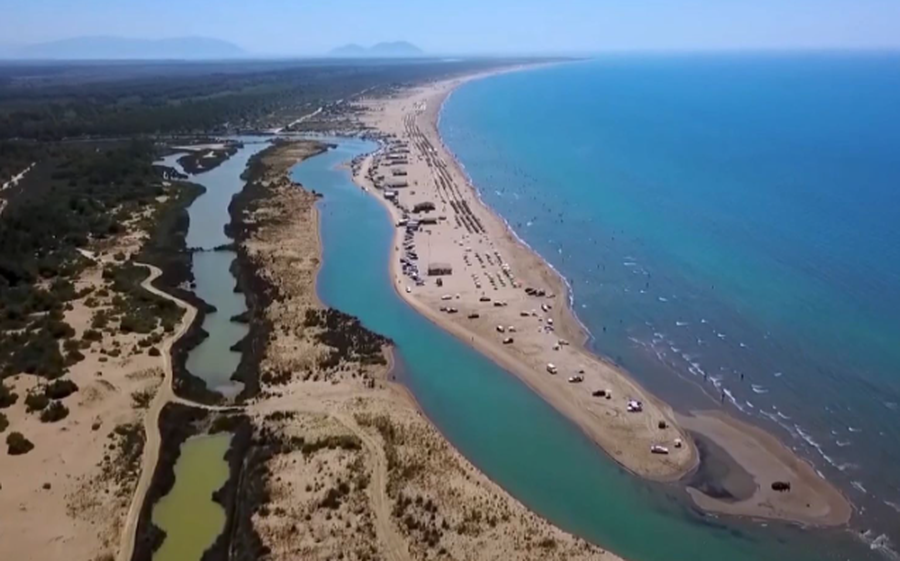
While the protests have focused on the Zvërnec project, the government has approved another mega-project on the coast, which envisages the concreting of 110 hectares in the last untouched area of the Albanian Adriatic…
While protests have been taking place against the construction project in Zvërnec for two weeks, the government has also approved the concreting of the Darëzeza coastline in Fier, between the two mouths of the Vjosa and Seman rivers into the sea.
In the central part of the 21 kilometers of Adriatic coastline in Darëzezë, Prime Minister Edi Rama has decided to initially concrete 110 hectares of state land and, consequently, occupy a significant part of the public beach space, which he will hand over to private companies with which he has made the relevant agreements.
The coastal area of Darëzeza is the only part of the natural habitat untouched by concrete in the Western Lowlands of Albania.
But for more than a year, greed for construction has included this area on the list of targets for concreting, under the guise of tourism development and increasing the well-being of citizens.
This project was approved by Prime Minister Edi Rama himself at the meeting of the National Council for Territory and Water, on April 18, 2025, where the first item on the agenda was precisely “Tourist development of the Darëzeza coast”.

The decision does not reflect concrete details, but informed sources indicate that the project envisages the transformation of 110 hectares in the central part of the Darëzeza coastline.
Hotels, towers, palaces, villa complexes and other tourist structures are expected to be built on this area, with an investment value estimated at around 1.2 billion euros.
According to data from the Territorial Development Agency, the project includes the construction of a “Lungomare” type pedestrian promenade, hotels, palaces, villa complexes, markets, sports facilities and a large aquapark, all privately owned.
One of the arguments used by Edi Rama, accompanied by presentations and 3D videos of the project, is the increase in the number of foreign tourists and the current lack of capacity to accommodate and entertain them in Saranda, Vlora, Lalzit Bay, Kavaja, Durrës and Velipojë.
But critics of the project consider this argument as a justification to open another large concreting front on the Albanian coast.
Even before the companies that will benefit from the public lands and beaches have been officially selected, Prime Minister Edi Rama has engaged the Albanian Development Fund for the construction of the road segment from the Sopi District to the Darëzezë Bridge.
The goal is clear: to have the infrastructure ready for private investors who will take over the development of the area.
But this is not the only case.
In the last three years, the government has also granted around 270 hectares of land along the Seman coast, in the Topojë area of Fier, for projects declared as photovoltaic investments.
According to critics of these projects, not only energy plants will be built on a significant portion of this area, but also hotels, palaces, villa complexes, and tourist resorts.
Thus, while the public debate has focused on Zvërnec, another important part of the Albanian coast is preparing to enter the same process of transformation and concreting./Pamphlet