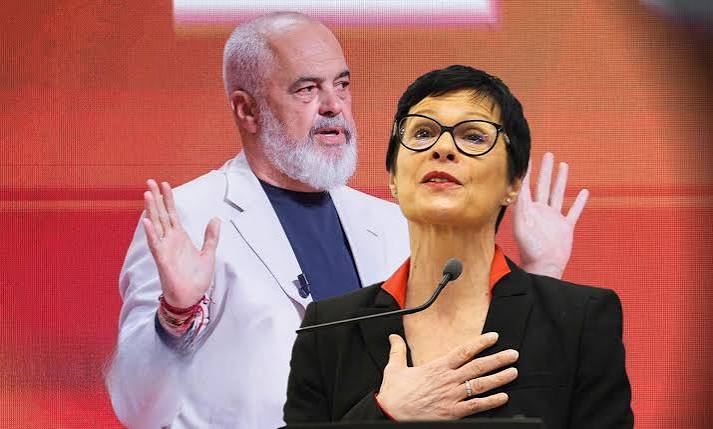
While the European Union described this Monday as a “Mega Monday” for the enlargement process, the statement of the Commissioner for Enlargement, Marta Kos, was missing a name that until a few months ago was considered among the most advanced countries in the region, Albania. Kos announced the opening of Group Chapter 1 for Ukraine and Moldova, welcomed Montenegro’s progress and hinted that Podgorica could reach the finish line of the negotiations during the Irish presidency of the EU. But at no point did she mention Albania.
“Today will be a truly big day, a ‘Mega Monday’, for the enlargement process. Firstly, Ukraine and Moldova will take the biggest step since they received candidate status in 2023. We will finally be able to open Cluster 1 for both countries. Why? Because they have fulfilled their obligations and it is time for us to do our part. If they deliver, we must deliver too. That is why I expect that in July we will open the remaining five clusters. Secondly, we will close two more chapters for Montenegro.
In total, this will bring the number to 16 closed chapters, approximately half of what needs to be completed. I have just returned from Ireland, which will hold the upcoming Presidency of the Council of the EU. If the Commission, Montenegro and the Member States work properly, then during or by the end of the Irish Presidency we can take Montenegro to the finish line”, declared Marta Kos. On the very day when Marta Kos declared that “if the candidates deliver, we must deliver too”, Albania was not part of the list of countries that received assessments or concrete deadlines from Brussels.
Tirana’s absence on a day that Brussels calls historic for enlargement raises strong questions. Especially in a period when European institutions have expressed reservations about a series of decisions by the Rama government, from changes to the law on protected areas and tourist projects in sensitive areas like Zvërnec, to the law on strategic investments and concerns about the functioning of the rule of law.
The EU’s concerns were materialized by the several-month delay of the IBAR report, which, although given the green light, synthesized the EU’s concerns towards Albania. For a country that until recently was presented as the success story of enlargement in the Western Balkans, the European Commissioner’s silence may be as significant as her words.
The question of whether the Rama government is hindering the country’s European integration arises again. At the end of her speech, Marta Kos also emphasized that the most important foreign policy of the EU now is enlargement. “This is very important because enlargement is proving to be the most important foreign policy of the European Union. In the last 16-17 months we have achieved more than in the previous 15 years,” added Kos.