Yesterday, at a meeting of the Ministry of Economy with the American Chamber of Commerce in Albania, the Chargé d’Affaires of the US Embassy in Albania, Nancy VanHorn, spoke about strategic investments in Albania: “Welcome investments that strengthen economic growth, ensuring that critical infrastructure and strategic sectors remain safe… Albania can attract more American and international investments only if it guarantees transparency, legal certainty, and equal rules for all market actors.”
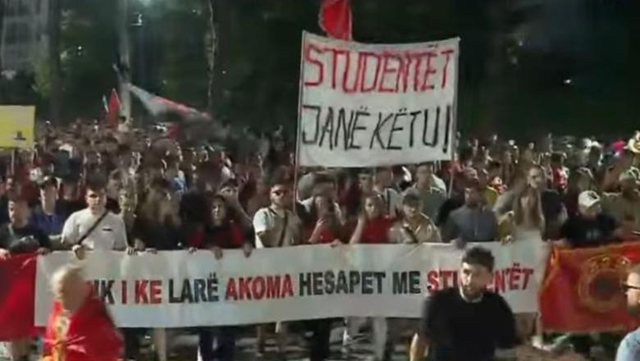
Yesterday, at a press conference, European Commissioner for Enlargement Marta Kos stated that Albania has given guarantees that a full environmental impact assessment will be carried out for the Zvërnec project. Regarding the protests that have been going on for more than two weeks, she expressed her happiness that the right to demonstrate is respected in Albania. Can the words of VanHorn and Kos be interpreted as indirect support?
Really, what should we as citizens take away from these statements?
First, although Ms. VanHorn’s words do not mention either Zvërnec or Sazan, nor any specific investment project, she invites us to welcome projects that bring economic development, maintain the security of critical infrastructure and strategic sectors, respect the rule of law, guarantee transparency, legal certainty for investors, as well as fair competition and equal treatment of economic actors. The contention is clear: if the projects in Zvërnec and Sazan respect these criteria, then welcome them!
Secondly, the European Union Commissioner for Enlargement yesterday expressed how the EU has received guarantees from the Albanian Minister of Environment that a full environmental impact assessment will be carried out for the Zvërnec project. Finally, the Commissioner conveyed another important message. “For us, it is less important where the investments come from and more important whether they are carried out in accordance with European Union legislation.”
This means that the European Union has nothing to do with the origin of investments from Qatar, as long as they respect the standards required by the EU. Even in this case, the European Union’s support for the projects in Zvërnec and Sazan is indirect. It will be full and direct, if these projects with an impact on the environment will meet certain standards, such as full and independent environmental impact assessments, real and comprehensive public consultations, transparency in decision-making, respect for national legislation and approximation with the EU acquis, as well as taking into account the concerns of local communities and environmental organizations.
If the European Union had considered that the projects in Zvërnec and Sazan would be, in principle, unacceptable or in flagrant violation of European standards, then Ms. Marta Kos would have used more critical language.
Why is the EU Commissioner happy with the protests?
When Commissioner Marta Kos declares that she is happy that the right to demonstrate is respected in Albania, she is not judging whether or not the protesters are right in their objections.
It reaffirms a fundamental principle of the European Union: citizens have the right to protest peacefully. Albania’s institutions must guarantee this right and debates on important public projects must take place in a democratic climate and free from repression.
In other words, 16 days of intense protests in the heart of Albania, without a single state official or police officer intervening with the protesters, give our country the European passport for handling peaceful protests, no matter how prolonged and intense they may be.
What will the protesters do with the US and EU stance?
The statements made on June 15, 2026 by representatives of the United States and the European Union do not constitute direct support for these projects, but they also do not represent the opposition that some of the protesters may have hoped for.
On the one hand, the US Embassy Chargé d’Affaires, Nancy VanHorn, stressed the importance of investments that promote economic growth, while insisting on transparency, legal certainty and a level playing field. On the other hand, the European Commissioner for Enlargement, Marta Kos, focused on the need for a full environmental impact assessment and respect for the right to protest.
These statements have a clear meaning: international partners are not categorically opposing the projects and are not calling for their ban. They are demanding that the processes be transparent, legal, and in accordance with democratic and environmental standards.
For the organizers and participants of the protests, this may be a reason to reflect on the strategy followed so far.
If some of them had hoped that international pressure would lead to an open stance against the Albanian government or against the projects themselves, recent statements suggest that the US and the EU are opting for a more institutional approach: evaluating procedures rather than taking sides in the domestic political debate.
This does not mean that the concerns of the protesters have been ignored. On the contrary, the fact that the EU mentions the importance of environmental assessment and the right to protest shows that their voice is part of the democratic debate.
The main question for today’s protest is perhaps: will the protesters understand that the modern crusade “Albania is not for sale” makes no sense where we want to integrate? Or will they continue to block the Tirana-Durres highway today?