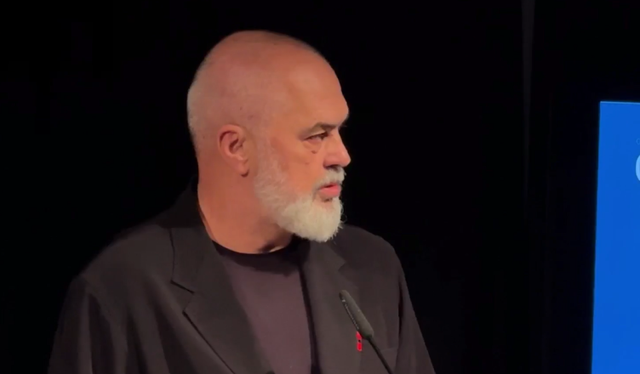
The Prime Minister of Albania, Edi Rama, was an honorary guest at the Annual Conference of the Eastern Bloc Commission in Berlin, a German entrepreneurship platform that brings together experts in security, economics and innovation, as well as representatives of the Bundestag, the Chancellery and the diplomatic corps.
In his speech, Rama also touched on the debate that has accompanied the proposed tourist project in the Zvërnec area, for which protests have been taking place in Albania for 17 days. The Prime Minister presented the case as an example of how, according to him, disinformation and unconfirmed narratives can spread rapidly in the digital age, emphasizing that Europe needs not only protection from traditional threats, but also mechanisms that protect democracies from information manipulation and digital lynching.
Rama: Europe doesn’t just need a missile shield, it also needs a shield for the age of algorithms. In recent weeks, my country has experienced and continues to experience a vivid example of this. A proposal for a tourist development on the Albanian coast suddenly became the center of an international digital storm. Environmental catastrophe was presented as a proven fact. Corruption was declared proven before any evidence existed. Conspiracy theories multiplied hour by hour. Claims became headlines, headlines became truths, truths became dogma, and anyone who sought evidence was treated as a suspect. I mention this not because the project itself matters to Europe. It does! But what matters even more is what this episode produced. Indignation produced millions of views before the facts had a chance to speak. Narratives made the rounds of the world before documented procedures could circulate on a single channel. This is no longer an Albanian phenomenon, it is a European phenomenon. An American phenomenon, a democratic phenomenon. If democracies fail to defend the distinction between fact and fiction, between fact-checking and hysteria, between criticism and digital lynching, they will sooner or later lose something far more valuable than any political argument. The belief that democracy is worth it. And where belief disappears, institutions change their very physiology. And when institutions change their very physiology, mainstream politics loses legitimacy.