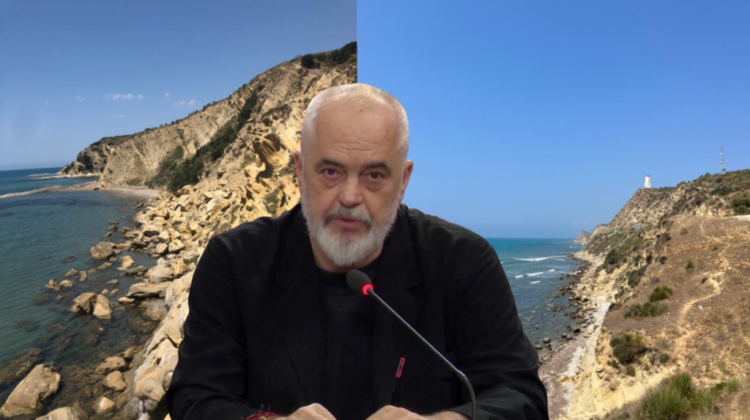
Here, the European Parliament also separated the sugar from the molasses, but not in the way the Prime Minister shows it.
Rama, in his statement yesterday, said that the European Parliament “separated the wheat from the chaff” and that Zvërnec has no connection to Vjosa-Nartë. The text of the resolution says the opposite. To understand the distortion, two different amendments must be distinguished.
The first, which Rama calls a “victory,” required the European Parliament to directly mention Jared Kushner’s company and support the SPAK investigation. This amendment was defeated.
The second, Amendment 46a, focused on developments in the Vjosa-Narte protected area and called for an immediate moratorium on new permitting procedures, construction works and development interventions in protected areas. This amendment was approved on 17 June 2026.
Rama only speaks about the first. He is completely silent about the second. And precisely Amendment 46a, approved by a majority:
Explicitly identifies developments in the Vjosa-Narte protected area as evidence of the practical consequences of the legal changes undertaken by the Albanian government;
Calls for an immediate moratorium on all new permitting procedures, construction works and development interventions within protected areas, until the incompatible provisions of the amended law “On Protected Areas” are repealed and full compliance with EU standards is ensured;
I closely follow the peaceful mass protests, not as a “struggle for power”, but as a legitimate expression of a real concern;
It directly links the moratorium to the closing criteria of Chapter 27, that is, to the conditions of membership in the European Union;
It requires that any project in this area be subject to a comprehensive environmental impact assessment, in full compliance with EU standards, as well as a transparent process of public participation with local communities, scientists and civil society.
Amendment 46a is not disconnected from previous institutional developments. The May 2026 resolution expressed “deep regret” for the postponement of the repeal of the 2015 law “On Strategic Investments” and called for the repeal of the 2024 amendments to the law “On Protected Areas”, point 46 identifies the legal problem: accelerated permit procedures, reduced environmental review, large-scale tourist development within protected areas and the transfer of decision-making powers to the National Territorial Council. Amendment 46a identifies the concrete consequence of this problem: the developments in Vjosa-Narta. And it calls for the immediate measure: the moratorium.
This is not, as the Prime Minister likes to present it, “support” for the government. It is a harsh rebuke and documented escalation. The diplomatic language is clear: from “deep regret” for the legal framework it moves to “deep concern” for the concrete consequences in Vjosa-Narta; from the request for the repeal of the legal changes it moves to the request for an immediate moratorium. In diplomacy, this is not a matter of style, but rather an escalation trajectory, from criticism of the law, to the identification of concrete damage, to the request for an immediate halt to the interventions.
One more fact must be understood. The KKTU approved the Zvërnec development permit on March 30, 2026. The environmental authorities only decided on the need for an in-depth EIA on May 15, 2026, 46 days after the permit was issued. Commissioner Kos stated on June 15 that she had received “guarantees from the government” that the assessments would be carried out in accordance with EU standards. But the EIA is not a formality that is carried out after the development decision has been made, it must precede the decision-making and really influence it. How can “EU standards” be guaranteed when the development permit was granted before the obligation for an environmental assessment was imposed?
The European Parliament voted two days after Commissioner Kos’s statement and, despite the government’s assurances, adopted Amendment 46a. This does not demonstrate any inconsistency between the Commissioner and Parliament. The amendment itself refers expressly to the “long-standing request of the Commission and Parliament” and puts her statement in the right context. The government’s assurances are not a preliminary certificate of compliance nor a substitute for legal procedures. The Commissioner noted the assurances she had received. The European Parliament set out the conditions under which those assurances can be considered credible. Until the assurances are translated into proven and verifiable compliance, new permit procedures, works and interventions in protected areas must be halted.
So, how did the stone get separated from the rock? By differentiating the amendment for Kushner from the issue of protecting Vjosa-Narta, but by explicitly identifying the developments in this area as a concrete example of the consequences of the legal changes, by following the peaceful protests and demanding an immediate halt to new interventions.
The defeat of the Kushner amendment does not delete Amendment 46a. It does not remove Vjosa-Narta from the resolution. It does not eliminate the demand for a moratorium. Any other interpretation is not a full reading of the resolution and remains a propaganda selection of only that part that interests the government.
Rezoluta e PE, 11 maj 2026 Pika 46.
“Deeply regrets that the repeal of the 2015 law “on Strategic Investments” has been postponed, given its provisions allowing for accelerated permitting procedures and reduced environmental review, which risk negatively impacting protected areas and other environmentally sensitive areas; calls for the repeal of the 2024 amendments to the law “on Protected Areas”, which allow for the development of large-scale tourism infrastructure within protected areas and transfer key governance and decision-making powers to the National Territorial Council, thus weakening environmental oversight.”
Amendment 46a, adopted June 17, 2026 :
46a. Expresses deep concern that ongoing developments within the Vjosa-Narta protected area demonstrate the practical consequences of these legislative changes and the risks they pose for areas of recognised ecological value; follows closely the ongoing peaceful mass protests in this regard; calls on the Albanian authorities to immediately impose a moratorium on all new permit granting procedures, construction works and development interventions within protected areas, until the incompatible provisions of the amended Law on Protected Areas have been repealed, based on a long-standing request by the Commission and Parliament and in line with the closing criteria of Chapter 27, and until full compliance with EU nature protection standards has been ensured; stresses that any project in this area must undergo comprehensive environmental impact assessments, fully in line with EU standards, including a transparent process of public participation with local communities, scientists and civil society. /Shteg.org