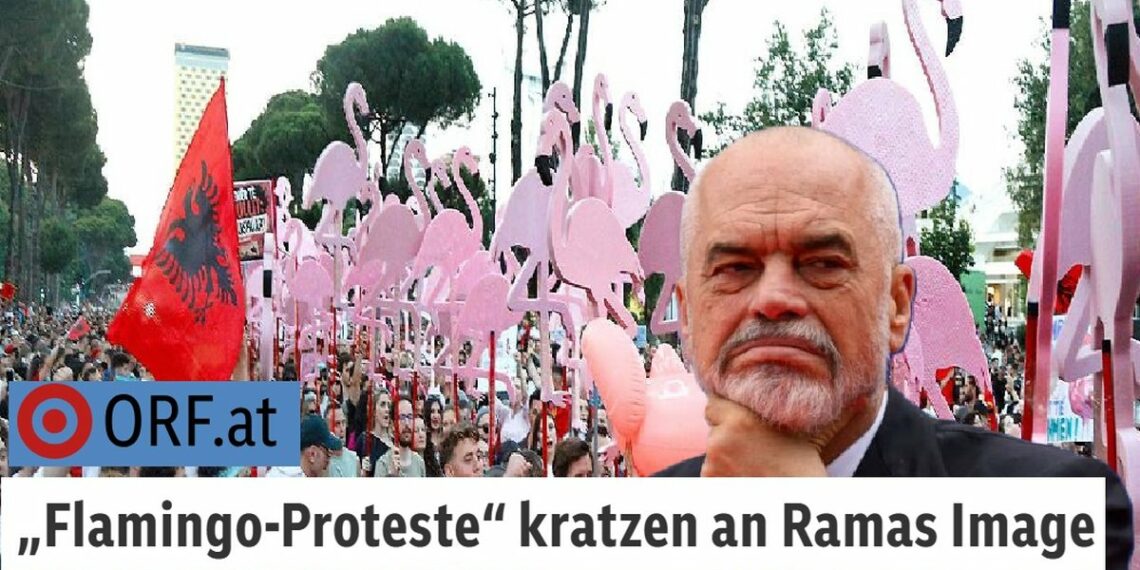
The “Flamingo Protest,” which has been going on daily for three weeks, was sparked by luxury tourism projects planned in nature reserves by Jared Kushner, son-in-law of US President Donald Trump, and his wife Ivanka Trump. But the anger goes beyond the environmental aspect.
Public broadcaster ORF writes that on Sazan Island, Atlantic Incubation Partners LLC, affiliated with Kushner’s investment firm, Affinity Partners, plans to invest 1.4 billion euros in the project.
Tourism projects in the Narta Lagoon near Zvërnec are planned to receive 4.7 billion euros. Both areas are protected. Plans include the construction of hotels, apartments, villas and a marina.
At the end of May, bulldozers entered the Vjosa-Narta coastal protected area and construction fences were erected. The local population began to protest against this.
“Through the controversial figure of Kushner, local protests have taken on a global dimension,” Oliver Schmitt, an expert on Southeast Europe at the University of Vienna, explained to ORF.at.
The protests quickly spread both domestically and abroad, including to Austria last weekend. On Friday, thousands of people took to the streets in Tirana. So far, criminal proceedings have been initiated against dozens of demonstrators.
“Unprecedented” protests
Until now, civil society in Albania was weak.
People had thought that elections could not bring change, explains Schmitt: “They resigned themselves to the situation or emigrated.” Now, Schmitt sees an Albanian “Generation Z,” “well-educated and internationally connected,” driving these protests.
It is a broad protest movement, notes Albania expert Gresa Hasa: “People are organizing themselves without leadership.” In an interview with ORF.at, she described the protests as “unprecedented” for Albania.
The protests are motivated by environmental concerns, but above all by the lack of transparency in the political system, according to Hasa.
As a result, not only are calls for Rama’s resignation growing stronger, but the protest movement is also distancing itself from the largest opposition party, Sali Berisha’s Democratic Party (PD). Berisha sided with the government over the Kushner projects.
Rama cannot understand the criticism of the Kushner project. He portrayed the demonstrations as manipulated by foreign agents, but provided no evidence.
According to Schmitt, “Rama does not take the demonstrators seriously.” Furthermore, he accused them of lying.
The “Myth of Edi Rama” is being challenged
Hasa said Rama was nervous about the protests. He had just built an image in Brussels as a credible socialist politician. The protests now revealed a different picture.
Rama had transformed Albania into a state “where public institutions increasingly serve private interests.” He presents himself as a semi-authoritarian leader who is pushing these projects forward.
Albania expert Fron Nahzi also notes that Rama has managed to advertise himself to Western elites. He does not believe that Rama will resign as a result of the protests.
However, he commented to Euractiv that the protests have “challenged the myth surrounding Edi Rama for the first time in years and have revealed that behind the image of the artistic statesman, the favorite of Western conferences (…) lies a politician who is increasingly accused of concentrating power and presenting himself as progressive.”
Massive protests in Albania have been demanding the resignation of Socialist Prime Minister Edi Rama for weeks.
The “Flamingo Protests” were sparked by plans for luxury tourist resorts in nature reserves, in which US President Donald Trump’s son-in-law, Jared Kushner, also intends to invest.
Kushner’s projects are no exception.
Specifically, the demonstrators are demanding the repeal of exemptions to the Protected Areas Act, which were passed in 2024 shortly after the publication of Kushner’s plans.
They are also calling for the repeal of the Strategic Investment Act, which allows for faster processing and approval of preferred projects.
The law has been extended until 2027. The Kushner Project will also benefit from this law. Atlantic Incubation Partners LLC has already been granted strategic investor status.
The Kushner project is likely just the tip of the iceberg. According to Hasa, there are projects across the country in which land containing historical and cultural sites, as well as ecologically protected areas, is being transferred to private hands, including those of foreign investors, in an extremely shady manner.
Rama sees these luxury projects as a way to develop Albania into a major tourist destination: “As long as I am here, there is no chance that this investment will stop.” In recent years, Rama has pushed for the expansion of tourism.
While around 2.6 million tourists visited the country in 2020, according to figures from Albania’s Ministry of Tourism, this number had already reached 12.5 million last year.
This is mainly due to the boom along the coast, which is highly developed, according to Schmitt.
Environmental standards have also been ignored in other projects aimed at boosting tourism. The construction of Vlora Airport in the Vjosa protected area, Narta, is particularly controversial.
The government removed the area from the protected area. Environmentalists criticized the environmental impact assessment as biased.
Investigations into Kushner’s projects
Criticism of Kushner’s projects did not go unheard. The anti-corruption agency SPAK launched an investigation in June.
Just last Wednesday, the European Parliament adopted a resolution echoing the protesters’ demands and calling for a moratorium on new construction permits in protected areas.
But the EU Commission continues to stand behind Rama and his promises to comply with EU laws. Hasa questions these assurances.
On paper, Albania is doing a good job; it is, along with Montenegro, a pioneer in EU membership: “But this is only formal. There have been practically no real reforms.”
Rama was currently cultivating an image as a reliable partner, especially through his contacts with Brussels.
Schmitt argues similarly: “The pro-EU show is a staged show for foreigners.” Rama wants to take Albania into the EU by 2030. He skillfully plays on Albanian stereotypes, such as that of being the most exotic country in Europe. Schmitt also criticized the role of the EU.
“It does not support civil society, but instead cooperates with very problematic actors.” Hasa also hopes that the EU will not “blindly support” Rama and will turn to other partners.
Although Andreas Schieder (SPÖ), the EU Parliament’s standing rapporteur for Albania, acknowledged that Albania was the first Western Balkan country “to directly confront the problem of corruption under the Rama government,” experts say the country still faces numerous issues: corruption, organized crime, and shortcomings in the rule of law, media freedom, and the implementation of environmental standards.
“EU reports are partially disconnected from reality,” Schmitt criticized.