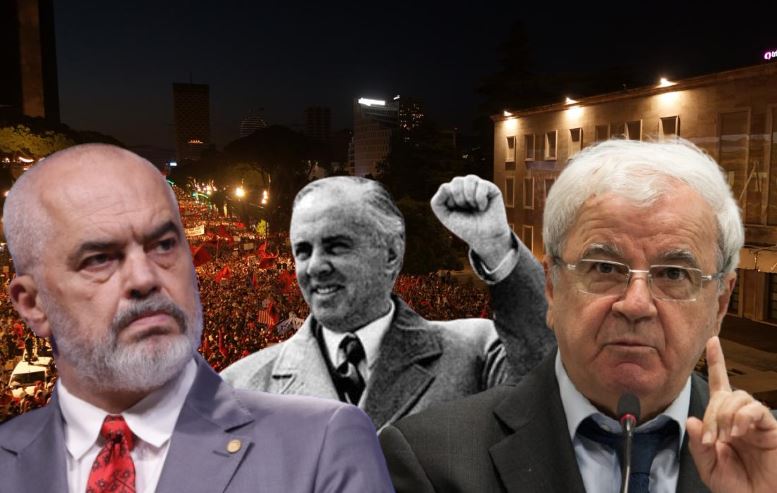
Lawyer Spartak Ngjela has reacted to Prime Minister Edi Rama’s statements regarding the citizen protests by comparing him to former dictator Enver Hoxha.
Rama Hoxha is a hero.
In a post on social media, Ngjela writes that Rama is using the same rhetoric that Hoxha used, describing the protests as organized by foreign agencies.
According to him, the prime minister is trying to imitate the former communist leader in some aspects of behavior and communication.
“I am like Ener Hoxha, because he, too, called every social movement that acted against him as organized by foreign agencies. Edi Rama is imitating Enver Hoxha, in many aspects: Rama walks like Enver Hoxha, he seeks to argue with his style, that he is asking for Rama to have his strength. And, do you know why? Because Rama has in his unconscious the desire to have a dictatorial force, like that of Enver Hoxha. But can he achieve it? This is impossible, because Rama does not have the current time in his favor, at a time when Enver Hoxha, his time, was not won by votes, but by the muzzle of a gun,” Ngjela writes, among other things.
Full post
Enver Hoxha returned to Albania.
Rama told us yesterday about the protest against him that it was organized by foreign anti-Albanian agencies.
I’m like Ener Hoxha, because he too, called every social movement that acted against him as organized by foreign agencies.
Edi Rama is imitating Enver Hoxha in many aspects:
Rama walks like Enver Hoxha, he seeks to argue with his style, because he is asking for Rama to have his strength too.
And, do you know why?
Because Rama has in his unconscious the desire to have a dictatorial force, like that of Enver Hoxha.
But can I achieve it?
This is impossible, because Rama does not have the current times in his favor, at a time when Enver Hoxha, his time, was not won by votes, but by the muzzle of a gun.
But can one seek to achieve the power of a dictator without first making the state itself an organized party dictatorship?!
No, of course it cannot be requested.
But here, Rama, precisely for this request that he is making, it is understood that he is mistaken, and, mistaken, in Albanian means: a mistake made unintentionally, which gives you the strength to believe in a request that cannot be fulfilled.
Spartak Ngjela
Tirana on:
June 26, 2026