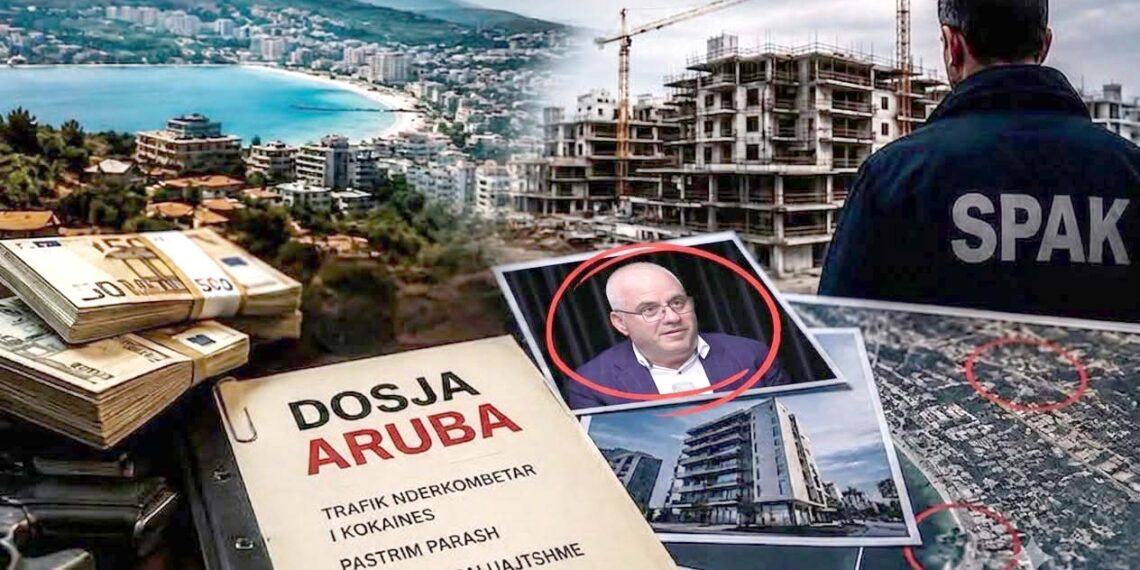
Artan Hoxha sheds light on the behind-the-scenes of the meeting in Aruba, here’s how the wiretapping of Belgian authorities brought to light the plans of the billion-dollar drug scheme for giant investments in Albania
Investigative journalist Artan Hoxha has revealed new details in “Radar” about the mysterious meeting on the island of Aruba, showing how Belgian authorities stumbled upon a giant scheme aimed at laundering criminal money through investments in tourism and construction in Albania. Hoxha had been called to testify in Belgium in the “Toyota Yaris” case involving organized crime and politics, and there one of the investigating officers gave him information about a meeting that had taken place on the island of Aruba.
“I learned this from the Belgian prosecution’s investigations. I was called to testify at the Belgian Federal Prosecutor’s Office for the “Toyota Yaris”, a case involving organized crime and politics. After that, I, the first time I testified for six hours there and the second time then, talking to federal officers, investigators, that the Federal Judicial Police questioned me and one of them gave me information about this. And he gave me the idea that he knows these people. Now what is the Aruba case itself.
The Aruba case is a meeting that was chosen to take place on an entertainment island, because the characters who met there are characters who like, or are owners of gambling, i.e. casinos, etc., or are frequenters of these types of resorts. And since some, i.e. those from Europe, could not go to the United States because they had a criminal record, it was found that those from America and those from Europe would meet in an intermediate place. And this intermediate place would also have this other access, would also have a casino and they would have fun, they would pass the time.
They stayed for a week and they didn’t know that the Belgian authorities were eavesdropping, following those who came from Europe, and that’s why the meeting was revealed, otherwise we would never have known.
And the meeting in Aruba, even in Albania, but also in the European media, was exploited and described as the meetings that the Medellin Cartel used to hold. There was no meeting where an agreement was made for drug trafficking.
There was a meeting where they talked about doing business and investing in large business projects in the Republic of Albania, mainly in tourism and construction, because one of the people who was there was Artur Sheu, who has a lot of land in that country. So, as the case of Zvërnec showed.
This was before Zvërnec. Some of the people who came from Europe even asked at that time to build a hotel worth somewhere around 35-40 million euros in Zvërnec.
- And Mr. Sheu said: “I have a much bigger project”, because it was not born overnight, it is quite timely, and he said: “I am not interested in this type of investment because it disrupts my big project, but when the big project starts, if you want to get involved in it as an investment, you can get involved”. Because the initial project there planned to build 12,000 apartments, then there are two piers, the airport is only 10 minutes away”, said Hoxha, among other things.
Money laundering
In the following, investigative journalist Artan Hoxha offers a clear and highly critical insight into the reality of the construction industry in Albania, where urban development, informal money and the actions of the new justice system are intertwined. Through this analysis, he unravels the path of dubious capitals — from state corruption to international drug trafficking — and how this money became fuel for the concrete boom when second-tier banks made lending difficult. “The question is: is money being laundered in construction? Of course, money will be laundered, it is a form that has happened all over the world. Even if we were Swedes, with this rate of increase in property values, it would be laundered.
Informal money has two main sources: corruption (money stolen from Albanians) and drug trafficking (money taken from European citizens and invested in Albania). But we should not confuse them all; there are investors who have been in the market for 35 years. Regarding SPAK’s recent actions, I have said that SPAK can seize a tower, but there are landowners and immigrants who have thrown their life savings there. When the news is given that “we have seized 500 million euros”, this creates trauma in ordinary citizens.,
Businessmen are transferring investments abroad, to Greece, Guatemala or the Dominican Republic, because they have no guarantees from this “fog”. We need to have a strategy, not to burn the wet and the dry together. In 2016 I communicated with a character who is today the most famous Albanian in the world (Gramoz Rexhepi), who was in prison in Quito, Ecuador. He told me: “Don’t mess with us, look at a construction company that will be strengthened in the next two years.” His prophecy came true; after two years it was the largest company with 500 trucks and concrete mixers.
He knew where the crime money would go. Crime groups became important when second-tier banks made it difficult to get loans for builders. Crime came as financiers: at first they bought apartments, then they gave money with interest, then they became shareholders and finally they became owners. But you can’t hit everyone the same. As for Ilir Shtufi and “Ferrobeto”, he has been in the market for 30 years. Shtufi has connections with all the prime ministers of Albania, because he is a concrete worker, he is an important market actor.
If you hit companies without separating the “corn from the sugar”, traditional buyers leave and organized crime takes the money abroad. The EU supports SPAK because they are following the money that is taken from European citizens and brought to Albania. But if we continue like this, only “Firma Parmenda” will remain here. In the US, Zuckerberg or Jeff Bezos are not arrested, but they are fined 2 billion dollars. The cow that gives milk is not killed. If the business has made mistakes, penalize them with money that goes to the budget, do not put them in prison and dissolve the company. SPAK has seized cryptocurrencies worth 14.5 million dollars, after six months they can make zero., What will SPAK do with them?”, said Hoxha, among other things.