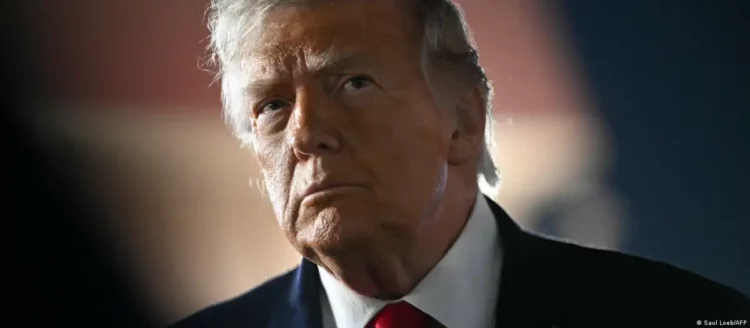
Which countries will face Trump’s new tariffs?
The Trump administration announced new tariffs a few days ago against 60 economies, including the European Union, citing how they treat imported goods produced with forced labor.
In a statement, the United States Trade Representative (USTR) said it had investigated major trading partners and found that they had not effectively established or enforced a ban on the import of goods produced through modern slavery.
The tariffs cover more than 99% of US imports and replace a temporary global tariff of 10%, which was due to expire.
A 10% tariff will apply to countries such as Argentina, India, Pakistan and the United Kingdom, which have adopted or pledged to impose restrictions on imports related to forced labor.
The EU, Taiwan, Japan, South Korea and Switzerland will face tariffs of 10% or 12.5%, depending on the product.
Goods from 38 other countries will be subject to a higher tariff of 12.5%, including China, most of the Middle East, much of Latin America, Australia, New Zealand and Russia.
Exemptions include steel, aluminum, automobiles, civil aircraft, rare minerals, and goods covered by the U.S.-Mexico-Canada Agreement.
The new tariffs came into effect on July 24.
Do Trump’s new tariffs really have anything to do with forced labor?
The USTR stressed that the US has banned imports of goods produced with forced labor for almost a century, adding that, despite international consensus, “the prevalence of forced labor continues worldwide and has even escalated in recent years.”
Washington argues that foreign manufacturers gain an unfair price advantage from this practice and that American workers cannot compete with wages based on forced labor.
In reality, many critics and analysts see this measure as a legal maneuver to circumvent obstacles to US President Donald Trump’s extensive tariff program, announced on “Liberation Day” on April 2, 2025, which the US Supreme Court has upheld.
At the time, Trump relied on the International Emergency Economic Powers Act (IEEPA) of 1977 to impose tariffs without Congressional approval, but the court ruled that this law does not give presidents the authority to impose tariffs unilaterally.
The new forced labor charges were imposed under Section 301 of the Commerce Act of 1974, a more consolidated trade law that many analysts believe will be more difficult to overturn in the courts.
Does the EU really have a problem with forced labor?
Compared to Africa, Asia and Latin America, forced labour is not a major problem within the 27 EU member states, thanks to comprehensive labour legislation and its strong enforcement.
The International Labor Organization (ILO) defines forced labor as work performed under the threat of punishment and without voluntary consent.
Although worker protections in the EU are relatively strong, many imports still contain raw materials or components linked to forced labor in other countries.
In December 2027, Brussels will impose one of the strictest import bans in the world, according to which no product related to forced labor will be allowed to enter, circulate or leave the EU market.
Reacting to the new tariffs, the EU’s top diplomat, Kaja Kallas, compared the bloc’s labor laws to those of the U.S., noting that European workers enjoy paid vacations and better working conditions.
Why do critics see fees as an alternative legal route?
Some analysts argue that the new tariffs do not respect the spirit of the Supreme Court’s decision and could be legally challenged.
“These new tariffs would represent another case of presidential overreach,” Alan Wolff, former deputy director-general of the World Trade Organization (WTO), wrote in a blog post before the announcement.
“The world is already accustomed to higher US tariffs. There is no evidence that changing the US rationale for them will significantly reduce forced labour in other countries,” Wolff added.
Others said Trump is using concerns about forced labor as a pretext, while the share of imports linked to modern slavery from most developed economies is negligible compared to China.
“The tariffs are about real concerns about labor practices in China not as a basis for tariffs on China, but for broad tariffs on much of the world,” Brad Setser, a senior fellow at the Council on Foreign Relations, wrote on the X platform.
Chad Bown, a senior fellow at the Peterson Institute for International Economics, also thinks the tariffs “distract the attention of the US and its allies from the trade war that we need to be waging,” referring to reducing dependence on Chinese goods and building “alternative supply chains that are more resilient.”
Other trading partners expressed similar criticism, with Brazil calling the tariffs “unjustified” and Australia calling them “absurd.”
Can Trump use Section 301 for other tariffs?
The administration is already using Section 301 for another investigation into excess manufacturing capacity in 16 major trading partners, including China and the EU. Trade experts expect that could lead to additional tariffs.
During his first term, the same legislation allowed Trump to impose tariffs on China for intellectual property theft and forced technology transfers. These measures were later expanded by the Biden administration.
The Trump team also continues to maintain existing national security tariffs on steel, aluminum, automobiles and other products, under Section 232 of the same legal act.
The first Trump administration imposed tariffs of 25% on steel and 10% on aluminum in 2018 after the US Department of Commerce determined that low-cost imports threatened US national interests.
During his second term, Trump reinstated, expanded and increased many of these tariffs, while adding new tariffs on vehicles, auto parts, copper and other similar goods./ DW