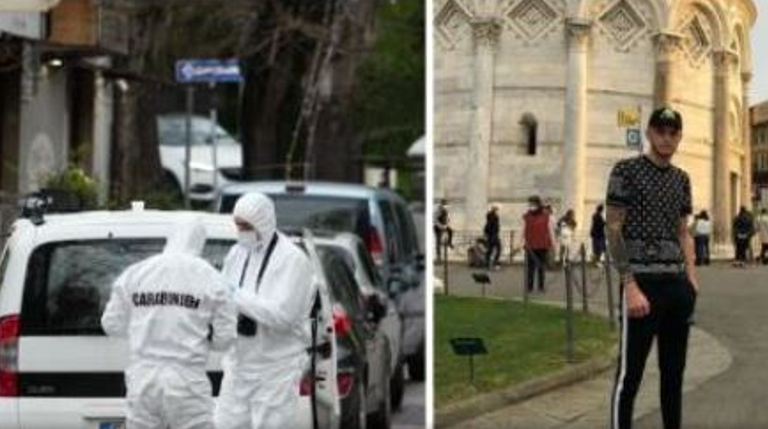
The autopsy results for the murder of 25-year-old Albanian Kevin Muharremi, who was executed on February 14 in Montecalvoli, in the municipality of Santa Maria a Monte, Italy, have been released. The forensic report has revealed that only one of the bullets fired was fatal, while investigations are also shedding light on the dynamics of the crime and the suspected perpetrators.
According to the expertise of forensic doctor Marco Di Paolo, the fatal bullet hit Muharrem on the right side of the neck, severely damaging the spine at the level of the C2 and C3 vertebrae. The injuries caused respiratory paralysis and internal bleeding, leading to the 25-year-old’s immediate death.
The autopsy, carried out on March 13 by order of Pisa prosecutor Fabio Pelosi, also confirms that the victim was also injured in the forearm and right wrist, but this wound did not contribute to his death.
The 20-year-old Albanian Renato Xyke, who has been in prison since the day of the crime, is accused of the incident. He was arrested in Arezzo while he was leaving with his family in a “Range Rover Evoque” vehicle, the vehicle from which Muharrem was allegedly shot. According to the investigation, Xyke has not denied shooting at the victim.
The Italian prosecution suspects that the murder was the culmination of a conflict between two groups of Albanians, which had started a few hours earlier in a bar in the Capanne di Montopoli area and then continued in its parking lot. After telephone contacts between the parties, they met again in Viale della Repubblica, where the execution took place.
An examination of the scene revealed that at least six bullets were fired, as evidenced by the damage found in the Fiat Doblò vehicle, where the victim was.
As part of the investigation, an 18-year-old Albanian, who was in the vehicle with Renato Xyken, is also under investigation. He is being investigated at large and has voluntarily appeared at the Prosecutor’s Office to give his testimony.
Italian authorities are continuing their investigations to fully clarify the motives and circumstances of the crime, before the case moves to the judicial phase.