But this absurd theory that seeks to deny reality, to ignore corruption, to ignore poor service in hospitals, schools, or mortgages and state offices, is completely refuted by the numbers.
Right at the height of the summer season, when government propaganda deafens you with the tourist paradise of Albania, Eurostat shows with statistics that more than half of the inhabitants of this country do not have the opportunity to take even a week of vacation per year.
According to the European Union’s statistical office, whose role is to collect, harmonize and publish comparable statistics for EU member states, as well as for some partner and candidate countries, 53% of Albanian families cannot reach this target due to their financial situation.
To understand the significance of this figure, a comparison is enough. The European Union average is around 27%, while in higher-income countries, the percentage is significantly lower. In Germany and Ireland, only one in five families cannot afford a holiday, while in the Netherlands and Sweden, the level drops to around 12-13%.
Even in comparison to the region, the impossibility of Albanian families is obvious. In Serbia, only 36% of families cannot afford a vacation, while in Macedonia, citizens have more opportunities compared to us.
And to be clear, this Eurostat statistic does not measure whether a person actually went on holiday, but whether the family has the financial means to pay for a week away from home. If a family chooses not to travel for personal reasons, it is not counted in this classification.
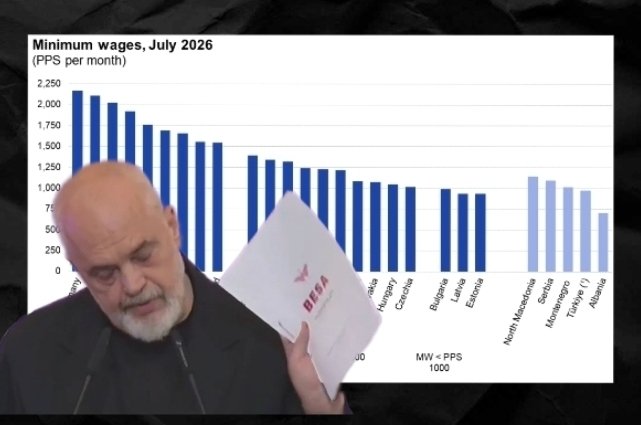
We are also ranked just as low in terms of minimum wage, for which we are ranked last in Europe. According to the latest Eurostat data, published by Monitor magazine, the minimum wage in Albania is 517 euros per month. For comparison, Eurostat statistics show that, on January 1, 2026, the minimum wage in European Union countries ranged from 620 euros in Bulgaria to 2,704 euros in Luxembourg.
Although Bulgaria remains the country with the lowest minimum wage in the EU, its level is now 103 euros higher than that of Albania. In the region, Albania ranks last again. North Macedonia has a minimum wage of 586 euros, Serbia 744 euros, while Montenegro 670 euros. This means that all Western Balkan countries reported by Eurostat have higher minimum wages than Albania.
The increase in the minimum wage to 50,000 lek, from January 1, 2026, brought its value to 517 euros, thanks also to the exchange rate of the lek with the euro. But this has not changed Albania’s position in the European ranking, as countries in the region have increased minimum wages at a faster pace in recent years.
So, it is enough to refer to the numbers to deflate Edi Rama’s propaganda balloon. Even if the prime minister talks about a country with a higher GDP and a larger budget in recent years, this does not necessarily indicate greater well-being for everyone.
Fewer and fewer hands have benefited from the embezzlement of national wealth. The rich have become richer and richer, while the poor have become poorer and poorer. According to the GINI Index that the World Bank uses to measure income inequality, it has been steadily deepening from 2014, when Rama was at the beginning of power, until 2020, when the latest measurements are available.
Even according to the AROPE (At Risk of Poverty or Social Exclusion) indicator used by the World Bank, Albania ranks among the countries with the highest percentage of people at risk of poverty or social exclusion in Europe.
More than 4 in 10 residents in Albania (42-43%) face at least one of three forms of risk: low income, material/social deprivation or very low work intensity in the family. While in Western Europe this figure drops to 21.0%, the countries of the region are classified as follows:
-Albania around 42–43%
-North Macedonia around 32–34%
-Montenegro around 30%
-Serbia around 26–28%
-EU average 21.0% (2024)
So even compared to the Western Balkans, we are the country with the greatest risk of falling into poverty and social exclusion.
These statistics, drawn from the most prestigious international institutions, clearly show that those tens of thousands of people who have protested, and many more who support them, are not a people with high expectations, but citizens who feel robbed and deprived of sharing the national wealth. /Lapsi.al