During an interview with British media outlet Channel 4 News , Prime Minister Edi Rama defended the interventions carried out in the Zvërnec protected area, stating that the use of bulldozers was intended to facilitate the movement of the community.
“Bulldozers were used to open passage for people, for the community, to create roads through private property, so that people were not prevented from moving,” Rama said .
But the British journalist immediately questioned this claim.
“But people were crossing the sandy road before. They were only blocked after the fence was put in place,” she replied to the prime minister.
Faktoje’s verification, based on residents’ testimonies, the reaction of environmental organizations, and official state administration documents, shows that the prime minister’s claim is untrue.
Residents: The road existed
For the residents of Zvërnec, the bulldozer interventions were not intended to create a new passage for the community, as the road to the coast has existed for years and has been used regularly, especially during the summer season.
The mayor of the village of Zvërnec, Kostaq Konomi, in a reaction to Faktoje, describes the prime minister’s statement as an attempt to justify interventions in the area.
“I heard it and for me it’s the biggest lie he’s told. A lie to get out of the situation. The way it was, they put up the fence without permission, which we removed with protests. And everyone saw very clearly how that fence was removed,” says Konomi.
According to him, the residents’ concern was not related to the lack of a road or the inability to move, but to the restriction of access after the fence was put in place. Nikolla Pulla, a resident of Zvërnec, also expressed the same opinion.
“That road was passable by car, a little difficult until the mouth of the large gorge. Residents used to pass through, mostly during the summer to go to the beach. So it was passable before, although with difficulty. The fence hindered movement, and it was even one of the main reasons why residents were indignant,” says the 31-year-old .

PPNEA
The Association for the Conservation and Protection of the Natural Environment in Albania (PPNEA) also disputes the narrative that the interventions were only functional in nature for access. According to the organization, numerous interventions in the Vjosa-Nartë protected area were documented during the works.
“Heavy machinery entered natural habitats. A fence was erected, roads and construction sites were opened, inert materials and gravel were dumped, the dune system was disturbed, and a bridge was built, changing the natural characteristics of the area.”
PPNEA emphasizes that these are not interpretations, but documented facts on the ground.
“The fence may have been removed after public backlash, but the damage to nature has not disappeared with it. Interventions have been carried out without the necessary permits in violation of the legislation and there should be legal responsibility.”

Fence and works
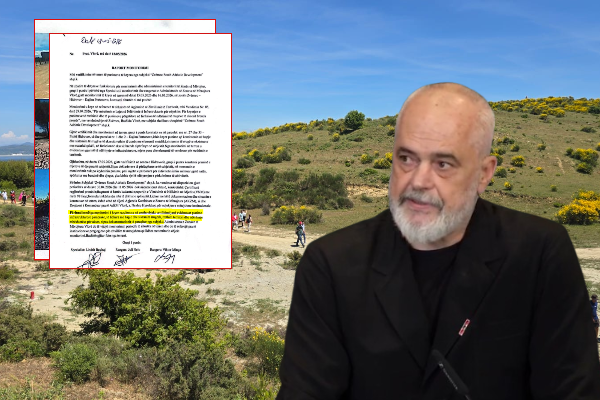
The claims of residents and environmental organizations are also supported by an official document. A monitoring report dated May 18, drafted by the Administration of Protected Areas in Vlora and obtained by Faktoje, states that in the area where the works were taking place, the following were identified:
“Preliminary infrastructure works, related to the opening and arrangement of roads, territory fencing and supporting interventions for access.”

The report is also accompanied by photographs from the field, documenting the open roads, the fence in place, and the interventions carried out in the area.

cONcluSiON
The Prime Minister’s claim that bulldozers were used to create a passage for residents is not supported by verified facts. Testimony from residents shows that the road existed and was in use before the works began, while the restriction of movement came after the fence was put in place. The Channel 4 News journalist also raised this fact during the interview.
The PPNEA also documents that the interventions were not limited to opening a passage, but included extensive changes to the protected area, while the official report of the Protected Areas Administration confirms that works were carried out on the ground to open roads and enclose the territory with a fence. In the absence of evidence that residents were prevented from moving before the interventions and in the face of abundant evidence that the road existed and was usable, the claim that bulldozers were used to open the way for the community is untrue.
/Esmeralda Topi – Fact