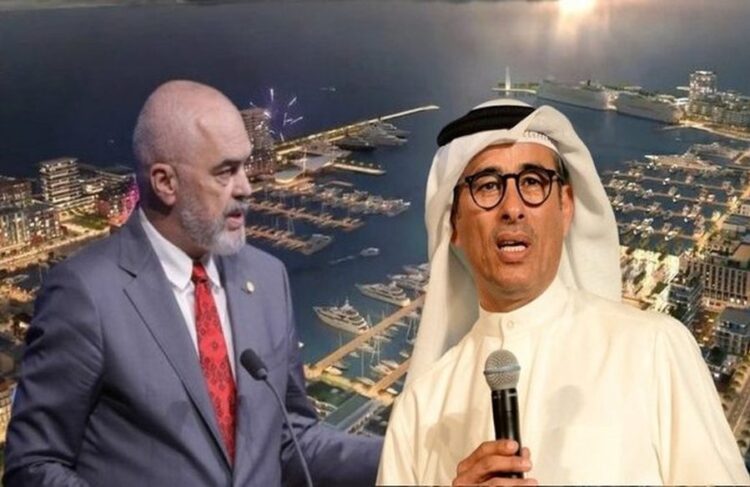
Businessman Mohamed Alabbar, investor of the Durrës Marina project, has admitted failure with the billion-euro project in Albania.
In an interview with foreign media , the founder of the company “Emaar” stated that “I built very quickly in Albania ” and that this, according to him, “was a mistake.”
Alabbar also dwells on another of his projects on the coast of Montenegro, which he also describes as a mistake. According to him, the decision-making was influenced by the advice of an Indian lawyer, which, according to the businessman, turned out to be a wrong choice.
We recall that the “Durrës Yacht & Marina” project , presented as one of the largest strategic investments in Albania, with a value of 3.2 billion euros, has faced serious problems during implementation.
Two of the buildings constructed on the site in management areas A02 and A04, which are in the external arrangements phase, have suffered significant structural damage.
According to the topographic report of the Construction Institute, building 02 has suffered a decrease of 28 centimeters, while building 04 has sunk by 18 centimeters.
According to a denunciation published earlier in the media, the problem began in the early stages of construction, where the deep piles necessary for a sandy and unstable terrain near the sea were not placed.
This development comes at a time when the project has been under criticism for its slow progress and financial model. Although the construction of around 1,680 apartments was promised in the first phase, only three buildings have been completed so far, while real investments remain far from the initially declared figures.
According to financial data, for the years 2023–2024, about 41 million euros have been spent on works, while the company itself has invested only a small portion of the capital from its own funds, relying mainly on the sale of apartments in the project phase.
However, the fundamental question still remains unanswered: who is responsible for this situation – the designers, the implementers, or the state institutions that supported the project?