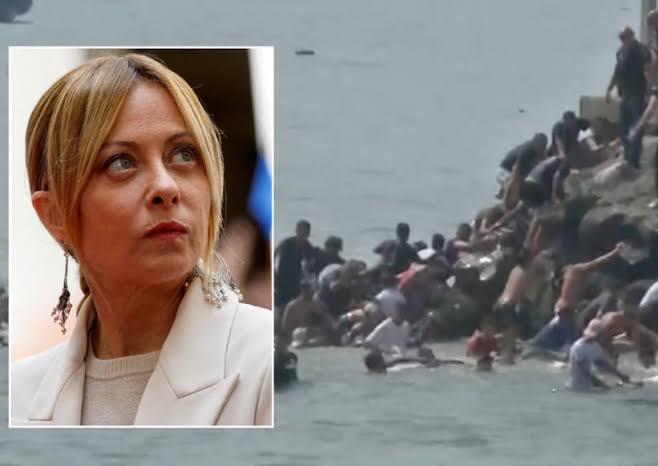
The Italian government aims to bring back to the European table the idea of repatriation centers outside the EU borders, based on the “Albanian model”, following the migrant crisis in Ceuta.
According to Italian media, Rome wants these structures to be financed mainly by the European Union, avoiding the financial burden on Italian taxpayers, following the high costs of the centers opened in Shëngjin and Gjadra, which have so far operated at minimal capacity.
The proposal will be presented at a meeting of EU interior ministers, as Italian Prime Minister Giorgia Meloni is trying to secure support from several European countries to expand the scheme of agreements with third countries as a solution to migratory flows.
Full article:
Exploiting the Ceuta crisis to benefit Brussels. This is the objective of the Italian government, which intends to seek the acceleration of the creation of repatriation centers in countries outside the EU, according to the “Albania model”, but without burdening them on Italian taxpayers, as happened with the centers of Shengjin and Gjadri, which have remained almost empty for a long time. According to the plan, most of the costs would be covered by the European Union.
This is one of the demands that Italy will present on Tuesday at the meeting of EU interior ministers, called after the wave of mass immigration into the Spanish enclave of Ceuta, on the border with Morocco, a situation that has since largely calmed down.
Prime Minister Giorgia Meloni believes she has the support of the Danish Prime Minister, the socialist Mette Frederiksen, and hopes that German Chancellor Friedrich Merz will also join this initiative. Strong pressure is being exerted by the Chigi Palace and the European Conservatives group, as the cautious stance of the European Commissioner for Migration, Magnus Brunner, towards this project has not been well received, although it is foreseen in the new Pact on Migration, which entered into force on June 12.
Rome hopes that the developments in Ceuta will speed up the process and restart negotiations with 12 countries, revealed a few months ago by AFP. Preliminary discussions have been held with Rwanda, Ghana, Senegal, Tunisia, Libya, Mauritania, Egypt, Uganda, Uzbekistan, Armenia, Montenegro and Ethiopia.
Whether the proposal will move forward is expected to be understood tomorrow, during the meeting of EU ambassadors, where Italy will be represented by Vincenzo Celeste.
The Chigi Palace is convinced that there is a majority in support of these ideas. As proof, the letter signed yesterday by 22 heads of state and government of the EU, promoted by Meloni, is cited. France is missing from the signatories, but Italian government sources do not consider this a problem.
“Most governments share the Italian approach,” they say, adding that French President Emmanuel Macron has never wanted to join the “group of friends” on migration issues, which meets before European summits. According to Rome’s interpretation, in this case it is precisely France that remains isolated.
German Chancellor Merz had also taken a more cautious stance during the height of the Ceuta crisis, but he signed the letter, which contains more softened wording, after diplomatic negotiations. Meloni’s circle says there has been no direct contact between the two leaders.
According to the Italian Prime Minister, “the scenes from Ceuta showed how urgent a European response is.” While the letter from 22 countries is, according to her, a “signal” that the Italian line is being supported by an increasing number of countries. The same message was echoed by her sister, Arianna Meloni, from Puglia.
Only one passage of the letter is less critical of Spain, which is not mentioned by name: “The protection of the external borders of the European Union is not the interest of a single country, but the common responsibility of Europe.”
Meanwhile, Foreign Minister Antonio Tajani released a 1997 video, where Silvio Berlusconi is seen breaking down in tears in front of Albanian immigrants, to support the idea that migration should be “regular and integrated.”
On a practical level, the consequences of the suspension of the Schengen agreement and the risk of problems at airports remain, an issue that is also being discussed by the police forces. At the highest levels of the Italian government, the possibility is being considered that the suspension will not last a month, as initially foreseen, but much less, since the situation in Ceuta has already normalized.
The main concern is related to the decision of Spanish Prime Minister Pedro Sánchez to legalize immigrants. The program provides for up to 500,000 residence permits, but the applications submitted are at least twice as many. The fear of some Northern European countries, which convinced them to sign the letter, is that the criteria could be relaxed and some of the immigrants would then be relocated to other EU countries.
The Italian opposition calls the Schengen suspension a purely propaganda move and speaks of “political exploitation of the situation.” It asks Meloni to report to Parliament.
The head of the Democratic Party, Elly Schlein, called the decision “a farce”, saying that “they are even arguing with geographical maps”. While the leader of the 5 Star Movement, Giuseppe Conte, accused the prime minister of “choosing to blame Spain, opening a wound with a friendly country”.
Angelo Bonelli, leader of the Green and Left Alliance (AVS), also called on the president of the European Commission, Ursula von der Leyen, to “draw Meloni’s attention and open an investigation into the geopolitical reasons that led to the Ceuta emergency.”/ La Repubblica