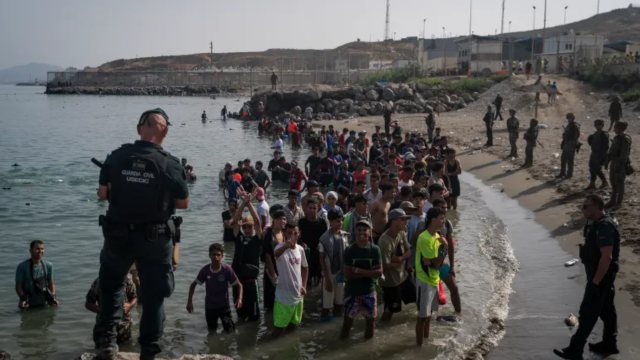
The wave of migrants who flooded into Ceuta, believing that Spain would be an “open door” of opportunity, proved a disappointment for thousands of young Africans. Within just 24 hours, thousands were turned back, seeing their dream of a legal life in Europe shattered. More than 48,300 people, out of an estimated 60,000 who crossed en masse into Ceuta, voluntarily returned to Morocco, following the same route they had entered. They had spent the night outside, wandering the streets in search of food and water. There they realized that there was no “easy access” to Europe, unlike what they had been told.
“They lied to us. No one accepts us. It’s like a prison,” said an 18-year-old Moroccan, expressing the frustration of many of his peers.
Spanish authorities are now trying to identify who was behind the messages that led tens of thousands of young people to gather in the Moroccan city opposite Ceuta before attempting the crossing. Posts and social media messages were found on the phones of many migrants, according to which anyone who managed to swim to the Spanish side could obtain a residence permit, benefit from supposed legalization procedures and then travel without difficulty to mainland Spain. These promises turned out to be false, but for thousands of unemployed and hopeless young people, they were incentive enough to attempt the dangerous crossing.
According to the Financial Times, many of those who swam across the sea border had prepared for weeks, with the sole aim of reaching European soil. This came days after around 1,800 people managed to enter Ceuta by swimming around the breakwater that separates the Spanish territory from Morocco. According to the testimony of a Moroccan swimming instructor, some migrants had taken lessons or taught themselves to swim, knowing that the sea would be the only way to Europe.
At the same time, an informal “infrastructure” for the venture was organized on social media. Facebook groups posted ads for the sale of fins and diving suits, while other users exchanged information in Arabic about weather conditions, sea currents and the route to Tarajal beach in Ceuta, even accompanying their posts with screenshots from Google Maps. Since the early hours of Thursday morning, thousands of people have been heading to the border from the Moroccan side. They have arrived on foot, by bicycle, by car and even by truck, causing traffic jams on the roads leading to the border line. Instead of going through customs, many of them have walked down steep slopes to a narrow beach.
Although the shortest distance to Ceuta is only a few hundred meters, overcrowding and strong sea currents forced many to swim much longer distances, staying in the water for hours. On the Spanish coast, arrivals were being pulled out of the sea with leg injuries from rocks. The Spanish Guardia Civil, which had taken over border security, monitored the situation without preventing the migrants from disembarking. The image of one man who managed to reach land even with his bicycle in his hand, while others recorded their attempt on mobile phones, was characteristic. According to Spanish media, at least 57 people lost their lives at sea during the crossing.
Many of those arriving in Ceuta headed for the migrant reception centre, which had been overcrowded in the previous days and remained closed. Some remained on land under the supervision of police and the Red Cross, awaiting further developments. Despite the impression created by the recent ruling by the Spanish Supreme Court that those arriving by swimming cannot be immediately turned back, Ceuta is not a free gateway to the rest of the European Union. Additional border controls are needed for crossing into mainland Spain. By Friday afternoon, according to Spanish authorities, around 48,300 people had voluntarily returned to Morocco, while later the European Commissioner for Migration, Magnus Brunner, stated that “almost all” of those who had crossed the border had been returned.