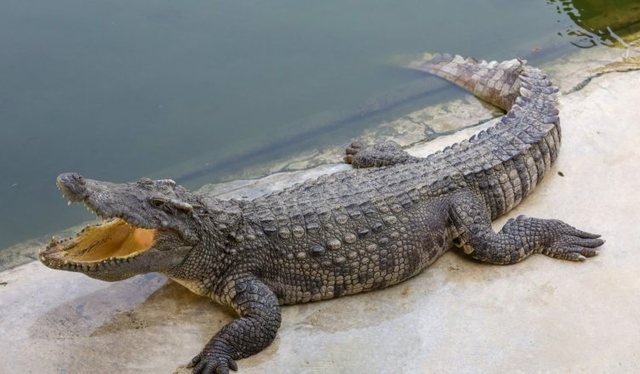
We’ve all heard the expression “crocodile tears” to describe someone who pretends to be sorry or sad, while their feelings are not sincere.
This expression exists not only in Albanian, but also in many other languages, and originates from an ancient belief, according to which crocodiles shed “fake tears” while eating their prey.
The myth of crocodile tears dates back centuries.
Over time, the expression “crocodile tears” spread to religious tradition, medieval literature, and later to the works of various authors. William Shakespeare also used this idea in his play “Othello”, where fake tears are compared to crocodile tears.
But how true is this when we talk about the very animals that gave birth to this expression?
Do crocodiles really cry?
Yes, crocodiles can shed tears, but these are not related to emotions or sadness. Like most living things, their tears have a biological function.
The fluid produced by the tear glands serves to clean and lubricate the eyes. Tears become more visible when crocodiles spend a long time on land. In some species, such as saltwater crocodiles, tears also help to remove excess salt from the body.
In 2006, neurologist Malcolm Shaner and researcher Kent Vliet from the University of Florida investigated whether there was any truth behind the myth that crocodiles “cry” while feeding.
The study was conducted at the St. Augustine Alligator Farm in Florida, where seven crocodiles were observed feeding. Five of them showed tears while eating, indicating that the phenomenon really exists.
Scientists think that tears during feeding may be caused by warm air being forced out of the airways during chewing, stimulating the tear glands.
Do crocodiles have emotions?
For many years, scientists have studied emotions mainly in mammals and birds, while reptiles were considered creatures that acted solely on instinct.
However, recent research has changed this perception. New studies suggest that some species of reptiles can experience states such as fear, stress, pain, anxiety, and pleasure.
Behaviors have been observed that indicate a more complex world than previously thought. Some crocodiles have been seen playing, sliding in mud or pushing objects, while communicating with each other through sounds and body language.
In some species, females show great care for their young, while the cubs make sounds not only to call their mother, but also to communicate.
So crocodiles don’t cry out of sadness or hypocrisy, as the famous expression suggests. But science shows that these animals are much more complex than the image created over the centuries, not simply predators guided by instinct, but creatures with social behaviors and abilities that continue to be studied by scientists.