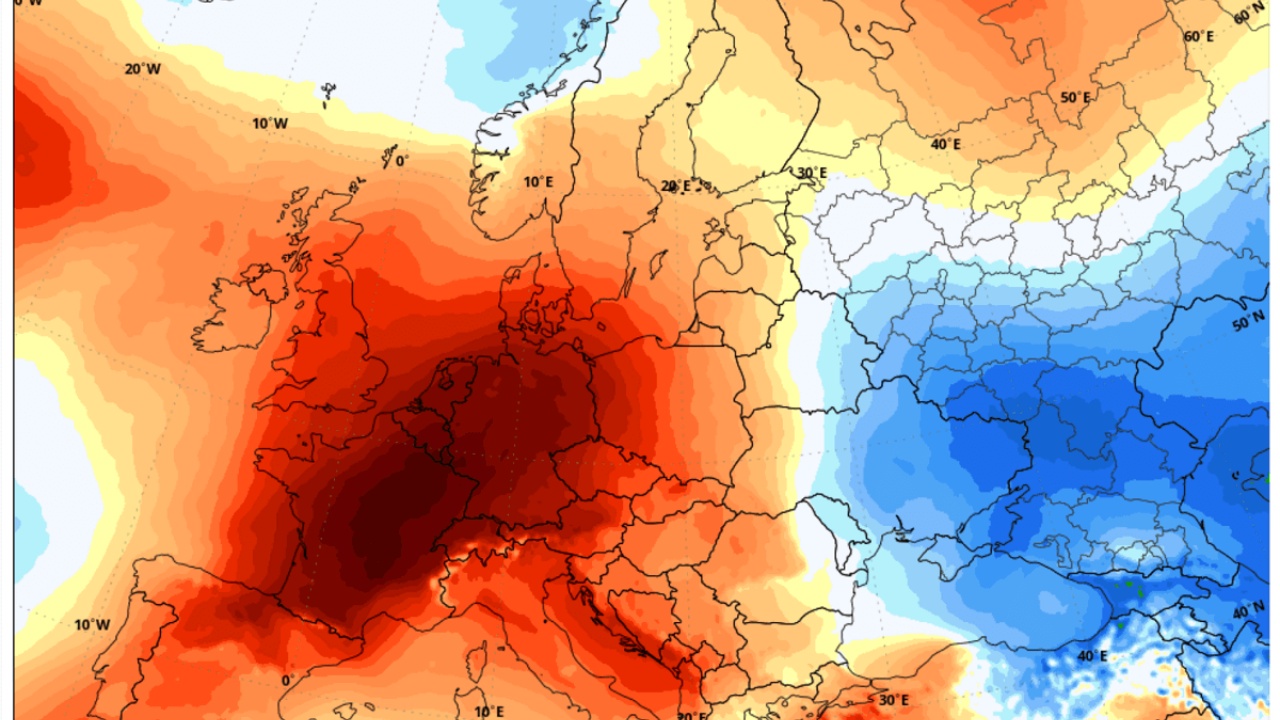
A new intense heat wave is sweeping across Central Europe and the Balkans, with meteorologists warning that the first week of August will bring the highest temperatures of the summer to many countries in the region and the continent. The cause is a powerful high-pressure system, known as the “Heat Dome,” which has blanketed Europe with a mass of very hot and dry air coming from North Africa.
Temperatures are forecast to reach 40 to 43 degrees Celsius (104 to 111 degrees Fahrenheit) this week in the northern Italian lowlands and the Pannonian Basin, including Hungary, eastern Croatia, northern Serbia and western Romania. Eastern Austria, Slovakia, the Czech Republic, Germany and Poland will also experience temperatures well above seasonal normal.
Meteorologists explain that the “Heat Dome” phenomenon is created when a very strong area of high pressure remains for days or weeks over the same area. The hot air remains trapped beneath it, compresses towards the surface and heats up even more, causing temperatures to continuously rise. For this reason, these episodes last longer than regular heat waves and are much more intense.
In addition to extreme daytime temperatures, tropical nights remain a concern. In many cities, minimum temperatures will not drop below 22-26 degrees Celsius, while in some areas they are expected to remain above 24 degrees throughout the night. This means that the body is unable to cool down sufficiently, significantly increasing the risk of health problems, especially in the elderly, children and people with chronic diseases.
According to the analysis, the hottest days will vary from one area to another. On Tuesday, the highest temperatures will be recorded in Germany, Austria, the Czech Republic and Hungary. On Wednesday and Thursday, the center of the heat will shift towards Croatia, Serbia, Romania and other parts of the Balkans, while on Friday the wave will extend even further east, affecting Bulgaria, Greece, Ukraine and parts of western Russia.
Experts warn that the combination of very high temperatures, lack of precipitation and dry winds will accelerate soil drying and significantly increase the risk of forest fires in Southern Europe and the Western Balkans. At the same time, the extreme heat is also expected to put pressure on energy systems, due to the increased use of air conditioning and electricity consumption.
According to meteorologists, medium-term models show that even after this week, the hot weather may not go away. Forecasts signal the creation of another “heat dome” over Western Europe during the next week, which could bring a new wave of very high temperatures to Spain, Portugal, France and then towards the Alps, while the situation over the Balkans is expected to gradually change only next weekend.
Albania is also expected to face a severe heat wave in the coming days. According to meteorological forecasts, temperatures will gradually increase starting from the end of the week, while in some specific areas the thermometer may approach 40 degrees Celsius.
During the first days of the week, the weather will remain mostly stable. Maximum temperatures will reach up to 32 degrees Celsius in most of the territory. On the coastline, the thermometer will fluctuate around 30 degrees, while mountainous areas will register values between 27 and 28 degrees Celsius. Minimum temperatures will remain relatively low, with the coolest values recorded in the northeastern areas of the country.
Although the weather will be characterized by clear skies, cloudiness will be present during the afternoon hours. Isolated and short-term showers are expected in mountainous areas until Thursday. On Tuesday, the rains will be concentrated mainly in the northern part of the country, while on Wednesday they will affect the northeast and southeast. On Thursday, showers may appear in most of the eastern areas, mainly during the afternoon.
The change in the weather situation is expected to start on Thursday evening. Hot African masses will return to the region, bringing an immediate increase in temperatures. On Thursday, maximum temperatures are expected to reach 35 to 36 degrees Celsius, while on Friday they will rise to 37 degrees, said MeteoAlb meteorologist Lajda Porja. The weekend and the first days of next week will be the hottest period. Temperatures are expected to approach 39 degrees Celsius in many areas of the country, while in isolated areas the possibility of the thermometer reaching 40 degrees is not excluded.