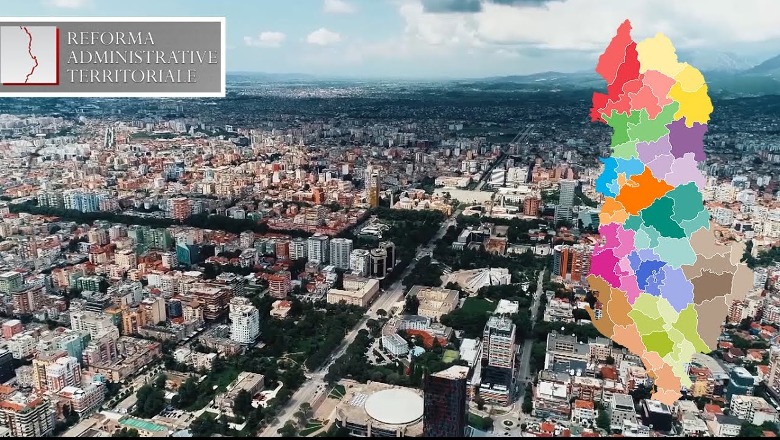
The variant proposed by the Socialist Party for the new territorial reform, which will likely be implemented due to the votes the majority has in the Assembly, shows that the new division does not only take into account the number of inhabitants.
The Socialist Party, in the draft it submitted to the Assembly, proposed the consolidation of 15 municipalities: Maliq, Dimal, Cërrik, Divjakë, Përrenjas, Patos, Belsh, Rrogozhinë, Klos, Selenicë, Poliçan, Memaliaj, Fushë-Arrëz, Këlcyrë and Libohëvo.
According to the 2023 Census data, of the 46 remaining municipalities, 10 have fewer than 10,000 inhabitants. Among them are Himara, Dropulli, Përmeti, Kolonja, Tepelena, Memaliaj, Puka, Delvina, Konispoli and Pusteci.
Pusteci, with only 1.8 thousand inhabitants, is the smallest municipality in the country, but continues to be preserved as a separate unit. Konispol, with 4.9 thousand inhabitants, also has a population similar to Fushë-Arrëz and much smaller than some of the municipalities being merged.
Analysis of Census 2023 data shows that reorganization is not limited to municipalities with very small populations.
Municipalities with over 20 thousand inhabitants lose their status
The list of units that will lose their municipal status also includes relatively large municipalities, with over 20 thousand and up to 31 thousand inhabitants.
In total, the 15 municipalities scheduled to merge with larger municipalities have about 224 thousand inhabitants, or approximately 9.3% of the country’s population. Their average population is about 15.6 thousand inhabitants, while half have more than 14.8 thousand inhabitants.
The largest municipality expected to lose its status is Maliqi, with 31,000 inhabitants. It ranks 18th among the country’s 61 municipalities in terms of population and has more inhabitants than 43 other municipalities.
After Maliq, the largest units to be merged are Dimali, with 28.1 thousand inhabitants, Cërriku, with 25.2 thousand, and Divjaka, with 24.9 thousand inhabitants. These four municipalities together have around 109 thousand inhabitants and constitute almost half of the population of the units affected by the reform.
The list also includes Përrenjasi, with 18.8 thousand inhabitants, Patos, with 18.2 thousand, and Belshi, with 17.1 thousand inhabitants.
In total, 7 of the 14 municipalities being merged have more than 15 thousand inhabitants, while 9 of them have over 10 thousand inhabitants.
Other municipalities included in the SP variant are Rrogozhina, with 12.6 thousand inhabitants, Klosi, with 12.2 thousand, Selenica, with 9.6 thousand, and Poliçan, with 8.8 thousand inhabitants.
At the bottom are Fushë-Arrëzi, with 4.9 thousand inhabitants, Këlcyra, with 4.4 thousand, and Libohova, with less than 2.8 thousand inhabitants.
Consolidation increases the average size of municipalities
With the transition from 61 to 47 municipalities, the theoretical average population per municipality would increase from around 39.4 thousand to over 51 thousand inhabitants
In practice, the increase will depend on how the territory and population of the 14 municipalities will be distributed to the host units.
The consolidation aims to create municipalities with larger administrations and a broader population and income base. But the inclusion of units such as Maliqi, Dimali, Cërriku and Divjaka shows that the reform is not only eliminating municipalities that have become unsustainable due to demographic shrinkage.
In some areas, units are being merged that have more residents than many of the municipalities that will continue to exist.
This shifts the debate from the question of which municipalities are too small, to how the centers that will be consolidated and the units that will maintain administrative status were selected. Monitor