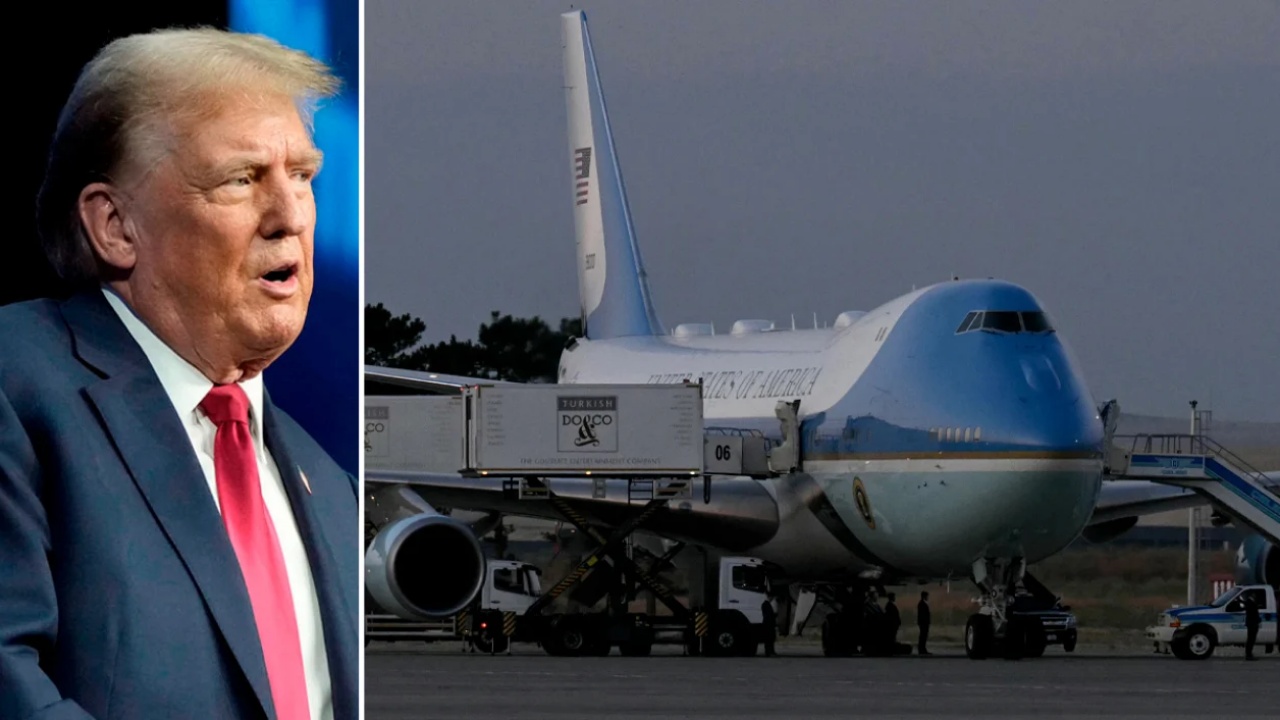
A sophisticated deception operation was staged in Turkey last month to ensure the safe departure of US President Donald Trump, after US intelligence agencies assessed that there was a credible threat from Iran to him.
According to the New York Times, Trump appeared before the cameras boarding the old Air Force One, giving the impression that he would be traveling with it for the first part of the return from the NATO summit.
In reality, the US president was secretly removed from the plane via a supply container and transferred to another plane, on which he traveled covertly to Britain.
The operation was planned within hours and was reportedly known only to a very limited circle of senior American officials. Journalists traveling with the president, as well as some White House staff members, were unaware of the plan and were used unknowingly as part of the “distraction.”
“Performance” in front of the cameras
Trump was scheduled to leave Turkey on July 8, after the end of the NATO summit.
It was initially announced that he would not use the new Boeing 747-8, donated by Qatar, for the first leg of the return trip, but one of the older Air Force One aircraft.
At the time, Trump had linked the decision to nostalgia, telling reporters that he wanted to fly the old plane to “remember the old days.”
In front of the cameras, the president boarded the old Air Force One from the left side. The journalists accompanying him also boarded the plane, giving the impression that Trump would be traveling with them.
But, after the cameras left, the plan changed.
A supply container was placed on the other side of the plane. According to a US official quoted by the New York Times, Trump was secretly taken out through it and sent to a third plane.
How Trump “disappeared” from the radar
According to the Washington Post, the plane that secretly transported Trump to Britain was a C-32A, the military version of the Boeing 757.
The plane flew with the call sign “Reach 18” or “RCH18”, instead of “Air Force One”, while systems that allow easy tracking of the plane during flight were deactivated.
At the same time, the old Air Force One, which departed from Turkey with journalists and some White House officials but without Trump, continued to appear on radar with the call sign “AF1.”
This created the impression that the American president was on that plane, while in reality he was traveling to Britain on a C-32A.
Trump was accompanied to the C-32A aircraft by Defense Secretary Pete Hegseth, who boarded separately via an external staircase so that the plane’s presence at the airport would appear to be a regular government flight.
The journalists knew nothing.
Journalists on board the old Air Force One were not informed that Trump would not be traveling with them.
The same thing happened to several members of the White House staff.
After taking off from Turkey, journalists were asked to keep the window curtains in the press booth closed.
The old Air Force One landed at 10:16 p.m. at Mildenhall Air Base in England. About 40 minutes later, Trump appeared to disembark, looking as if he had just finished his flight from Turkey.
In fact, he had arrived in Britain on the next plane.
After the C-32A landed, Trump transferred to the old Air Force One, entered it through another entrance, and then disembarked in front of reporters through the upper left door.
He then moved to the new plane donated by Qatar and returned to Washington along with the journalists.
“If I leave, you leave too”
After this operation, the main goal was for American services to assess that there was a credible Iranian threat to Trump.
According to sources at the New York Times, the threat was not only related to the new plane donated by Qatar. The information indicated that the target was the American president himself, regardless of the aircraft he would be using.
Trump was informed of the threat while still in Turkey and within hours the plan for his departure was organized.
Among the limited group of senior officials who participated in the planning were Defense Secretary Pete Hegseth and the chairman of the Joint Chiefs of Staff, General Dan Kaine.
During the flight back from Britain to the US, reporters asked Trump about using the old Air Force One. The president said he wanted American soldiers stationed at the British base to see the new plane.
Asked why reporters were asked to keep the curtains closed during the flight from Turkey, Trump said he was not aware of any specific threat, but acknowledged that he was constantly being targeted by Iran.
“I’m number one on their list, ahead of you,” he told reporters, adding: “But if I leave, you leave too. Or not?”
A tactic used before
The use of fake convoys or flights is not an unknown practice for the Secret Service, especially when the president is in high-risk areas.
However, the operation to secretly remove Trump from Turkey is notable for the degree of deception.
According to the Washington Post, a similar incident occurred in March 2000, during President Bill Clinton’s visit to Pakistan. Due to security concerns, Clinton traveled to Islamabad in a white, unmarked plane, while another plane with presidential markings was used as a “distraction.”
On other occasions over the past 30 years, Air Force One has been used as “bait,” especially when the president was near high-risk areas.
Iranian threats against Trump
Trump and some of his associates have faced threats from Iran for years, especially after the order given during his first term to assassinate Iranian General Qassem Soleimani.
During the 2024 presidential campaign, Trump’s aides were informed that Tehran was still trying to harm or kill the American president.
This information led even then to the use of “interceptor” aircraft by his security team.
The Biden administration had beefed up Trump’s protections in the summer of 2024, following new information about plots to assassinate him. Then there were two separate, unrelated attempts against him, in Butler, Pennsylvania, and in September of that year.
Threats against Trump have also included a paid assassination plot by an Iranian agent, as well as cyberattacks on the email accounts and social media accounts of his campaign officials. /Top Channel/