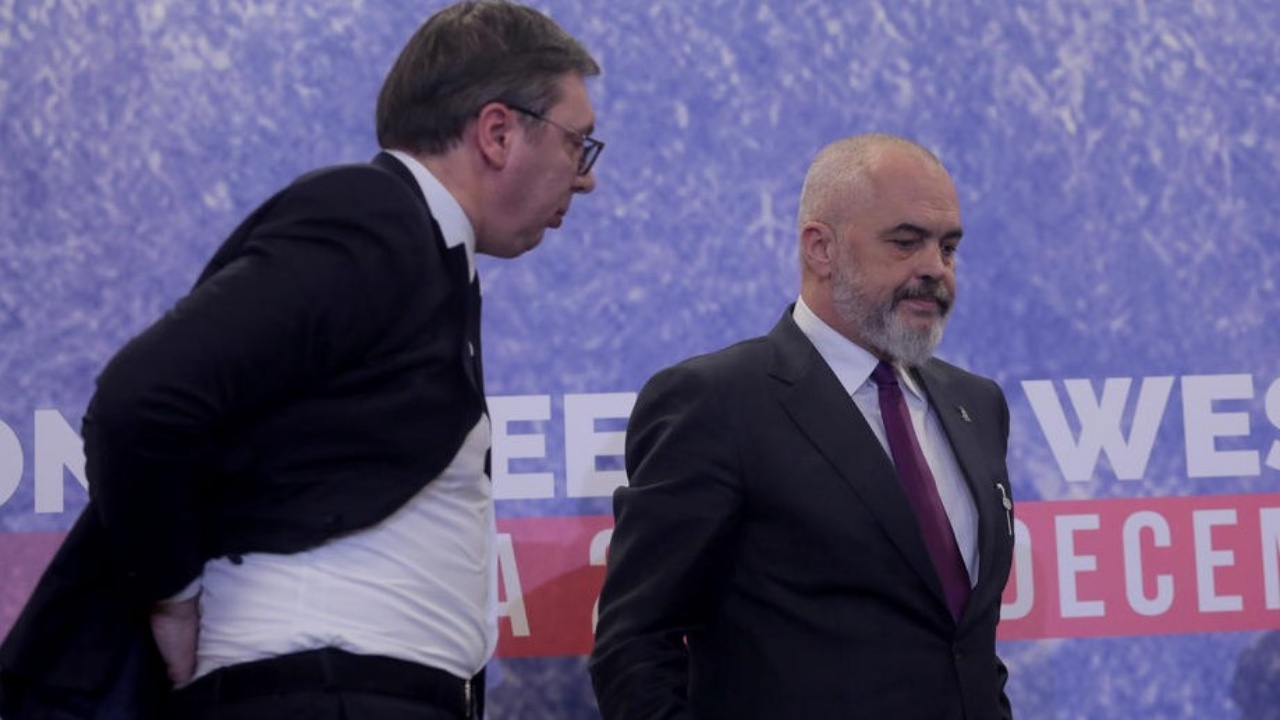
Prime Minister Edi Rama has reacted to the recent statement by Serbian President Aleksandar Vučić regarding the Ibar River and the Kosovo issue, shifting the debate from hydrology to relations between the two countries and the status of Kosovo.
In response, Rama mocks the Serbian side’s statements, saying that the debate over the Ibar River ended up moving from hydrology to international law, “Greater Albania” and Serbia’s historical claims. The Prime Minister categorically rejects any claim that Albania has territorial interests towards Serbia. Rama emphasizes that Kosovo is a separate state and that the Albanians of Kosovo have the institutions and the right to determine their own future. Rama also states that Serbia has lost Kosovo and that repeating the opposite does not change reality.
Full post:
A very interesting summer exchange between our Foreign Ministers. Although I was expecting an answer on #Ibar, somehow we traveled from hydrology to international law, made the obligatory stop at “Greater Albania”, passed through “Kosovo and Metohija” and finally arrived at the famous museum of Serbian historical anxiety.
There is a particular piece of political folklore in Belgrade that seems to be immune to time: whenever Albania talks about #Kosovo, “Greater Albania” must be immediately invoked, as if its repetition might one day transform an old ghost into a relevant argument.
It won’t happen.
Albania has absolutely no claim to Serbian territory and has no need to invent one. Nor do we need a “Greater Albania” to stand by Kosovo. Kosovo is a separate state. The Albanians of Kosovo are exactly that: Albanians of Kosovo. They have their own Republic, their own institutions, and the right to determine their own future. We will always stand in support of this right.
Serbia lost Kosovo. Reiterating that it did not lose may perhaps turn defeat into victory in the geography of political imagination, but unfortunately maps are less tolerant. The territory of the Republic of #Kosovo is not Serbian territory and the natural resources located within it are not resources of the Republic of Serbia. Our Serbian friends know this very well, including when we sit together at European tables.
So, let’s get back to the river. The original issue remains exactly where Albania left it: the #Iber is a transboundary water system. Serbia is completely free to manage the resources within its jurisdiction. What it cannot reasonably claim is that the potential consequences for another state magically stop at the Serbian border. That is precisely what international water law is for, after all. Rivers have this annoying habit: they follow geography, not diplomatic arguments.
The situation of the Serbian community in Kosovo was also mentioned. Their rights matter. Their security matters. Their property, their language, their cultural and religious heritage must be protected. Albania has never had any difficulty saying this, because this is simply what a democratic state owes its citizens. And here we come to perhaps the most amusing acrobatic maneuver of this exchange: Albania’s warning against ethnic expansionism, while in the same statement referring to the territory of another sovereign state as if it were still Serbian territory. It is a rather difficult circle to close.
Maybe this works within the political bubble in Serbia. Outside it, the geometry becomes less tolerant. And yes, I couldn’t agree more that the future of our region should be one where borders gradually lose their power to divide us. Absolutely. But there is one small prerequisite before borders become less important: accepting those that already exist. The genius of the European project was precisely the separation of national belonging from the thirst for territories.
The Albanians of Kosovo are Albanians of Kosovo. Albania will stand by them and their Republic, because we share history, language, families and a common future, but above all because a free, democratic and secure Kosovo is a legitimate European state and an indispensable part of the stability of our region.
There is nothing secret about this stance. There never has been. No secret maps. No hidden borders. No “Great” of any kind is necessary.
Therefore, Albania’s position will remain exactly the same, both in public and in private: we respect Serbia, we want good neighborly relations with Serbia, and we want the entire region to be within Europe – including, of course, Serbia. But good neighborliness cannot mean asking all of Serbia’s neighbors to be permanently relegated to the Serbian version of history. The Balkans have already paid dearly, in blood and lost time, for this kind of adjustment.
Meanwhile, the #Iber, blissfully unaware of all our historical cartography, will continue to flow according to geography and not folklore.