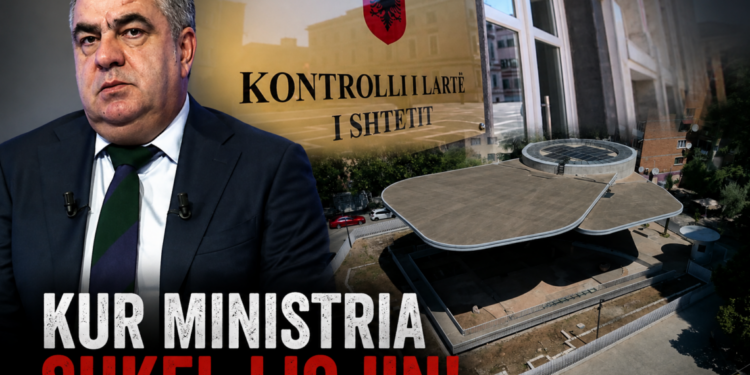
The ministry that should guarantee the implementation of the law is itself faced with the findings of the HSE.
Since September 2025, this Ministry has been led by Mr. Blendi Gonxhja, who has often been presented as one of the most critical voices against illegal behavior. But the findings of the KLSH audit raise questions precisely about the implementation of the law by the institutions responsible for the administration and protection of art, culture and cultural heritage.
At a time when citizens face administrative measures and penalties for unauthorized works, the ALSHI report highlights that even in public projects related to important cultural objects, valid unauthorized works, unsubstantiated changes to projects, and a lack of mandatory approvals have been found.
In the end, the question that arises is simple: how can citizens be required to strictly comply with the law on construction, when public institutions themselves result, according to the audit of the Albanian Supreme Audit Institution, from having allowed or carried out works in violation of legal requirements?
Unauthorized works also in art and culture facilities, KLSH finds violations in the Tirana Mosaic and the Art Gallery
At a time when citizens are penalized for violating legislation and where the law clearly states that construction work without a permit is not allowed, it turns out that state institutions have not always respected the same legal obligation.
According to the audit of the Supreme State Audit Office (SSA), conducted in April 2026, violations and deficiencies were also found in some of the projects and works related to art, culture and cultural heritage.
The audit focused on several facilities and contracts, where problems related to construction permits, changes to projects, technical documentation, supervision of works, and compliance with legal procedures were identified.
How many cases and in which facilities were violations found?
From the findings cited in the SAI report, violations or deficiencies directly related to the implementation of the works were found in three main objects/contracts:
1. The Tirana Mosaic
In the project “Restoration Intervention in the Mosaic of Tirana, Building Construction”, the SAI has identified several problems in the design and implementation phase.
One of the main violations is related to the commencement of works without the relevant construction permit. In addition, a lack of design documentation and professional liability insurance, technical discrepancies between the architectural project, the construction project and the actual situation on the ground, as well as shortcomings in the price analysis in the estimate were found.
The report also highlights unsubstantiated changes to the preventive design, lack of necessary approvals for changes to cultural assets, and failure to report regularly by the works supervisor.
So, for the Tirana Mosaic, among the violations found is specifically the start of works before being equipped with the relevant construction permit.
2. University of the Arts – Concert Hall
In the contract with the object “Implementation of works for the restoration, reconstruction and renovation of the concert hall at the University of Arts in Tirana”, the SAI has identified another series of problems.
According to the report, unsubstantiated changes were found in the preventive project, carried out after the actual completion of the works, and without obtaining all mandatory approvals from the competent bodies for cultural assets.
Also, discrepancies were identified between the technical specifications of the project and the works carried out on the ground, including deletions of items and dimensional changes with financial impact.
In this facility, according to the audit material, the main problem is related to changing the project and estimate after the work was completed, without the necessary approvals, as well as technical and financial discrepancies.
3. National Museum of Fine Arts – Art Gallery
Another case identified by the ALSAI is the contract “Restoration, Reconstruction and Rehabilitation of Spaces at the National Museum of Fine Arts (Art Gallery)”.
In this case, the finding is even more straightforward: the works began and continued without a valid construction permit.
According to the report, payments were also made before the permit was issued, while unjustified amendments to the deadline were found, without technical justification and without supporting documentation, in violation of the relevant legal framework.
The SAI has also identified deficiencies in the reporting and supervision of works, formal approval of changes after their actual implementation, and a lack of effective monitoring by the Contracting Authority.
Two direct cases with construction permits
Of the three objects/contracts above, two cases are directly related to construction permit issues.
In the Tirana Mosaic, works have begun without the relevant construction permit.
Meanwhile, at the Art Gallery, works have begun and continued without a valid building permit, while payments were made even before the permit was issued.
In the case of the University of Arts, the problems identified by the ALSAI are mainly related to changes in the project and estimate after the completion of the works and the lack of mandatory approvals for cultural assets.
So, according to the findings cited in the report, there are three objects/contracts with identified problems, two of which have direct violations related to construction permits.
Shortcomings also in the administration of arts and culture
The SAI audit did not stop at the implementation of projects. The report also highlighted broader issues in the way the Ministry of Tourism, Culture and Sports has pursued policies and programs in the field of art, culture and cultural heritage.
According to the SAI, the Ministry has not effectively followed up and implemented the objectives and measures foreseen in the strategic document for the development of art and culture. According to the audit, the planned products for the consolidation of the legal and institutional framework have not been provided and a dedicated mechanism for the follow-up, monitoring and reporting of the implementation of the strategy has not been established.
The SAI also notes that the new sectoral strategy has not yet been drafted and approved after the end of the previous period, creating a gap in the planning and orientation of public policies and financial support in the field of art, culture and cultural heritage.
Another problem is related to the fact that, despite the management of budget programs for art, culture and cultural heritage, the necessary sub-legal acts and internal regulatory acts for the full implementation of the legal framework have not been issued.
According to the SAI, there is a lack of clear rules for financing procedures, division of responsibilities, audit trails, control activities and documentation management./weblajm