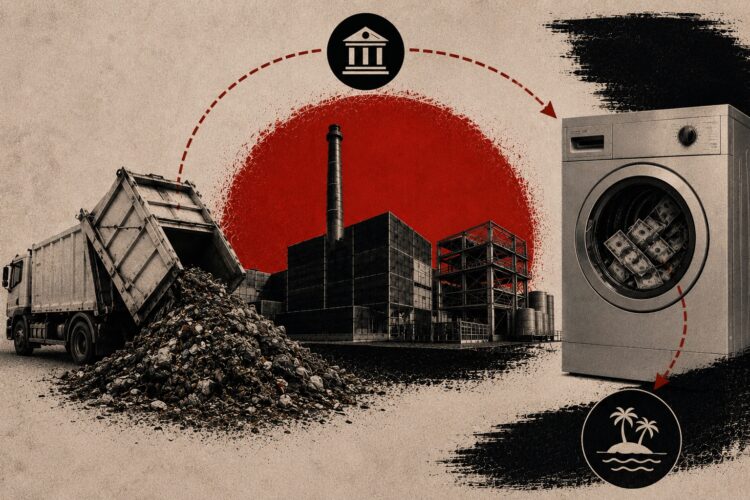
In the capital’s landfill, along the Erzeni Valley in Sharra, the hill of urban waste continues to rise stubbornly towards the sky, while dump trucks bring in new tons of garbage every day, which are collected with the help of bulldozers and compacted on top of the existing massif.
Located next to the Sharra cemetery in Tirana, the landfill burns under the scorching August sun and spreads a pungent stench of gases into the air that mercilessly attacks the nostrils. On the site where the Tirana incinerator was supposed to be built – depicted in the concessionaire’s graphic videos as a futuristic complex in the form of twin pyramids of colored glass and a metal structure – there is no trace of the promised investment.
After six years of investigations and public debate, the Special Prosecution Office against Corruption and Organized Crime, SPAK, sent 12 people to trial in mid-July. They are accused of being part of a structured “white collar” criminal group, which according to the prosecution was led by fugitive businessmen Mirel Mërtiri and Klodian Zoto, and which is suspected of embezzling tens of millions of euros from public funds intended for the Tirana waste treatment concession.
According to the investigative file filed with the Special Court Against Corruption and Organized Crime (SCOC), a copy of which is available to BIRN, the defendants are accused of having illegally obtained significant sums of money – misappropriated through fraud, while failing to make the anticipated investments.
“Mirel Mërtiri and Klodian Zoto used the mechanism of withdrawing monetary amounts from the accounts of the concessionaire company, through fraud with fictitious invoices, the use of fictitious companies created inside and outside the country, as well as through cash transfers,” SPAK prosecutors said in a media release.
The Tirana incinerator file is one of SPAK’s most important investigations, not only because of the high value of the concession contract, but also for the negative impact that the failure of investments in urban waste management has brought – one of the most acute environmental challenges facing the country.
“For years, we have accumulated tons of waste and wasted precious time and funds, which, if they had been put to real waste management, would have a much improved situation on the ground today,” says Besjana Guri, director of the “Lumi” environmental center and winner of the ‘Goldman’ environmental award, as part of the successful campaign to protect the wild bed of the Vjosa River and turn the valley into a national park.
“Not only has the situation not improved, but waste from across the country continues to be deposited in landfills, illegal dumps or dumped on riverbanks, causing continuous and uncontrolled pollution,” she added.
Businessmen Klodian Zoto and Mirel Mërtiri have been on the run since 2024. They are believed to have taken refuge in Austria and were not available for comment. Meanwhile, Mërtiri’s lawyer, Klodian Skënderaj, told BIRN that SPAK “has invented the term ‘de facto owner’ for Mr. Mërtiri and without attributing any concrete actions to him has raised a series of accusations, which are not based on concrete facts.”
Cost inflation
Within a few years of the Socialist Party coming to power, companies linked to Klodian Zoto, Mirel Mërtiri and his partner, Stela Gugallja, secured three projects from the Albanian government to build and manage incinerators in Elbasan, Fier and Tirana. The first two projects were worth a combined €50 million, while Tirana’s 30-year contract predicted revenues of almost €430 million over the entire concession period.
The concession contract for the Tirana incinerator was signed in 2017. It included the construction of a landfill, the establishment of a waste-to-energy plant for electricity production, and the rehabilitation of the existing landfill in the Tirana waste treatment area. In exchange for an investment estimated by the Ministry of Environment at 128 million euros, the municipalities of the Tirana region would deposit waste for a fee of 29 euros per ton for a 30-year period.
This contract came as a result of an unsolicited proposal from the companies “Energy Recuperator SPA”, “Paul Wurth Italia SPA” and “Integrated Technology Services” sh.pk (ITS) – the latter owned by businessman Klodian Zoto.
However, SPAK’s investigation shows that the initiative to build the Tirana incinerator was planned as early as 2015 by the Ministry of Environment and the Municipality of Tirana. Not only was the proposal not Klodian Zoto’s idea, but the documents submitted for obtaining the concession were drafted by public officials, who were paid simultaneously by the state and by his company, ITS.
The investigative file describes a continuous communication between the former advisor to the Ministry of Environment, Vladimir Bezhani, and the businessman under investigation. According to the evidence administered by SPAK, Bezhani sent Zoto documents, information and even drafted the “Letter of Interest” himself that was presented as the company’s unsolicited proposal in the concession procedure.
Bezhani himself has admitted that, while serving as an external advisor to former Environment Minister Lefter Koka, he was paid by Zoto’s company and used the official email address of the Ministry of Environment for communications with the company. SPAK argues that these circumstances demonstrate the high level of coordination between officials within the contracting authority and the proposing company, calling into question the “unsolicited” character of the project.
Data obtained by SPAK from emails seized from Klodian Zoto’s computer also suggest that the concessionaire company inflated the cost of investing in the landfill by 25.7 million euros, while half of the waste disposal fee was the concessionaire’s profit.
According to the investigative file, on August 26, 2016, Klodian Zoto sent an e-mail to the company “Paul Wurth”, sharing the forecasts for the business plan, in which the total cost of the investment was estimated at around 102.5 million euros.
“Dear gentlemen, attached is the real business plan and not the state plan,” Zoto wrote to the Italian partners.
Bezhani is not the only public official who has benefited financially from favors given to concession companies and businessmen Zoto and Mërtiri.
The two businessmen are suspected of transferring millions of euros in bribes to family members and people connected to senior officials – including former Minister of the Environment, Lefter Koka, former Secretary General of the Ministry, Alqi Bllako, and former Deputy Prime Minister Arben Ahmetaj – to secure contracts for the construction of incinerators.
Koka was found guilty of corruption, money laundering and abuse of office, while Bllako was found guilty of abuse of office. The case against Ahmetaj is expected to be reviewed by the Special Court, while the former deputy prime minister has fled the country, seeking political asylum in Switzerland.
All three former officials have denied the charges, calling them politically motivated.
According to Jorida Tabaku, a Democratic Party MP in the Albanian Parliament and chair of the Parliamentary Investigative Committee on Incinerators in 2021, SPAK has uncovered an important part of the incinerator scheme, but has not yet provided a complete picture of criminal responsibilities, the connection between the three contracts, and the final destination of the money.
She attributes this partial result to the division of the investigation into several separate proceedings. Although she acknowledges that the prosecution may have had its own procedural reasons for this approach, Tabaku believes that the investigation has so far produced a fragmented picture of the case. According to the opposition MP, it remains unclear why SPAK has characterized the Tirana incinerator scheme as the activity of a structured criminal group, while the same actors were not considered part of such a group in the Fier and Elbasan incinerator cases.
“We still do not understand how it is possible that three private actors reached the level of the Deputy Prime Minister of Albania and how several ministers were involved, at different times, in the same scheme,” she said, adding that the evidence collected by the Investigative Committee and media investigations point to “direct channels of communication and intervention that reached the highest levels of government.”
“These connections have not yet received a full criminal and institutional response,” Tabaku stressed.
Actual owners

According to SPAK, behind the concession company of the Tirana incinerator stood a two-tier ownership structure, which passed through the Netherlands and which, despite the names appearing in the documents, was actually controlled by Klodian Zoto and Mirel Mërtiri.
The consortium of companies that won the Tirana incinerator concession initially established a holding company in Eindhoven, called Integrated Energy BV. Through it, the company Integrated Energy BV SPV sh.pk was later founded in Albania, which signed the concession contract with the Ministry of Environment on August 31, 2017. The Dutch company owned 100% of the shares of the Albanian concessionaire.
According to SPAK, Integrated Energy BV was created by Klodian Zoto’s Integrated Technology Services (ITS) and two Italian partners, Paul Wurth Italia and Energy Recuperator. However, a cooperation agreement concluded before the company was founded provided that, after winning the concession, the Italian partners would transfer their shares to ITS, if the latter requested them.
The formal ownership structure changed several times in the years that followed. On June 25, 2021, the Albanian register of beneficial owners declared three Italian citizens as shareholders of the Dutch company – now renamed Geogenix BV: Giuseppe Ciaffaglione with 30%, Salvatore Russelli with 25% and Alberto Pressezzi with 43%.
Pressezzi explained to prosecutors that his and his partners’ involvement in Geogenix was as a “sleeping shareholder” and was conditional on securing 100 million euros in financing for the construction of the Tirana incinerator. Only if the financing was secured would they become active as shareholders and take full financial and managerial control of the company. According to his testimony, the financing was not secured and this control was not exercised.
After this series of formal ownership changes, SPAK claims that the reins of control remained in the hands of Zoto and Mërtiri. According to the prosecution, both were the ‘de facto’ owners of the Dutch company and used other persons and companies to hide the real ownership, while continuing to make decisions and give instructions to its managers. Mërtiri, in particular, appears as a micro-manager, who decided on the salaries of the guards and punished subordinates with financial sanctions for ‘failing to inform the superior.’
According to Zef Preçi, an economic expert and director of the Albanian Center for Economic Research, ACER, the use of offshore companies and structures with non-transparent ownership by a concessionaire financed with public money constitutes a high institutional and fiscal risk, as it violates one of the basic principles of accountability – knowing who benefits and where public funds end up.
“When the real owners hide behind such structures, authorities find it more difficult to verify the concessionaire’s connections with public officials, politically exposed persons or sanctioned entities, simultaneously weakening control over conflicts of interest and the use of public money,” said Preçi.
“Offshore structures make it significantly more difficult to identify the real beneficiaries and follow the money trail, especially when chains of companies, nominee shareholders and jurisdictions that do not provide quick or complete ownership data are used,” he added.
According to Preçi, if a concessionaire financed with public funds is allowed to use offshore structures and non-transparent ownership, without being subject to full identification, verification and monitoring, the problem goes beyond the responsibility of the individuals involved and highlights systemic weaknesses in the control mechanisms of public money.
“Our system, largely due to political control, open government collaboration with oligarchs, and connections that extend to segments of organized crime, continues to exhibit significant weaknesses,” he said.
“International reports on Albania, but also our own studies, continue to highlight risks related to potential PPP liabilities, the lack of fiscal transparency and weaknesses in contract monitoring,” Preçi added.
Money laundering scheme
When the state took over the company that had won the Tirana incinerator concession, in the summer of 2023, the balance between the money in circulation and the work built was deep. Integrated Energy BV SPV had collected more than 11.3 billion lek (about 104 million euros) from public funds and other sources related to its activity, and had received about 12.9 million euros in bank loans, of which 8.8 million euros had remained unpaid. But according to the technical expertise act, the investments made amounted to only 21 million euros, or 12.4% of the estimated value, while only 4 million lek (about 37 thousand euros) remained in the company’s coffers.
For SPAK investigators, this gap raised a crucial question: where had the money gone?
Part of the answer was provided by the accounting expertise. According to him, most of the money circulated by the concessionaire was not invested in the construction of the incinerator according to the project and business plan, but was used for the company’s own activity and for payments to the main subcontractor, Integrated Technology Services, ITS, owned by Klodian Zoto. About 5.6 billion lek (51.5 million euros), or 45.1% of the total purchases, result in being recorded as autoloads – an accounting mechanism where the fiscal document for the transaction is generated by the entity itself, while 2.72 billion lek (25 million euros), or 21.9%, are related to ITS. Operating expenses, including salaries and social security, increased by another 1.83 billion lek (16.8 million euros).
Tracing the bank accounts took the investigation further. According to SPAK, ITS benefited from the concessionaire over 3 billion lek (27.6 million euros) and another 6.7 million euros in payments that significantly exceeded the value of the subcontracting contract between the two companies – which the prosecution considers falsified, as well as the declared invoices of around 2.88 billion lek (26.5 million euros).
Within this flow, the prosecution also identified around 973 million lek (9 million euros) in counterfeit invoices, linked to companies that, according to the investigation, were fictitious and did not exercise real commercial activity. Bank records show that for these invoices, ITS paid around 398.3 million lek (3.7 million euros) and 2.27 million euros, money that, according to SPAK, was later withdrawn in cash and ended up in favor of Mirel Mërtiri and Klodian Zoto.
SPAK also claims that Mërtiri and Zoto directed the concessionaire’s staff to withdraw directly from the company’s bank accounts approximately 112.8 million lekë (1 million euros) and 247 thousand euros, which were allegedly used for their personal interests.
The traces of the misappropriated money also crossed the borders of Albania. EM Capital Group AD, a Bulgarian company controlled by Mertiri and in which Zoto later became a shareholder, received 1.05 million euros from the concessionaire for engineering services. But according to SPAK, the investigation found no evidence that the company had provided the goods, projects or services for which it was paid.
A similar mechanism, according to the prosecution, was used with the Dutch parent company Geogenix BV. Integrated Energy BV SPV transferred hundreds of thousands of euros to it through accounts in Turkey and Lithuania, based on invoices that SPAK considers fictitious and that were related to a 3.2 million euro contract for the supply of a smoke treatment plant.
But transfers to related companies and suspected fictitious invoices were only part of the ways SPAK claims were used to extract money from the concession.
The investigation also describes inflated costs of engineering services, diversion of revenues from the deposit of soils and aggregates, cash movements through foreign exchange points, clearing and payments for real estate – mechanisms that, according to the prosecution, served to transfer a portion of the funds related to the concession to private interests.
According to MP Jorida Tabaku, the cash flow documented by SPAK may only be the tip of the iceberg, as there is still no clear picture of all transactions.
“We don’t know where all the money ended up, how many companies and accounts it went through, what wealth it created, and who the real ultimate beneficiaries are,” she said.
“There are serious reasons to suspect that the circle of beneficiaries does not end with the people who have been identified so far and that the connections may go to higher levels,” Tabaku added.
Test i litmus

Even though the Tirana incinerator was never built and the concession company has been under preventive seizure since July 2023, the municipalities of Tirana and Durrës pay tens of millions of euros every year for the disposal of waste in landfills, while incineration does not take place.
These payments, along with millions of euros that SPAK claims were misappropriated through the scheme set up by Mirel Mërtiri and Klodian Zoto, highlight the weaknesses of the state and justice institutions in protecting public money and recovering funds suspected of being the products of corruption or criminal activity.
“The incinerator case highlights the lack of means and legal loopholes that justice bodies face to block or recover these funds,” said Rigels Xhemollari, executive director of the Citizens’ Resistance, adding that even when abuse is identified, “corrupt interests manage to prevail over the public interest.”
According to Xhemollari, the state manages in this way to diagnose corruption, but not to stop it or recover the damage caused. The inability to interrupt abusive mechanisms in time creates, according to him, ground for their repetition in other public projects, while criminal investigations in some cases last longer than the actual implementation of the works under investigation.
MP Jorida Tabaku also raises questions about the scope of the investigation, emphasizing that the new scandals of the “Rama” government should not eclipse this issue.
According to Tabaku, the role of the Municipality of Tirana and the decision-making chain in the central government for declaring the environmental emergency that paved the way for the incinerator projects remain without a public answer. She also singles out as completely unclear the issue of the disposal of soil from construction sites in the Sharra landfill, which according to her created a “de facto monopoly” and an additional source of income for the concessionaire.
The opposition MP also demands answers on the execution of international arrest warrants, asset tracing and money recovery. According to her, a financial investigation does not end with the filing of charges, but should identify the ultimate beneficiaries and lead to the seizure of the proceeds of crime.
“SPAK has shed light on an important part, but answers are still missing for the most essential issues: the full chain of decision-making, the connection between the three files, the flow of money, the ultimate beneficiaries and the recovery of the proceeds of crime,” said Tabaku, describing the incinerator investigation as “the litmus test for justice reform.” /BIRN