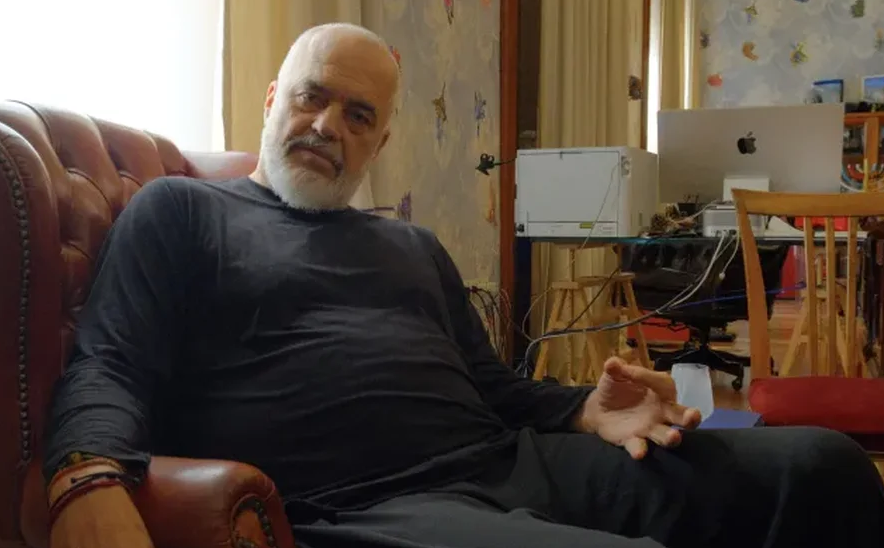
Prime Minister Edi Rama, during an interview with the Belgian media outlet UnHerd, commented on the protests, the development project in Zvërnec, the opposition’s accusations of links to organized crime and claims that Albania is a “narco-state”, or the internal clashes in the Socialist Party.
One of the main topics of the interview was the planned project in the Zvërnec area, which has been met with opposition and protests. Rama said that the government has no intention of withdrawing from the project, but announced a consultation process with the community.
The interview also discussed the opposition of some residents to the development of the coastal area. According to the material published by UnHerd, the debate is related to the fact whether this part of the coast should remain public land or be developed through tourism investments.
Rama also recalled previous protests during his government, saying that in one case he withdrew because the protesters, according to him, were right, while in another he chose to open a dialogue with them. According to him, today’s situation has taught the government some things, but it will not lead to withdrawal from the Zvërnec project.
Meanwhile, Rama also commented on the clashes with former Foreign Minister Elisa Spiropali, saying that they are internal issues of the Socialist Party. The head of government was also asked about the Aruba meeting and the accusations of connections between government figures and people suspected of drug trafficking at this meeting, while Rama asked for concrete evidence.
“Where is it? Who, where? Where is the photo? Where is the document? Where are the tickets? Where, where?” he replied. “Then how would you respond,” he added, pointing at me, “for example, an accusation that you were with some drug traffickers yesterday in the hotel where you are sleeping. How do you respond to that?”, the interview states.
Excerpt from Prime Minister Rama’s interview:
The PPNEA’s wish is for the beach and the rest of the coastline to remain public land, as it has been since the time of King Zog’s Kingdom of Albania. But it is a highly marketable commodity, as much for those who have cultivated it for generations as for the Kushner family. And it is not clear whether the villagers themselves want the land to remain undeveloped, rather than benefiting from the tourism boom they believe the Shehu has stolen from them. In nearby Vlora, local opinion is significantly more in favor of the Kushner project. “These people [in Zvërnec] are stupid,” a taxi driver in Vlora told me. “They don’t want to move forward, but it is one of the biggest investments in Europe. It will be very good for our city. I just hope it is as they say and Israel doesn’t build a base there,” he added. However, he told me that he supports the Tirana protests “because they are about high prices. Albania is still a very poor and very corrupt country.” I asked him who he voted for. “Rama, of course,” he said, looking at me as if I had asked an idiotic question, “Edi Rama every time.”
For Rama himself, who was re-elected a little over a year ago for a fourth term, the protests have come as a shock. In the recently published “Besa” strategic document, whose name alludes to the unbreakable oath central to traditional Albanian culture, Rama’s government declared that the “flamingo boulevard” represented “a mirror that society held before us” and proof that “more and more Albanians, including the older ones, no longer compare the Albania we have with what we had in 2013, but only with what they themselves believe Albania can and should be.” Much of Besa’s document seems to rely on de Tocqueville’s observation that the most dangerous moment for any regime is when the rising expectations stemming from reforms already undertaken make any remaining injustices seem intolerable. “The citizen who has more than yesterday,” the authors of the strategy write, “is a more dissatisfied citizen. Precisely because they live better today than yesterday, they also believe that their country is capable of doing much more than it does today.” In a recent open letter, former Socialist Party member and Rama loyalist Elisa Spiropali, who was recently dismissed from her role as Minister for Europe, declared that the protests represent a “political and social mobilization, especially among the younger generation, that cannot be ignored without consequences.” In what can only be read as a criticism of Rama’s style of governance, Spiropali asserted that Albania requires “not more personalization of power, but institutions stronger than individuals”, “more humility, less arrogance”, “more representation and less concentration of decision-making”, to build “a state where the law stands above power and where power is not identified with any single person”.
When I asked Edi Rama whether Spiropali’s open letter exposed internal disagreements within the Socialist Party, he closed the question. “This is a very internal, internal thing,” he said. “And we should keep it to ourselves because I don’t think we should export our internal things outside to the audience, because then it becomes like feeding curiosity, feeding curious things, an audience that is not at all inside the story, uninformed or anything.” But the opposition had no such concerns, I replied, adding that Berisha had made very specific accusations that political figures within Rama’s inner circle had participated in the Aruba meeting with suspected drug trafficker Artur Shehu, and that the government had unsavory connections with organized crime bosses. “Where is it? Who, where? Where is the photo? Where is the document? Where are the tickets? Where, where?” he replied. “Then, how would you respond,” he added, pointing at me, “for example, an accusation that you were with some drug traffickers yesterday at the hotel where you are sleeping. How do you respond to that?”
Rama rejects the idea that Albania is a narco-state.
He continued, “Yes, opposition figures can tell you a lot of things, but it’s not my job to tell you whether we are connected or not, it’s their job to prove that we are connected or not, because I am truly disgusted by the years that in this country… that the burden of proof has shifted to those who were accused.” Asked about the opposition’s characterization of Albania as a narco-state, Rama completely rejected the idea. “You can say whatever you want. But a ‘narco-state’, a narco-state that started closing the chapters of negotiations with the EU? It doesn’t fit in any way shape or form. If Albania has problems with corruption, Albania has never fought corruption like it has in these years. If Albania has problems with crime, Albania has never fought crime like it has in these years. And when it comes to crime, I’m telling you, we pay a big price in the Balkans, for the fact that people from the Balkans are very active in organized crime. Abroad. But the crime industry is not here. It’s there.”
Referring to the fact that I am a journalist, he added: “You know narco-states, I think, how they feel, you know poor corrupt countries, how they feel, you know middle-income countries, how they feel. I don’t think you need me or anyone else to tell you what kind of country you are in, with all the good and the bad… It doesn’t feel unsafe, it doesn’t feel like a poor country, you don’t feel all these things.”
I asked Rama if, having secured his place as one of the most important figures in Albanian history, he worried that an escalation of the protests might damage his legacy. “No, how can protests threaten a legacy?” he said. “I like the pressure.” He had faced two previous waves of protests, he told me, perhaps bigger than today’s, in 2013, shortly after he came to power, and also in 2018. “When it came to the first one, I backed off because they were right. They had a very strong point. I said, you’re right, we’ll stop. And that’s it, they got what they wanted. The second time, I didn’t back off. But I started a conversation with them and we did some good things. This time, I learned things, so we won’t back off the [Zvërnec] project, for sure. But we’ll do a [consultation] process.” In the end, he added, “I strongly believe that the project will completely close this chapter because it will be beautiful.”