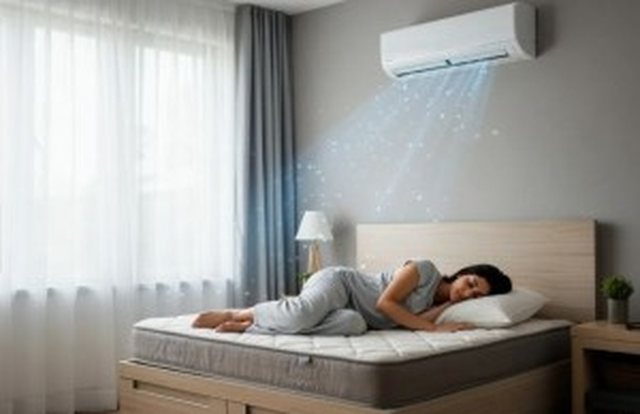
On hot summer nights, air conditioning can be an important aid to sleeping more comfortably. But its incorrect use can bring the opposite: a feeling of cold, dryness, and irritation in the nose and throat, affecting the quality of sleep.
The goal is not to make the room too cold, but to create a cool and comfortable environment. Too low temperatures, cold air constantly directed at the body, and lack of maintenance of the device are some of the mistakes to avoid.
1 Do not lower the temperature to the extreme
When temperatures outside are very high, it is not necessary to set the air conditioner to 18 or 20°C.
A very large difference between the outside and inside temperatures can create a strong feeling of cold and discomfort. The goal should be a cool and comfortable room for sleeping, not an excessively cold environment.
2 Do not direct cold air at the body
The airflow should not be directed directly at the face, neck or body during sleep.
You can adjust the direction of the louvers so that air circulates in the rest of the room, without constantly falling on the bed.
3 Cool down the room before going to bed
A practical way is to turn on the air conditioner shortly before bedtime, so that the room temperature gradually decreases.
Then, depending on the temperature and ambient conditions, you can increase the temperature, activate sleep mode, or program the device to turn off after a while.
4 Don’t neglect cleaning the filters
An air conditioner that is used every day needs regular maintenance. The filters collect dust and other particles and, if not cleaned, can affect the air quality.
Cleaning should be done according to the manufacturer’s instructions, especially in homes where people with allergies or respiratory sensitivities live.
5 Use the timer or sleep mode
It is not necessary for the air conditioner to operate at the same intensity throughout the night.
Many modern devices have a “Sleep” function or timer, which can be used to gradually adjust the operation of the air conditioner and avoid excessive cooling of the room during the night hours.
Air conditioning is not necessarily the problem
The use of the air conditioner itself is not the only reason for sleep disturbances. The problem can be related to the temperature being too low, the constant flow of cold air over the body, or poor maintenance of the device.
On very hot nights, a cool environment can be especially important for people most sensitive to high temperatures, including the elderly and young children.
In the end, the key is moderation: a cool and comfortable room, without extreme temperatures and without direct airflow over the body, can create better conditions for a restful sleep.