Every time summer comes, the debate about tourism heats up in Albania as quickly as the asphalt at noon. Are the tents empty or not?
Are hotels filling up or are they waiting for last-minute bookings? Have tourists from Kosovo returned, or are they choosing other destinations again?
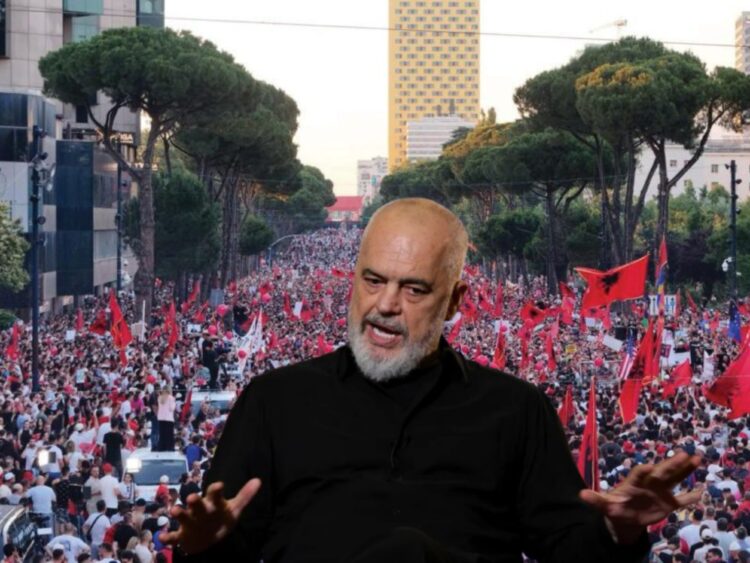
Are prices driving away vacationers, or is their profile simply changing? This year, another question has been added: are protests driving away tourists?
Since 2022, tourism has become one of the main pillars of the Albanian economy. The accommodation and food service activity now contributes almost 5.5% of the Gross Domestic Product, up from around 2% in 2015.
But the impact is even broader. Transportation, trade, construction, food, financial services, and daily rentals are increasingly linked to the tourist influx.
In an economy hit by immigration, consumption by foreigners has partially replaced the consumption the country has lost to emigration and an aging population. This makes any tourism fluctuations more important than before.
The beginning of this year was weak for the influx of foreign nationals into the country, also affected by bad weather. March and May brought improvement, culminating in May with an increase of about 16% in the number of nationals entering the country.
June figures show a significant slowdown, with an annual growth of only 1.3%.
It is possible that uncertainty, images of rallies, and international news may have influenced the decision-making of some tourists in June.
If they last, we must wait and see how the next few months go.
In Serbia, for example, from the beginning of 2026 to the end of May, Serbia recorded 1.7 million tourist arrivals and 4.8 million overnight stays, with an increase of 7.9% and 5.7%, respectively, compared to the same period in 2025, according to data from the Statistical Office of the Republic of Serbia, analyzed by ATIS.
In fact, beyond the protests, the focus should be on those long-term factors that are silently preventing tourism from turning from a numbers story into a sustainable industry.
The first obstacle is traffic, linked to poor infrastructure and the endless delays in the construction of main and secondary roads.
Tourism is growing faster than the roads that are supposed to support it. The axes towards Durrës, Golem, Lalëz Bay, the North and the Southeast turn into waiting corridors on weekends.
The North and Central regions hold about 63% of visitors to accommodation facilities, but face repeated congestion in key segments. Travel becomes the most tiring part of the holiday, while for businesses, traffic translates into delays, costs and lost customers.
The second obstacle is the loss of the image that initially attracted tourists. Albania was successfully advertised as a “hidden gem”: a yet undiscovered destination, with hidden beaches, untouched nature and lower prices than the traditional Mediterranean.
But tourists who come to find a hidden gem are increasingly confronted with cranes, concrete, unfinished construction and a coastline that changes from one season to the next.
Even in international travel forums, alongside positive reviews of nature and hospitality, complaints about roads, traffic, waste, and construction sites appear.
Some visitors describe Albania as a place where “half of it looks like a construction site,” while others note the contrast between the marketing of untouched nature and large projects near tourist areas.
These are individual testimonies and not statistical measurements, but they show that the image being sold and the experience on the ground are moving away from each other. Even the government itself was forced to make the decision to stop construction during the summer!
The problem is not that prices have increased. This is an almost inevitable phase for any destination experiencing a tourist boom.
Spain and Portugal have also experienced strong price increases, pressure on housing and dissatisfaction among residents. The problem is when price increases are not accompanied by increases in quality, infrastructure and service.
A destination can lose its price advantage and still remain competitive if it offers value. But it cannot charge Mediterranean prices with chaotic traffic, waste, polluted waters, overcrowded beaches, and ongoing construction in the height of the season.
Capacity can grow faster than demand, especially when the destination itself loses what made it attractive. And therein lies the biggest risk: Albania could sacrifice nature to build tourism and, in the end, lose the very reason why tourists came in the first place.
A balance must be maintained between the interests of investors, the well-being of residents, and the protection of the territory. Tourism cannot grow by driving locals out of the housing market, making cities unlivable, and turning the coast into an endless strip of concrete.
Tourism is not only hindered by protests, weather, or prices. The biggest obstacle is the lack of a model that knows where to build, how much to build, and what to preserve.
Otherwise, the hotels, resorts and apartments that are being built today as a promise of a tourist Albania may remain tomorrow as empty skeletons along the coast, monuments to a boom that forgot that tourists come for nature, but leave when it is no longer there./ Monitor