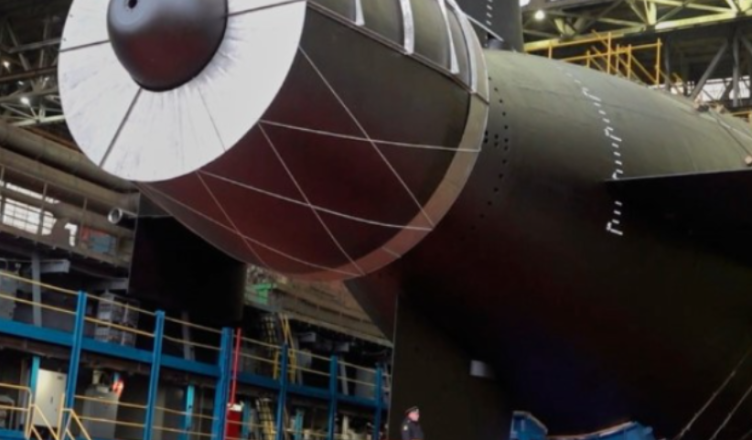
Without fanfare and without an official announcement from Moscow, one of Russia’s most mysterious new submarines has reportedly put to sea for the first time.
The Khabarovsk, a special-purpose nuclear-powered submarine designed to carry the infamous Poseidon nuclear torpedoes, was seen leaving Severodvinsk in mid-August for its first sea trials in the White Sea. Russian military blogs date its first appearance to August 16 or 17.
Military analysts and Western intelligence agencies are closely monitoring the development because the roughly 10,000-ton submarine was originally built to carry one of the most controversial weapons in the Russian nuclear arsenal.
According to what is known, it can hold up to six Poseidons.
What is Poseidon?
The Poseidon is not a conventional torpedo. Essentially, it is an autonomous nuclear-powered underwater vehicle, capable of carrying a nuclear warhead and traveling vast distances without a crew.
Its exact operational capabilities remain a secret. According to the Telegraph, it is said to have a range of more than 6,000 miles, about 9,600 kilometers, and can operate at depths of up to about 1,000 meters.
The theory behind this weapon is that it could be launched far from its target and move autonomously beneath the sea surface, before detonating its nuclear warhead near coastal installations.
Moscow has repeatedly claimed that such an explosion could cause a destructive wave on enemy shores. However, the exact magnitude of such an effect is the subject of heated debate among experts.
Vladimir Solovyov, one of the most popular presenters on Russian state television, called on Vladimir Putin to use Poseidon against Britain, following London’s support for Ukraine and the use of British technology in Ukrainian attacks deep into Russian territory.
Solovyov specifically suggested giving the British “three days” to learn to breathe underwater before hitting them with Poseidon.
Meanwhile, the Russian embassy in London has warned that the more British aid to Kiev increases, the greater the “price” Britain will pay. Prime Minister Andy Burnham has dismissed the threats, reiterating that London will not abandon its support for Ukraine.
How real is the threat?
Despite the terrifying image that accompanies Poseidon, experts who spoke to the Telegraph consider it extremely unlikely that Russia would use such a weapon outside of a nuclear war that is already underway.
Richard Connolly, an expert on Russian defense policy and a fellow at the Royal United Services Institute (RUSI), describes Poseidon as a specialized capability that is not produced in large numbers and is designed for the most extreme scenarios.
A Russian nuclear attack on Britain would activate the possibility of nuclear retaliation through the British Trident system, which acts as a key deterrent.
For William Alberg, a former NATO and US arms control official, Poseidon’s particular value also lies in the uncertainty it creates. Such a weapon could theoretically remain at sea for a long time, serving as a means of second-strike nuclear weapons, but also as a tool for psychological pressure.
According to the analysis, possible targets would be American, British or French nuclear submarine bases.
Can NATO detect it?
However, it remains unknown how “invisible” Poseidon actually is.
At high speeds, the disturbance it causes in the water could theoretically make it distinguishable from NATO sonar systems, anti-submarine warfare frigates, aircraft, and other submarines.
There is also the question of how effectively its small nuclear reactor is protected. If it leaves a strong thermal or other detectable trace, its operational value is significantly reduced. Experts acknowledge that there is currently not enough public information to draw a firm conclusion.
The roots of the idea go back to the 1950s, when Soviet scientists were considering ways to transport a hydrogen bomb to a point near the American coast, where it would explode, causing a tsunami capable, in theory, of destroying entire cities or naval bases.
Soviet designers eventually abandoned the idea, deeming it impractical. The military leadership even doubted whether such a weapon could get close enough to the American coast to be used effectively. At the time, it was technically impossible to incorporate a nuclear reactor into a torpedo, which limited its range to 20 to 30 miles.
However, in the early 2000s, Russian officials revived the idea as concerns grew that the United States was developing anti-ballistic missile defense systems that could limit or even neutralize the effectiveness of Russian intercontinental ballistic missiles.
In response, Russia developed the Poseidon missile, as well as a nuclear-powered cruise missile known as Skyfall, designed to fly over the South Pole to bypass US missile defenses. The goal was to ensure that Moscow would retain the ability to retaliate with a nuclear strike in any event.
To date, Russia has announced plans to purchase at least 30 Poseidon torpedoes and four submarines that can carry them, although so far only the Khabarovsk is believed to have been built under this program.
At the same time, an older submarine, the “Belgorod”, has also been specially modified to be able to carry these weapons, which NATO has assigned the codename “Kanyon”.
Theoretically, these low-visibility submarines could launch the Poseidon ship into the sea and then have the autonomous underwater vehicle – a hybrid of drone and torpedo – move slowly and autonomously towards a pre-determined target.