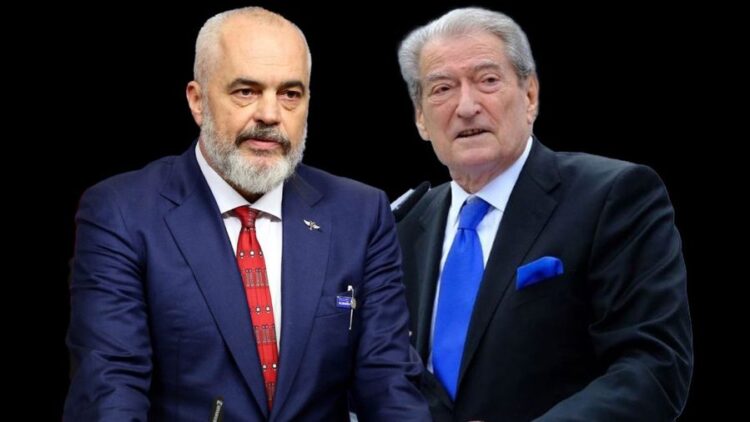
Sali Berisha has reacted on Facebook to problematic issues in the country, focusing mainly on corruption. Berisha accuses Prime Minister Edi Rama of fraud.
Berisha also focused on Albanian-Russian relations, while asking the question: Why this repeated deception by Rama about “zero relations” between Tirana and Moscow in the last 66 years? What forces this man to appear as a clown even in international audiences, to humiliate himself by repeating his deception, his banal denial, so often?
Full reaction:
What is Edi Rama hiding with “zero Albanian-Russian relations” in 66 years?
By Sali Berisha
Embarrassed for his pro-Russian initiatives, Rama, in self-defense, is now suffering from denial syndrome.
Edi Rama has become a joke with his public, national and international deceptions, and it is really not worth dwelling on their endless series. However, I will focus on just one of them, which has already become a syndrome for him.
It is about his repeated deception whenever he gives advice to Europe about Russia at international conferences, according to which Albania and Russia, since the 1960s – the time of the interruption of diplomatic relations by dictator Hoxha with the Soviet Union until today, that is, in 66 years – have not exchanged a single visit by their officials.
Albanian-Russian relations are a matter for historians. They have been entirely determined by Russia’s centuries-old ambition for the Balkans and its access to the waters of the Adriatic. This ambition has also predetermined its attitudes towards Albanians. Surprisingly, Russia was one of the two great powers of the time that signed in Budapest with Austria-Hungary in the 1870s (during the Eastern Crisis) an agreement for the creation of the Albanian state; a signature that was erased before the ink had dried.
Since then, with the exception of the year of the Fan Noli government and the 15 years after World War II, in other periods Russia’s positions have been entirely against the very existence of the Albanian state. After World War II, the Kremlin was in favor of the absorption of Albania by Yugoslavia, just as over the past decades it has been extremely against the independent state of Kosovo.
In 1960, Enver Hoxha, after a period of vassalage, severed diplomatic relations with the Soviet Union. However, after the restoration of these relations in 1990 and onwards, quite contrary to Edi Rama’s denials, there have been exchanges of visits at the highest levels between the two countries.
Moscow and Tirana have hosted and seen off presidents (Alfred Moisiu was even decorated by Putin), parliament speakers and vice-speakers, and prime ministers – including Edi Rama himself accompanied by Baton Haxhia. Russian Foreign Minister Sergey Lavrov visited Tirana in 2004, where he signed the Friendship Treaty.
Relations between the two countries have also included other areas. I had the opportunity to host the famous Russian poet Yevgeny Jeftushenko in Tirana. Rama himself hosted Patriarch Kirill (a former member of the KGB) in Tirana, and after the “McGonigal” scandal broke, it came to light that the Russian oligarch Oleg Deripaska was operating in Albania with 7 companies, in collaboration with Rama’s oligarchs.
Why then this repeated deception by Rama about Tirana’s “zero relations” with Moscow in the last 66 years? What compels this man to appear as a clown even in international audiences, to humiliate himself by repeating his deception, his banal denial, so often?
He does not suffer from retrograde amnesia (in this case selective). I also do not believe that this denial can be related to the fact that, according to official documents signed by Nexhmije Hoxha’s former deputy, Kristaq Rama, his father, Rama has a brother in Moscow who he never speaks of.
The cause of this repeated deception, now transformed into a denial syndrome, whenever he advises Europe about Russia lies first and foremost in the pairing of Edi Rama with his master Aleksandar Vučić, as two main initiators of projects, open structured initiatives to guarantee Russian influence in the region. The first is understood to be on behalf of Greater Serbia, a joint Serbian-Russian project, while the second is on behalf of his master.
Let’s briefly analyze these initiatives:
1-Changing borders and the division of Kosovo:
Edi Rama, immediately after coming to power, became part of Vučić’s project for “territorial exchange” (de facto partition of Kosovo), signed and sealed by the Soros Foundation in Belgrade. This was actually Slobodan Milošević’s project of the 1990s, for a Greater Serbia, sent several times through intermediaries to my office, but categorically rejected by the Albanian side. Rama and Vučić openly claimed that the project would be approved by Putin as well, as if they were his spokesmen or had secret communication with the Kremlin.
2-Open Balkans:
After the failure of the “Greater Serbia” project, Rama and Vučić established in Novi Sad (2019) the “Balkan Mini-Schengen”, later christened the “Open Balkans”. This project de facto returned Serbia’s political and economic hegemony in the region, and consequently, that of Russia. This initiative, which openly opposed the Berlin Process, was strongly supported by the Kremlin. In June 2022, a day after Lavrov’s visit to Belgrade was canceled due to the airspace blockade by NATO member states, Lavrov himself stated that the purpose of the visit was to consolidate strategic cooperation with Serbia and support for the “Open Balkans”, which according to him was completely different from the closed Balkans of Brussels and NATO. After the decisive and ultimate intervention of the EU, this initiative was annihilated, and Rama was forced to make a sharp U-turn, suddenly canceling the troika meeting in Durrës in July 2023.
3-International Conference on Kosovo:
Even after the failure with the Open Balkans, the Rama-Vučić duo did not give up on their common pro-Russian agenda.
In an open service to Russia, they came up with the thesis of calling an international conference on Kosovo, with the sole purpose of officially restoring Russia as a leading factor in the Balkans. This demand was repeated by both of them in synchrony two hours after the terrorist act in Banjska, Serbia. This implied that that act of aggression, successfully neutralized by Kosovo law enforcement authorities, had been undertaken precisely to create widespread destabilization that would force the intervention of an international format in which Russia would have a seat.
4-Belgrade’s stance on sanctions against Russia.
The Russian aggression against Ukraine clearly exposed the Vučić-Rama binomial as two powerful and registered assets of the Kremlin in the Balkans. In this context, the Serbian president refused to implement EU and NATO sanctions against Russia and transformed Serbia, Little Russia, into a powerful rearguard of Russia in the heart of Europe. Meanwhile, his vassal, the Prime Minister of Albania, Edi Rama, immediately became the main advocate of this position and this rearguard.
He used the privilege of being the prime minister of a NATO member country to openly defend Russian interests in the region at Alliance and EU summits, removing all masks and openly supporting his boss Vučić’s decision not to implement sanctions against Russia. Rama insisted that Belgrade should not have been asked to implement sanctions against Big Brother and that pressuring him on this issue was a “mistake”. After NATO and the EU issued Belgrade the “red card” for not implementing sanctions, the boss and the employee remained silent.
Finally, in a new display of his role as a global charlatan, Edi Rama dares to attack Europe in Estonia for not speaking to “Vladimir Vladimirovich” – addressing Putin with such linguistic affinity as if he were an official of the Russian administration.
In conclusion, we can say that Edi Rama, after exposing himself as a defender of Serbian-Russian interests in the region, is hastening to put on the mask of ridiculous denial, inventing a story with “zero 66-year relations” between Tirana and Moscow. So this is not just an ordinary deception; it is a desperate attempt by him to hide the traces of a pro-Russian agenda that has severely damaged the national interests of Albania and Kosovo, and even Euro-Atlantic interests in the service of the geopolitical ambitions of Belgrade and Moscow in the region.