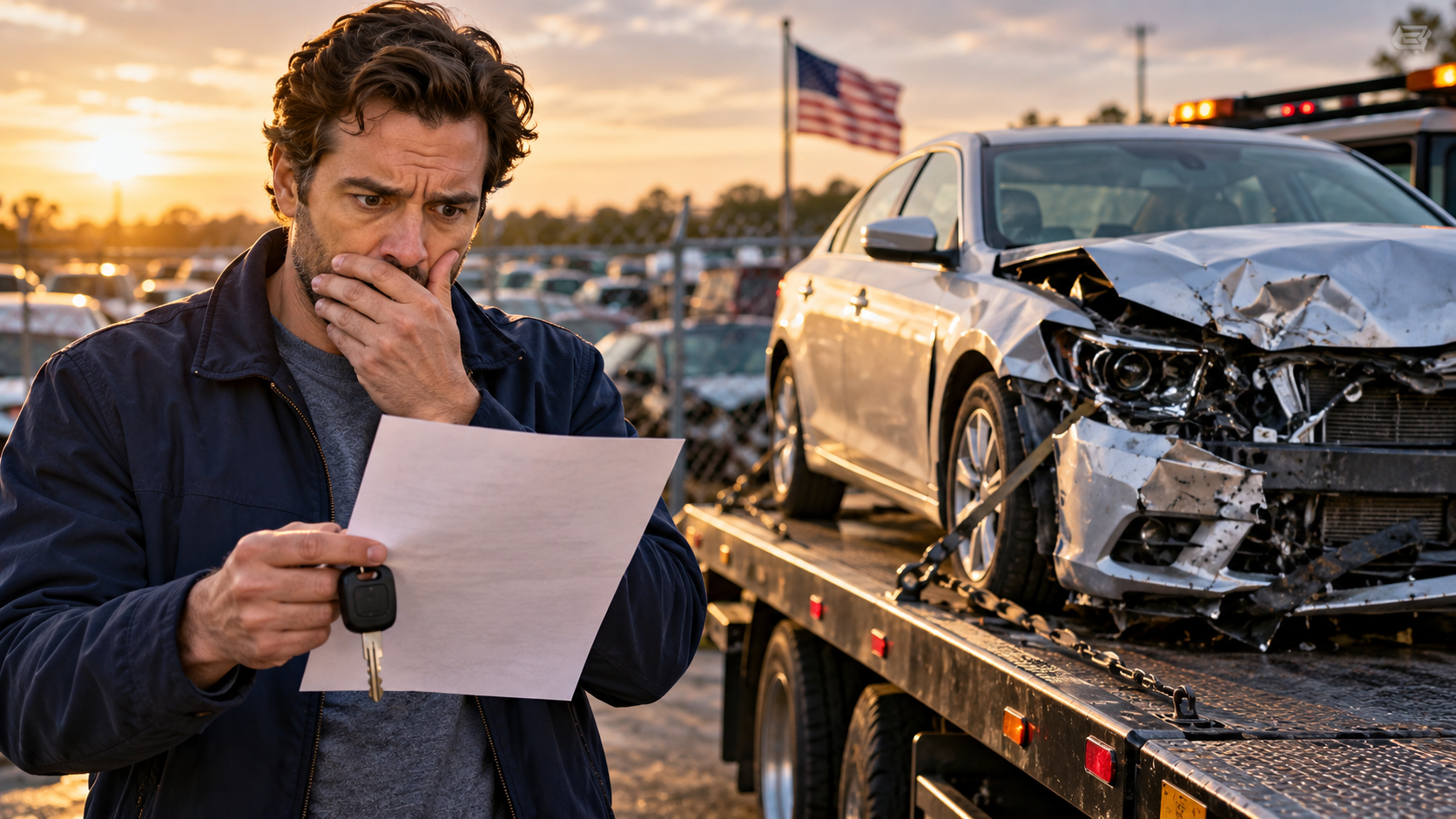
Imagine buying a car in America for $35,000, making your monthly payments on time, and then getting into an accident.
Your insurance company determines that the vehicle is a total loss. You assume the insurance payment will eliminate your remaining auto loan.
But a few days later, you discover something unexpected: you may still owe thousands of dollars to your lender, even though you no longer have the car.
This situation can affect drivers across the United States, including Albanian families living in New York, New Jersey, Connecticut and other states.
Understanding how auto insurance settlements and car loans work can help drivers avoid a costly financial surprise.
1. What Does “Total Loss” Mean?
A vehicle may be declared a total loss when an insurance company determines that repairing it is not economically reasonable or when applicable state rules require that classification.
The decision generally involves the vehicle’s value, repair costs and other relevant factors.
A car does not necessarily have to be completely destroyed to qualify as a total loss.
2. Why Insurance May Not Pay Your Full Loan
For a covered total-loss claim, an auto insurer generally bases its settlement on the vehicle’s actual cash value, subject to policy terms, deductibles and applicable rules.
Actual cash value reflects what the vehicle was worth immediately before the loss.
It is not necessarily the same as the amount the driver originally paid.
It is also not necessarily equal to the remaining auto loan balance.
3. A $35,000 Car Loan Example
Imagine a driver purchased a vehicle using financing.
At the time of an accident, the driver still owes $28,000 on the auto loan.
The insurance company determines that the vehicle’s actual cash value is $23,000.
Assume the policy has a $1,000 deductible and that the covered settlement is therefore $22,000.
| Financial detail | Amount |
|---|---|
| Remaining auto loan | $28,000 |
| Vehicle’s actual cash value | $23,000 |
| Insurance deductible | $1,000 |
| Insurance settlement | $22,000 |
| Potential remaining loan balance | $6,000 |
In this hypothetical example, the driver could still owe approximately $6,000, even after the insurance settlement is applied to the loan.
Actual results depend on the insurance contract, lender agreement and other circumstances.
4. What Is GAP Insurance?
Guaranteed Asset Protection, commonly known as GAP, is a product designed to address certain differences between an outstanding vehicle loan or lease balance and the amount paid following a covered total loss.
Depending on the contract, GAP coverage or a GAP waiver may cover some or all of an eligible shortfall.
However, GAP products have exclusions, limits and other conditions.
They do not necessarily cover every remaining dollar owed.
5. Does GAP Insurance Cover Your Deductible?
Some GAP products may address an insurance deductible up to a specified limit, while others may not.
Coverage depends on the particular policy or waiver.
Drivers should review their contracts rather than assume the deductible is included.
They should also check whether overdue payments, fees or other amounts are excluded.
6. Why New Cars Can Create This Risk
Vehicles can lose value after purchase.
At the same time, a loan balance may decline relatively slowly, especially when a borrower chooses a long repayment term or makes a small down payment.
This can create negative equity, meaning the driver owes more than the vehicle is worth.
Negative equity can increase the financial consequences of a total loss.
7. What If You Have a 72-Month Auto Loan?
Longer loan terms can reduce monthly payments, but they may also increase the amount of time a borrower carries a substantial balance.
For example, financing a vehicle over 72 months instead of 48 months generally spreads repayment across a longer period.
Depending on the interest rate and other loan terms, the borrower may pay more total interest.
A lower monthly payment does not automatically mean the loan is less expensive overall.
8. What Happens After the Accident?
When a financed vehicle is declared a total loss, the insurance settlement may be paid directly to the lender or jointly to the borrower and lender, depending on the circumstances.
If the settlement does not fully satisfy the loan, the borrower may remain responsible for the unpaid balance.
Drivers should continue communicating with their lenders until they receive confirmation that the loan has been resolved.
9. Can You Dispute the Vehicle’s Value?
Drivers who believe an insurer has undervalued their vehicle may be able to challenge the valuation.
Useful information may include the vehicle’s mileage, condition, equipment and comparable vehicle prices.
The insurer’s valuation process and the policy’s dispute procedures may provide a way to request reconsideration.
A higher valuation is not guaranteed.
10. What If You Never Purchased GAP?
A driver without GAP protection may still have options for managing an unpaid loan balance.
For example, the borrower can contact the lender to discuss the remaining amount and available repayment arrangements.
However, the lender is not automatically required to forgive the difference simply because the vehicle was totaled.
The loan agreement and applicable law determine the borrower’s obligations.
11. Check for Refunds on Unused Products
Some auto loans include financed optional products, such as extended service contracts or other add-ons.
If a vehicle is totaled and an associated product is canceled, the borrower may qualify for a refund of an unused portion, depending on the contract and applicable law.
Refunds may be applied to the loan balance rather than paid directly to the consumer.
Drivers should review their purchase documents and ask the provider or lender about cancellation procedures.
12. Why This Matters for Albanian Families
For many Albanian households in America, a vehicle is essential for commuting, family responsibilities and everyday transportation.
Losing a car can create immediate practical problems.
But when a loan balance remains after an insurance settlement, the family may face two financial challenges at once: paying an old loan and finding replacement transportation.
Understanding this possibility before buying a vehicle can help consumers compare financing and protection options more carefully.
13. What Should You Check Before Buying a Car?
Before signing an auto loan agreement, consumers should review the vehicle price, down payment, APR, repayment term and total financing cost.
They should also consider how quickly the loan balance will decline compared with the vehicle’s expected depreciation.
If offered GAP coverage, borrowers can compare its price, benefits, exclusions and cancellation terms.
GAP is not automatically necessary or beneficial for every borrower.
14. The Question Every Driver Should Ask
Many drivers focus on whether their monthly car payment is affordable.
But there is another question worth considering:
“If my car were totaled tomorrow, would my insurance settlement be enough to pay off my remaining loan?”
For some drivers, the answer could reveal a financial risk they had not previously considered.
Disclaimer: This article is for general educational purposes only and does not constitute personalized insurance, legal, lending or financial advice. Insurance settlements, GAP coverage, vehicle valuations and loan obligations depend on contract terms and individual circumstances. All examples are hypothetical.