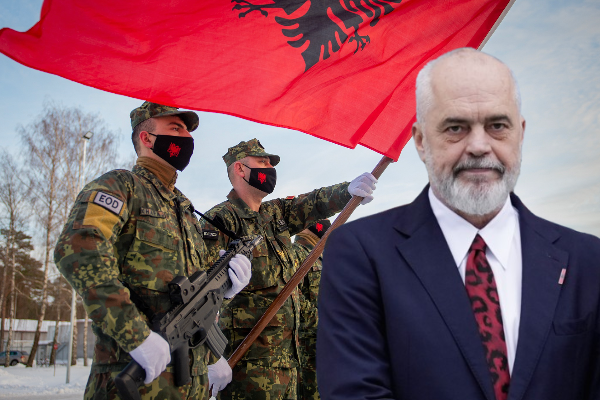
The approval of the $302 million loan agreement for the modernization of the Armed Forces with the United States of America, in addition to the procedural debate that ended in the Constitutional Court by the Democratic Party, also sparked discussions on Albania’s obligations to NATO.
Last week, the chairman of the Democratic Party Parliamentary Group, Gazment Bardhi, reiterated several times that the government led by Edi Rama has not fulfilled Albania’s commitments to NATO for years.
Factchecking shows that the claim is accurate regarding the failure to meet NATO’s key financial commitment, that of spending at least 2% of Gross Domestic Product on defense.
Albania did not reach NATO’s 2% target
Faktoje analyzed the defense budget since 2009, the year of Albania’s NATO membership, to provide a complete overview of spending since the Democrat government until this year.
As can be seen from the graph, since joining NATO 17 years ago, Albania has had difficulty reaching the defense spending threshold required by the Alliance.

During the democratic government (2009–2013), the year with the highest defense spending was the year of accession, with 21 billion lek. Then the spending decreased to 20 billion lek and in 2013 when the democrats lost power to 19 billion lek. After 2013, the defense budget was again not a priority. According to calculations, the first three years of the socialist government with the LSI the budget for the Ministry of Defense was lower than during the time of the democrats.
Gradual growth begins in 2017, but budget support for defense begins to become significant after 2021.

Following the Russian invasion of Ukraine in 2022, international pressure mounted when NATO called on member states to increase defense spending. According to NATO’s assessment, the minimum target was for defense spending to be at least 2% of national output.
Data over the years shows that neither during Sali Berisha’s government nor during most of Edi Rama’s government, Albania did not reach the threshold of 2% of GDP for defense.
In fact, in June of this year, NATO Secretary General Mark Rutte stated that Albania was among the countries that had not met the required threshold during the previous year.
Budget increase after pressure from the Alliance
Rutte’s statement came a few days before the NATO summit in Ankara and followed Reuters reporting that had previously questioned the organization of the 2027 NATO summit in Albania due to the level of military spending.
In a response to Faktoje, an Alliance spokesperson confirmed Secretary General Mark Rutte’s statement that Albania, the Czech Republic and Slovenia had not reached the 2% target by 2025, although the difference was considered relatively small in relation to the Alliance’s total budget.
Thus, on June 30, 2026, the Albanian government approved a normative act amending the State Budget. The budget of the Ministry of Defense for 2026 was increased by:
-58.9 billion lek , according to the initial plan
-to 69.2 billion lek after the budget change.
The increase was over 10.2 billion lek, or about 17.5% more than the initial forecast. The government admitted that the reason for the change was the Alliance. Prime Minister Edi Rama linked this increase to Albania’s commitments to NATO and the need to strengthen defense capacities. At the end of the summit in Ankara, Mark Rutte confirmed that the next NATO summit will take place in Albania, while the date remains to be determined.
allegation
“For years, the Albanian government under the leadership of Edi Rama did not fulfill Albania’s commitments to NATO” – Gazment Bardhi, chairman of the Democratic Party Parliamentary Group.
With this budget addition, the target of 2% of GDP was exceeded.
cONcluSiON
The statement by the head of the DP group, Gazment Bardhi, that the government led by Edi Rama has not fulfilled Albania’s commitments to NATO for years is true, referring to the Alliance’s main financial objective for defense spending.
Data shows that Albania has not reached the 2% of GDP threshold for defense during most of Rama’s government period and has only significantly increased funding for this sector in recent years.
But there are differences in the way the spending is calculated. Calculations based only on the budget of the Ministry of Defense and Albanian GDP show that by 2025 the 2% target has been reached. Meanwhile, NATO uses a broader methodology, which also includes other categories of defense spending, such as military pensions and contributions to international operations. It is precisely according to this methodology that Albania remained below the 2% target last year.
/Esmeralda Topi – Fact