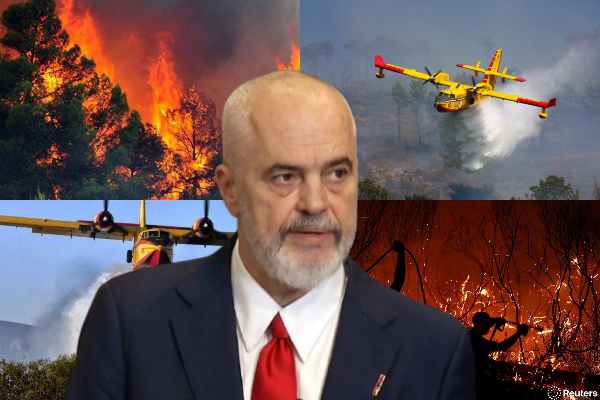
A week ago, Prime Minister Edi Rama promised that Albania would have two or three firefighting aircraft by the end of 2026. Just yesterday, he presented through a video on his social networks the first Albanian firefighting aircraft, the Air Tractor, a specialized aircraft with a turboprop engine, designed primarily for use in agriculture, spraying and treating agricultural crops from the air, as well as in fighting fires.
But this is not the first promise!
Since January 2023, the government has promised to purchase firefighting aircraft. During the 2025 election campaign, Rama declared that two aircraft would be available by the summer of that year. In December 2025, the prime minister said that the aircraft had been ordered. Now the deadline has been postponed again, this time to the end of 2026.
While promises continue to be repeated and Albania, for the first time, is adding to its firefighting fleet a limited-capacity aircraft, unlike the Canadair aircraft used by civil emergency services in neighboring countries and the European Union. Meanwhile, fires continue to engulf forests, pastures and other areas of the country.
From June 22 to early July of this year alone, 160 fires were recorded across the country.
According to data from the director of the National Civil Protection Agency, Haki Çako, 127 cases involved vegetation, bushes, thorns, forests and urban waste, while 33 were urban fires.
The extent of the damage is also shown in satellite data. According to mapping by the European Forest Fire Information System (EFFIS), around 46,600 hectares of territory burned in Albania during 2024.
Albania continues to face the same problem every year: more post-fire management than investment in prevention.
What makes the situation problematic is the analysis of the causes of fires.
High temperatures, drought, and wind are natural factors that affect the spread of fires. However, they are not the source of ignition. They are simply the elements that make a small fire turn into a massive fire.
Fire expert Fatmir Taraj explains that the analysis of a fire must be based on three elements:
-the source of ignition;
-factors that help spread;
-operational capacities to bring the fire under control.
“Extreme temperatures create the ideal environment for fires to spread, but human activity remains the main cause of their start,” says Taraj.
So, the biggest cause remains human hands.
Sources of ignition, according to Taraj, are mainly human. They include burning waste, agricultural work, cigarettes, mechanical sparks, defects in electrical lines and deliberate arsons.
ACQJ contacted the National Civil Protection Agency through an official request for information, which acknowledges that human activity constitutes one of the main sources of risk.
In the official response, AKMC cites negligence, uncontrolled agricultural burns, accidents, and deliberate arson as possible sources of ignition.
The State Police, on the other hand, confirmed that fires occur mainly during the months of June, July and August, in areas with forests, pastures, agricultural lands and dense vegetation.
According to the State Police analysis, based on data collected in the field, the most frequently recurring factors are the burning of plant waste, the careless use of open fire, and the deliberate actions of individuals.
From June 1 to July 14, 2026, the State Police reports that 29 people suspected of arson were arrested or prosecuted.
However, this number only shows the number of people arrested or prosecuted, not how many of them have been sent to trial or finally convicted. While the police publish dozens of cases of people prosecuted every season, the state does not provide a public balance sheet showing how many arsonists end up being convicted. As a result, every summer the debate returns to toughening penalties, without first testing whether the existing legislation is being effectively implemented.
Official responses do not provide a clear breakdown of how many fires were caused by negligence, how many by deliberate arson, and how many by technical causes.
AKMC explains that a final determination of the cause requires the consolidation of technical documentation and investigation results for each case. This means that the state does not yet have a complete national picture of the motives, patterns, and areas where arson attacks are recurring.
As a result, cases of deliberate arson continue to be treated individually and not as a phenomenon that requires structured analysis and investigation, especially when they are repeated in the same areas or are subsequently associated with other buildings or interests.
For years, forests have become “fuel” for fires.
A burning hearth spreads much faster when there is dry, unmanaged vegetation in front of it, says expert Fatmir Taraj. He explains that Albania is dominated by seasonal grasses, Mediterranean shrubs, pines and oaks, which during the summer create ideal conditions for the spread of flames.
Responsibility does not only lie with the hand that starts the fire. It also extends to institutions that fail to clear forest areas, maintain access roads, and create protective belts that limit the spread of flames.
Melitjan Nezaj, an expert from the PPNEA organization, says that one of the main problems is related to the structure of the forest massifs themselves.
“The damage does not only affect the plant composition. It also affects wildlife, including critically endangered species, such as the Balkan lynx. Areas like the Munella Natural Park face fires almost every year, endangering the habitats that are being regenerated,” explains Nezaj.
Another phenomenon is related to the abandonment of mountain pastures. The decline in livestock numbers has meant that dry grass is not consumed, but is instead accumulated year after year.
INSTAT data shows a significant contraction in livestock. In 2018, there were 467,318 cattle in Albania. In 2020, the number fell to 362,583, while in 2023 it fell to 263,385. In 2024, around 272,000 heads were registered, while in 2025 around 275,000.
Compared to 2018, the number of cattle in 2025 was about 41% lower.
Also, in 2018 INSTAT registered 1,863,837 woolen heads, mainly sheep.
The decline of livestock farming is not just an economic problem. Fewer sheep, goats and cattle on pastures means less natural clearing of grass and shrubs. In abandoned areas, this vegetation dries out in the summer and turns into fuel.
According to Nezaj, it is precisely this plant mass that feeds fires and contributes to the creation of much larger fires, as happened in the case of Mali i Thatë.
Of course, beyond the damage to nature, habitats, and the danger that these fires pose to residential areas, there is also a considerable financial bill.
One of the questions that the ACQJ addressed to the institutions was how much money was spent last year on fire prevention and extinguishing. However, the official responses failed to provide a national figure, even though this financial bill should have been made public.
AKMC states that the funds are not administered by a single institution. They are divided between ministries, the National Civil Protection Agency, prefectures, municipalities, fire services, the Armed Forces, the State Police, and structures responsible for forests and protected areas.
The law requires central institutions to plan funds for risk reduction and civil protection. Municipalities must also have special funds available for these tasks.
However, analysis of the budgets shows that these funds are not only used for fires. They cover all types of civil emergencies, including floods, earthquakes and rescue operations.
For this reason, AKMC was unable to provide a clear separation between funds used for fire prevention and those used for extinguishing them.
In its official response, the agency acknowledges that producing a national figure requires analyzing budget execution and intervention costs from all responsible institutions.
From the response provided, it appears that such an analysis has not yet been conducted.
One of the areas most affected by fires last year was Vlora. For this reason, ACQJ contacted the Municipality of Vlora to understand what measures have been taken one season later.
The Municipality of Vlora stated that it had planned around 95.6 million lek for civil protection for 2025. This fund included preventive measures, emergency response, a reserve fund, and a contingency fund.
However, this amount was not broken down by expenditure category. It is not known how much was used for firefighting, cleaning up the area, equipment, fuel, and field operations.
The municipality states that during 2025 it had approved a plan for preventing and responding to fires.
However, despite this plan, the structures have faced long operations, personnel fatigue, extreme temperatures, strong winds, and difficulties accessing mountainous areas.
For 2026, the Municipality of Vlora has purchased a firefighting vehicle and two drones for territory monitoring and early detection of fire outbreaks.
Meanwhile, the Ministry of Defense did not respond to ACQJ’s questions regarding the cost of engaging the Armed Forces during the past season, whether current capacities are sufficient, how many times international assistance has been requested, and what investments have been made after 2025.
As a result, there is still no complete national bill of the cost of fires.
AKMC lists a series of national and local documents, such as the national risk assessment, the National Strategy, civil emergency plans, and plans that municipalities must draft.
According to the agency, the implementation of these documents should help in the early identification of fires, the timely activation of structures, limiting the spread of flames, and the protection of life, property, and the environment.
However, the response lacks data on how many municipalities have updated plans, how many of them have tested these plans, and how many of the planned investments have been implemented in practice.
Also, no estimate is given of how many of the 2025 fires could have been prevented if these measures had been fully implemented.
For 2026, AKMC states that monitoring, patrolling, early warning, equipment verification, training, and inter-institutional coordination are being strengthened.
However, 160 fires were recorded during the first weeks of the season alone.
This figure shows that the system continues to be set in motion mainly after the source is created and not before it explodes.
Fire damage invoice
What our observation and research over the years has shown is that Albania still does not know exactly what is lost when a forest area burns.
“A full assessment of the burned areas or, further, the types of habitats affected has never been made,” says Melitjan Nezaj.
According to him, only after the type of habitat is identified can the real extent of the damage be determined.
Although a detailed national assessment by habitat type is lacking, data from the European Forest Fire Information System (EFFIS) clearly shows the extent of the territory burned by the flames. In 2024 alone, the European system mapped around 46,600 hectares burned in Albania.
“When old-growth forests are affected, it takes dozens, even hundreds of years for their ecosystem services to recover,” explains Nezaj.
In some cases, natural regeneration is impossible and requires restorative intervention.
Even expert Fatmir Taraj warns that the consequences do not end when the flames are extinguished.
High temperatures destroy soil organic matter, reduce fertility, and can create an impermeable layer that prevents water from penetrating the soil.
After the loss of vegetation, rainfall removes topsoil, increases sedimentation in rivers and reservoirs, and increases the risk of landslides. In Albania’s mountainous terrain, this is considered one of the most severe long-term damages.
At this point, an inevitable question arises:
What did we do wrong?
The first mistake is that fires continue to be treated as a seasonal emergency and not as a risk that needs to be managed year-round.
Institutional reports focus mainly on the number of forces and vehicles engaged in extinguishing fires.
Meanwhile, other much more significant indicators are not regularly published, such as:
-how many hectares of forest area have been cleared;
-how many protective bands have been created;
-how many forest roads have been rehabilitated;
-how many water supply points have become functional.
Without these indicators, it is impossible to assess whether the system is truly investing in prevention.
The second mistake is the fragmentation of institutional responsibilities.
Municipalities have local responsibilities. Prefects coordinate structures at the district level. The National Civil Protection Agency coordinates the national system. The Armed Forces are involved only when civilian capacities are not sufficient.
In practice, responsibilities are divided among many institutions, while ultimate responsibility remains unclear.
In this case too, as in many other sectors, investments are mainly focused on response after the damage has been caused and not on prevention.
The third mistake is the lack of a national database on fires.
Every large hearth must have documented:
-place of departure;
-the cause;
-land ownership;
-weather conditions;
-the damage caused;
-the result of the investigation.
“Every major fire should be investigated professionally,” says Fatmir Taraj.
He recommends the use of GIS maps, drones, laboratory analysis, and the creation of a national database for wildfires.
Without such a system, it is impossible to identify patterns of deliberate arson, areas where the phenomenon is repeated, and motives that may be related to clearing pastures, opening up land, or other economic interests.
What needs to change?
Firefighting aircraft are needed, especially in terrain where ground forces cannot intervene.
But they cannot replace prevention.
According to Fatmir Taraj, Albania must move from a reactive system to a model based on risk analysis.
This means:
-mapping of high-risk areas;
-systematic clearing of bushes and dry wood;
-creation of protective belts;
-maintenance of forest roads;
-establishing strategic water supply points.
Monitoring should rely on smart cameras, drones, thermal sensors, satellites, and real-time meteorological information.
Equally important are specialized forest fire teams, protective equipment, vehicles for difficult terrain, and a unified command that coordinates all responsible structures.
For Melitjan Nezaj, the priority is clear:
“Early prevention remains the key to the solution. Given Albania’s relief, the limited accessibility of natural areas and the current capacities of the authorities, the focus should be on investments in prevention and intervention groups.”
Albania could have the two or three promised aircraft by the end of the year.
But if the arson phenomenon is not analyzed in its entirety, forests are not cleared, damages are not measured, and institutional responsibilities are not clearly defined, the risk is that airplanes will remain more of a symbol of political communication than a solution to the problem.
The panorama emerging from the responses of institutions and the analysis of experts shows that promises for new aircraft may continue to be repeated, just like the fires that break out every summer.
Meanwhile, fundamental questions still remain unanswered:
Who lights the fires?
How much do they cost the country?
And, above all, why does Albania continue to invest more in extinguishing fires than in preventing them? /ACQJ