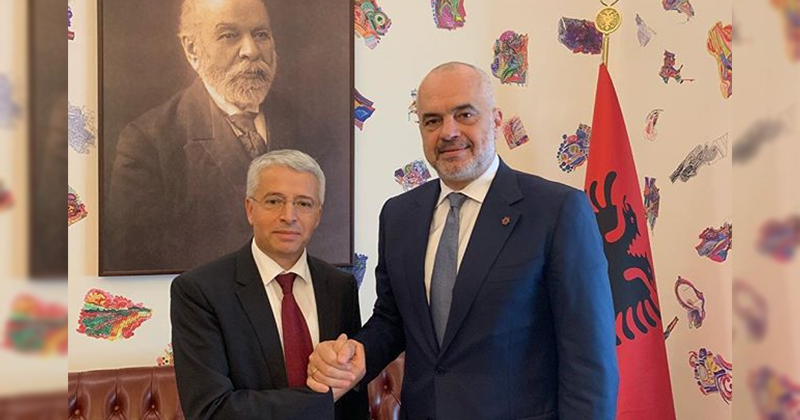
Former Minister Sandër Lleshaj PRO protests, message to Rama for resignation: The time is ripe!
Former Interior Minister Sandër Lleshaj supports the right of citizens to protest and considers the wave of protests an important democratic development for the country. Lleshaj harshly criticizes the political class and the way representation is built in Albania. In this interview for the newspaper “Panorama”, the former socialist minister sends a direct message to Edi Rama, emphasizing that the resignation is not a drama, but a decision that is made when “the time is ripe”.
Lleshaj raises strong questions about the functioning of institutions, the role of political parties and the relationship between citizens and government. He appeals for a radical change in the system, demanding a new law on political parties. Lleshaj is critical of the current model of governance and calls for a review of the way Albanian democracy functions. Regarding the “Balluku” issue, Sandër Lleshaj conveys the strong message to SPAK that Justice does not have to be dependent on someone’s will…
Mr. Lleshaj! How do you assess the wave of citizen protests demanding the resignation of Prime Minister Edi Rama? What woke up the Albanians this time?
The protests have brought a new and necessary dynamic to the life of the country, after a relatively long period of political and social lethargy. The wide international echo is an expression of their magnitude. Unlike the democratic world, Albania in recent years has paradoxically seen protests by parliamentary parties in the streets and a completely peripheral role for them in the Assembly. In fact, the parliament is the forum of political parties and the street belongs to the citizens who do not feel represented in the Assembly. This time we are experiencing a normal development. Citizens are in the streets, where it now seems that there is no place for politicians who are paid by citizens’ taxes. While the latter, the politicians, are no longer known where they are.
Could not addressing the protesters’ demands escalate the situation?
Politicians should take good note of even the protest of a single citizen. Politics must demonstrate respect towards the citizens who pay for it. And respect means listening without comment. The attempt to delegitimize those who protest, by seeking the reasons or motives of the protest beyond the citizens is anachronistic. Ultimately, the government remains responsible for protecting the protest of its citizens. It is also responsible for protecting the protest from foreign influences or infiltrations, for which there have been many unproven allusions. Even for the protests and tragic events of 1997, the government of the time washed its hands with irresponsible ease, pointing the finger of accusation at foreign services, as if it were not responsible for protecting the country from them. In the current case, there is only one way out: the protests must be heard, understood and well understood.
Do you think Edi Rama should resign to pave the way for a political solution?
If I had had communication with the Prime Minister and his willingness for advice, perhaps I would have given it to him, but time has also brought about the extinction of this communication. Therefore, under these conditions, I think that only the ethical and professional silence related to the former political relationship with the Prime Minister is mine. Personally, I think that resignation is not a drama, but a kind of blessing that a person experiences at the moment when the time is ripe for it. I myself experienced this blessing in 2020, when I resigned from the post of Minister of the Interior because one of the thousands of police officers committed a crime in the middle of the night during his patrol service. And every day that has passed since then has only increased my conviction that that decision was also a blessing.
As a former Minister of Interior, how do you see today the way the state manages the widespread citizen protests, where there has been no shortage of violence against protesters?
Once, during an interview, I was asked what the police would do if the people attacked the polling stations on election day. My answer was that the police would do nothing in such a situation, because it is not their mission to prevent the people from fulfilling their will, whatever it may be. This is my answer today as well. The police’s task is to guarantee the smooth conduct of protests. At the same time, they have the duty to always confront crime and lawlessness, always based on the principle of proportionality and restraint.
I have formulated this principle as principle 110. This means that the police react 1 step later in time to violent actions, 1 level below the one they are facing and that the balance of police engagement should have 0 victims. This strategy is that simple: 110. The police belong to the citizens before they belong to the state. I regret that I did not have time to concretize an initiative that I once had to change its name from “State Police” to “Albanian Police”. A police force, historically only belonging to the state, must increasingly take the form of a police force of the citizens.
Protesters are demanding a change in the system, the removal of the old political class, and a new Albania that should be led by young people.
The protests have highlighted a fundamental problem in Albania, which is the total exhaustion of the political class inherited from the Party of Labor of Albania in the form of the daughter parties that it created in the twilight of its life. In fact, today this is the first and last problem that Albania must deal with. But instead of focusing on this issue, the protest has expanded in topics and proposals that reach the level of cacophony. Before the law on strategic investments, on protected areas, on elections and many others like these, Albania needs to change the political system that has brought all the anomalies of these decades.
The protest seems to be pursuing many goals in parallel and it is known what he achieves by killing two birds with one stone. According to the legislation created over three decades, Albania is de jure and de facto hostage to political parties, or even worse: hostage to the presidents who have the right by law to personally determine the lists of candidates for whom the Albanian people must vote in vain. This has brought about the sad reality that the Albanian Parliament is filled with people appointed by the presidents of parliamentary parties. This situation is more than alarming. Without protecting the parliament as a temple of democracy, nothing can be protected, neither the lagoons as a “temple” of flamingos, nor natural resources, nor public properties.
If the protest could bring any real public benefit, it would be the contribution to imposing a new law on political parties, in order to remove their exclusive representation and to define legal standards for the democratic election of their leaders, forums, and above all, all the candidates that these parties present in the elections, just like in the Europe we aim for. As long as Albanian citizens do not exercise their constitutional right to be elected and to be elected, without being dependent for this on the will of the leaders of political parties, democracy in Albania will continue to be simply a propaganda term. As for the “power of the youth”, I would say that this is a cliché that, as beautiful as it sounds, is as dangerous. It is the same as that cliché about incorruptible women.
It is indisputable that young people have the right and duty to participate and exercise responsibility for building the future of the country, which is their future. But in this matter, no kind of age discrimination can be legitimized. Here, the issue of the old leaving for the young to come is not raised. In state and private affairs, people are engaged in accordance with their capacities and abilities. The knowledge and experience of the “old” cannot be excluded to simply pave the way for the energy of the “young”. These qualities must be combined to aim for the best. Behind the slogans for the promotion of the “young” and “women”, there always lurks the trap of their misuse, in those cases when precisely the lack of qualification and experience becomes the weak point from which failure and corruption begin.
Do we still not understand that our experiments in this field have brought us shame at international tables, when in more than a few cases, young officials, maximally groomed in appearance, but without any knowledge and experience, have left a bad reputation in front of international officials experienced in state affairs? Do we still not understand that in the numerous failures of these decades there is also the stamp of many young people who were promoted only as such and failed precisely because of this. Do we really not know that Albania has exceptionally many young people in parliament and in all state offices, compared to other countries, but this has not helped either. Young people must be created every space and opportunity to reveal their talent and energy. But their catapult into positions that normally belong to those with experience is harmful to everyone. Perhaps it would be good to understand the meaning of the term “senior” in English, a term that is used to define many high-ranking positions in economics, administration, and politics.
The protesters are also demanding the creation of a technical government with a one-year mandate. How do you assess this proposal?
This is one of the things that further deepens the cacophony of the protest that I mentioned a little earlier. A technical government would be just a waste of time and the best way to meaninglessly finalize the protest itself. The country needs the radical political change that I mentioned above: a new law on political parties. Without this, a technical government would only create the conditions for party leaders to catapult the next suicide bombers into the new parliament, to create a new copy of the one we have. Albania does not need another political cycle with other actors, but for a fundamental change in the system that creates its parliament.
Another demand of the protesters is related to the lifting of Belinda Balluku’s immunity and her arrest. Why do you think Justice is not acting against the former Deputy Prime Minister and is the position that the SP is not handing her over convincing?
Justice need not depend on someone’s willingness to surrender or be surrendered. As long as surrender or self-surrender are prerequisites for justice to function, it seems likely that it will be absent.
Do you think that SPAK is acting with the same standard towards all high-ranking officials? What message would an investigation of every official for whom there is sufficient evidence or clues send?
I think that public expectations towards SPAK have taken the form of a gigantic naivety and illusion. SPAK has a duty to bring to justice persons who violate the law, but we can never claim or expect that this structure will solve the fundamental problems related to the lack of democratic legitimacy of higher bodies than SPAK itself. SPAK will never be able to give neither legitimacy nor credibility to a discredited parliament, from which originate at best the most ridiculous anecdotes and stories of the country and at worst laws that destroy the public interest. Without a dignified parliament elected by Albanians and not by mayors, not one SPAK, but a thousand others will be created, things will continue to follow this course. / The interview continues tomorrow on Panorama.