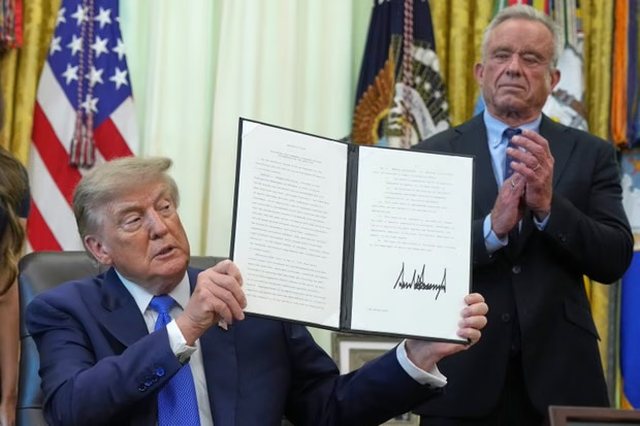
United States President Donald Trump signed an executive order on Monday that aims to significantly change federal recommendations for childhood vaccinations in the United States.
Under the new order, routine recommendations will focus on vaccines against 11 diseases, while several other vaccines will be recommended primarily for children at increased risk. Flu and COVID-19 vaccines, among others, will be handled through shared decision-making between parents and doctors.
MMR vaccine change
One of the most controversial changes relates to the combined MMR vaccine, which protects against measles, mumps, and rubella.
The Trump administration wants to split the combination vaccine into three separate shots, administered at different doctor’s appointments. Public health experts say that could mean more doctor’s visits and risk some children not getting all the doses on time.
Experts oppose the changes
The decision has sparked strong reactions from pediatricians and public health experts, who argue that the vaccination scheme is built on decades of scientific data.
Critics warn that limiting recommendations and increasing the number of visits required for vaccination could create confusion among parents and reduce vaccine coverage, increasing the risk of a resurgence of preventable diseases.
Meanwhile, the White House justifies the change by claiming that the US has had a greater number of vaccines recommended for children compared to other developed countries. A US administration assessment has proposed precisely a set of 11 vaccines as the basis for routine recommendations.
The new order is expected to spark widespread debate among federal authorities, US states, doctors and parents. However, the presidential order does not automatically change all vaccination requirements at the state level, as the rules for vaccinating students are largely set by the states themselves.