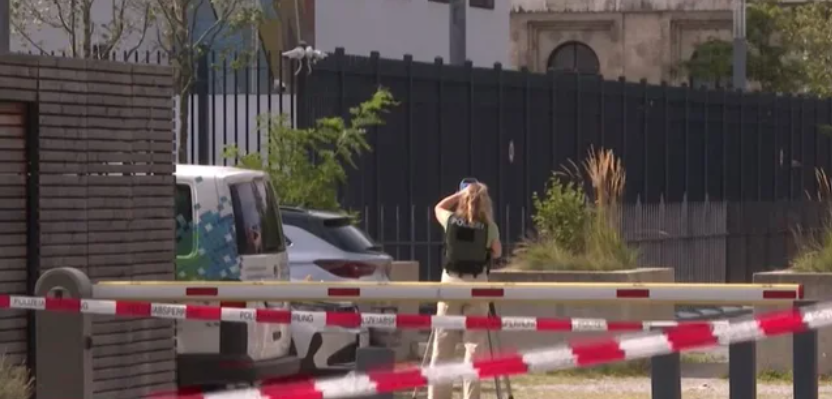
A 22-year-old Albanian man has been detained in Italy on suspicion of planning an attack at the Adigeo shopping center in Verona, Italian media report.
According to Corriere del Veneto, the young man was arrested on August 10 at Treviso airport, shortly after arriving from Tirana with his parents. He was subsequently deported from Italy for national security reasons.
Investigations, according to Italian media reports, have revealed that the 22-year-old had been radicalized online, had requested materials and information for the production of homemade bombs, and had opened a bank account for transferring funds.
Italian authorities also suspect that he had communicated with people linked to Islamic fundamentalism and had considered the possibility of traveling to territories controlled by ISIS.
The Italian Interior Minister announced a few hours ago that the 22-year-old Albanian was repatriated to Albania.
The case has been described by Vincenzo Pace, former professor of Sociology at the University of Padua, as an extremely rare case of radicalization of an Albanian.
Speaking to Corriere del Veneto, Pace said that the Islamic tradition in Albania is generally characterized by a moderate practice and that online radicalization remains a limited phenomenon, which can affect isolated individuals or groups.
Full article
The prevented attack at the Adigeo shopping center in Verona, Albania and the terrorism alert from the US and Brussels: “The 22-year-old, a rare case; in Tirana, a moderate Islam prevails”
Cryptocurrency, fighters in Syria and a strategic position at the gates of Europe. When we think of jihadist terrorism – the nightclub shootings, subway bombings and bridge stabbings that have rocked European capitals over the past decade – the connection to Albania is certainly not what immediately comes to mind.
However, the 22-year-old man detained on suspicion of planning an attack on the Adigeo shopping center in Verona is originally from Albania.
“A peaceful religious faith”
“It is an extremely rare case,” says Vincenzo Pace, former professor of Sociology of Religions at the University of Padua, referring to a case of radicalization of an Albanian.
“Albanian Islam is organized in Sufi brotherhoods, is connected to folklore and traditions, and was spread during the Ottoman Empire,” he explains. “In Albania, they don’t dream of an Islamic State.”
As Pace recalls, in 1967, during the communist dictatorship, the Muslim religion was banned.
“Leaders of religious brotherhoods used to gather in cemeteries to escape the police,” he says. “Today, about 70% of the population is Muslim, but it is a quiet religiosity. This does not exclude the possibility of isolated groups or lone individuals who radicalize online.”
However, the risk is not zero.
The US State Department’s “Country Reports on Terrorism 2024” has dedicated a special profile to Albania, highlighting the existence of a real terrorist threat from across the Adriatic.
Dangers from ISIS sympathizers
In the list of potential risks related to Albania, the State Department has included recent efforts by ISIS sympathizers to incite people living in the country to use violence, as well as the risk of radicalization of Albanian citizens repatriated after fighting with jihadist groups in Syria.
In 2025, at least 70 foreign fighters with Albanian citizenship were still detained abroad, including women and children, many of them in camps in Syria or Iraq.
Of these, 38 have recently been repatriated and last year were included in reintegration programs into society by Albanian institutions.
“The new Syrian president has released some foreign prisoners from the camps,” Pace explains. “There will be some who have repented and others who may continue to have militant ideas.”
Albania as a transit country
Due to its geographical location, according to the US administration, Albania also poses a risk as a transit country, which could be used by terrorists to send money and materials destined for violent activities to Europe.
On the other hand, the Albanian Police’s Anti-Terrorism Directorate constantly cooperates with its American counterparts and with police structures in the Balkans.
Over the past two years, Albania has adopted an action plan against the financing of terrorism, after previously adopting a law on cybersecurity, with the aim of combating terrorism and radicalization taking place online.
This has been followed by new legislation against the training, facilitation, financing and use of the internet for terrorist activities.
The measures have been supplemented by stronger border controls, the construction and updating of databases, and cooperation with international police.
Investigative network
This control activity had secured Albania a positive assessment from the European Commission.
In an information report on the country in 2025, within the framework of the European Union’s neighborhood policies, Albania’s fight against terrorism was assessed as “broadly satisfactory”.
In the same document, the terrorist threat in Albania was assessed as “low”, although Brussels had asked the Albanian government to allocate more resources to this area.
Over the last two years, Albanian police had identified “at least six criminal cases with terrorist intent.”
In its 2026 policy recommendations, the European Commission urged Tirana to further develop financial investigations related to terrorism, especially those related to the criminal use of cryptocurrencies.
“Safety councils” have also been created to prevent radicalization at the local level.
However, according to Brussels, significant challenges still remain.
“Online radicalization, radicalization in prisons, and terrorist content present on the internet continue to pose significant challenges,” the assessment for Albania states.
“Monitoring online content presents difficulties, as institutional capacities and resources are limited.”