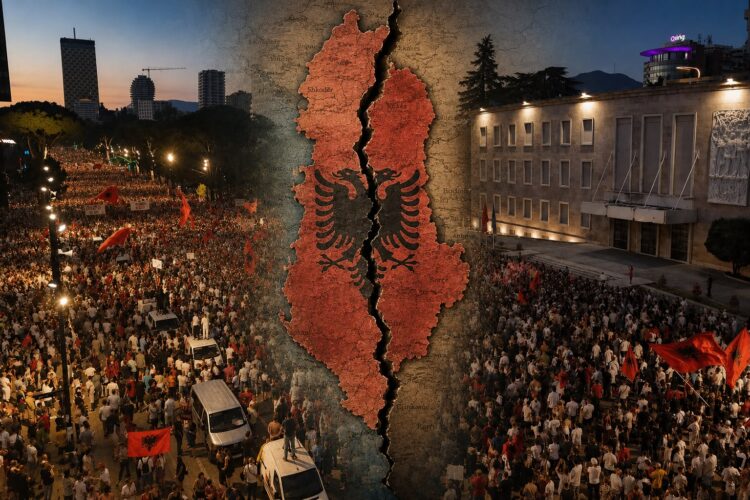
One of the most common mistakes in political analysis is to imagine political systems or regimes as machines that simply need to be hit in the right nerve center to stop functioning. In reality, political systems are much more like living organisms. They adapt, regenerate, change strategies, learn from shocks, and often sacrifice parts of themselves to survive as a whole.
Precisely for this reason, democratic change is almost always a process of accumulating many cracks and not a single act.
Sociologist Charles Tilly argued that major political changes do not usually arise from a single event, but from the accumulation of many small processes that, interacting with each other, together begin to weaken the foundations on which power rests. Institutions, civic movements, political conflicts, and cultural transformations do not operate in isolation, but feed each other until they create a new reality.
Precisely for this reason, tipping points are rarely noticeable at the moment they occur but only become apparent when the system can no longer absorb the accumulated pressure.
If we look at Albania through this lens, it becomes clear that in recent years several important cracks or fissures have begun to appear. Perhaps none of them are decisive in themselves. But together they are gradually changing the pillars on which the system has been supported for more than three decades. For many years, the impression has been created that the Albanian political system was almost immune to any shock. That the most powerful figures were practically untouchable. That the traditional parties had an unchallenged monopoly on political life. That citizens either had to swallow this reality or leave the country.
Read also:
Albania bans meat imports from Brazil/EU restrictions on European markets
Vacationer falls from cliff in Radhimë, taken to hospital in serious condition/ NAME
This fatalism was perhaps the greatest achievement of any consolidated system. A regime does not become strong simply because it controls the institutions but when it convinces its citizens that change is impossible. However, this conviction has begun to waver significantly, not through a spectacular explosion, but through a series of small cracks that I have categorized in the institutional, political, cultural, and socio-economic spheres.
I call them “cracks” because it is not yet a question of the collapse of the system, but of the gradual weakening of the pillars on which it has rested for decades. Taken separately they may seem small; together they change the balances of power.
Institutional Cracks
The first crack is institutional and relates to justice reform. For the first time since the beginning of the transition, figures who for many years were considered practically above the law have been investigated, arrested, charged and in some cases convicted.
SPAK, supported by international partners, has not yet properly transformed Albanian justice. However, it has transformed something equally important, which is related to the perception of citizens that impunity is no longer absolute.
In politics, perceptions matter almost as much as institutions. When people start to believe that no one is completely untouchable, the system has already taken a hit that is not measured solely by the number of criminal records or handcuffs placed on it.
A less obvious consequence of the justice reform is the rift that is emerging within the state administration itself, the machinery of the system. Fear of SPAK investigations has changed the way the bureaucracy functions. More and more officials are avoiding taking responsibility, postponing decision-making, or preferring not to sign off on issues they would once have approved without hesitation.
This creates a kind of passive disobedience and administrative paralysis. Although this slows down the functioning of the state, it is also an indication that the culture of impunity is no longer as absolute as it used to be.
At the same time, the advancement of the European integration process has created a new rift, which has to do with a new source of pressure on the Albanian state. For the first time, an increasingly large part of the reforms is determined not only by the will of the Albanian clique government, but also by the standards, conditionality and monitoring of the European Union.
This does not guarantee the success of reforms, but it increasingly limits the space for institutional arbitrariness of our political caste.
Political rifts
Another rift is that of the political sphere that occurred last year. For a long time, it seemed that any attempt to build alternatives outside the two traditional parties was destined to fail.
It is enough to recall that about a decade ago, two of the most important figures in Albanian politics, Bamir Topi and Ben Blushi (both considered in their time as the number twos of the Democratic Party and the Socialist Party) left their respective parties to create new political alternatives. Although they enjoyed a high public profile, had experience and political capital, and even bitten off structures and figures from the parties they left, those initiatives failed to attract enough electoral support to cross the threshold and enter parliament.
The last elections presented a completely different picture.
Three new political formations (Lëvizja Bashkë, the coalition Shqipëria Bëhet–Nisma Thurje and Mundësia) competed outside the two traditional blocs and managed to attract votes from both the left and the right and gain representation in Parliament. The very fact that a part of the electorate broke away from the traditional parties to trust new alternatives constitutes an important development. Of course, this does not mean that the system has already changed, but that it is no longer as closed as it seemed until yesterday.
What matters is that the monopoly no longer seems insurmountable. In a democracy, change begins precisely when citizens realize that a credible alternative exists. So alternatives matter even when they are still small. Their very existence changes the way citizens imagine the future.
The Flamingo Revolution is also part of the same trend.
The DP no longer has a monopoly on managing civic anger. For the first time, a significant part of the collective discontent was organized autonomously, choosing the path and not the traditional parties as a means of action. He reminded that democracy does not end at the ballot box. K
In addition to representative democracy, there are also participatory and direct democracy, where citizens organize, protest, propose, and exert public pressure without waiting for the next electoral cycle.
When it comes to breaking away from the party duopoly, a rift is emerging within the elite itself. For many years, one of the main sources of the system’s strength was the cohesion of the political elite and the discipline of critical voices. Today, there are signs that this homogeneity is no longer so complete.
The resignation of Socialist MP Marjana Koçeku, the more critical voices that are occasionally heard from important figures in the majority, such as Elisa Spiropali, as well as the public interventions of former senior officials such as Ditmir Bushati, Arta Dade or Ermelinda Meksi, show that even within the establishment the same level of uniformity no longer exists.
Equally significant is the fact that debates and grievances, which were once resolved within closed party forums, are increasingly emerging in the public space.
At the same time, fear of SPAK investigations has increased the caution and self-defense of a part of the political elite, weakening the discipline and cohesion that have characterized the government for many years. Taken separately, these developments may seem episodic. Together, they suggest that the political elite is no longer as monolithic as it once was.
On the political level, another important rift that should be noted is the media, which, through the control of the owners, has served as an anesthetic for collective discontent. This has to do with the weakening of one of the most important mechanisms of any consolidated power, the ability to produce public approval and consent, that is, to impose a single interpretation of reality and present it as the only possible one.
For the first time in many years, the government’s ability to control the public narrative is being challenged simultaneously by independent media, alternative online forums, social networks and, above all, by the increased attention of international media. When the debate about Albania also takes place outside its borders, it becomes much more difficult for reality to be monopolized by a single narrative controlled by the government.
In the political category, the dimension of the crack in international reputation should also be emphasized.
For many years, one of the main sources of legitimacy for the status quo stemmed not only from domestic elections, but also from the support and positive perception of international partners. In a context where elections were constantly contested by the opposition, the approval of key Western actors served as the main seal of the government’s legitimacy.
For years, the narrative was built that Rama represented Albania’s European future, while the opposition embodied the past, especially after its historic leader was declared non grata by the US and the UK. But this advantage has begun to fade. SPAK, the Sky EÇ and EncroChat files (which have brought to light suspected links between international organized crime and Albanian politics); the international exposure of the Zvërnec case after the Flamingo Revolution and the repercussions of the accusations of dubious affairs, as well as the demonstrative rapprochement with the Trump family, one of the most powerful and controversial families in the world, have gradually eroded Rama’s image as a symbol of European modernization.
The “leader of the future” narrative is no longer as compelling as it once was in Brussels, and is increasingly being replaced by questions about corruption, links to organized crime, state capture, and the quality of Albanian democracy.
Socio-economic divides
Beyond institutional, political, and cultural cracks, another category in its own right are the structural socio-economic cracks. The development model on which Albania has relied over the past decades is facing its limits.
The monopolization of the economy, mass emigration, an aging population, labor shortages, rising costs of living, and widening inequalities are putting increasing pressure on the economy and the social contract. These are not simply economic problems but signals that the status quo is becoming increasingly difficult to maintain without profound changes.
Another socio-economic rift is related to the transformation of the Albanian reference system. Mass emigration, diaspora and free movement have led a very large part of Albanian society to live, work or have family in Western countries. During 2025 alone, Albania recorded around 12.5 million entries of foreign citizens and around 8.6 million exits of Albanian citizens, figures that illustrate the extraordinary intensity of movement and contact with the world.
These are not unique individuals, as the same person may cross the border several times during the year, but they show that Albanians’ exposure to the West is no longer the privilege of a minority, but a massive experience.
They travel freely, compare prices, salaries, the quality of education, healthcare, the environment, administration and the rule of law. Many of them discover that in many cases the prices of basic products are similar, even lower than in Albania, while the quality of public services is significantly higher.
As a result, Albanians no longer measure Albania by the Berisha era as the current government insists, but by the European standard they experience themselves or through their family members. When the reference system changes, the threshold of patience also changes. Societies that have seen how a normal state functions are no longer satisfied with promises or the minimal progress made so far, but demand European standards.
This rift affects not only the government’s traditional democratic opponents, but also part of its own socialist electoral base. Someone may have secured a job thanks to party contributions, but they cannot buy clean air with a socialist party card. They cannot avoid dilapidated roads, hospitals in crisis, declining schools, rising prices, legal uncertainty or the arbitrariness of the administration.
Privilege can solve an individual problem, but it cannot replace a functioning state. In a captured state, the line between executioner and victim becomes increasingly blurred because the favors given by the party are temporary while the damages of state failure are collective and permanent.
Another socio-economic rift is related to the gradual consumption of the very clientelistic system on which power has been based for many years. Any patronage system functions as long as it has resources to distribute. At first, it offers jobs, favors, contracts, and privileges to expand the base of support. But over time, the space for rewards narrows. Jobs are filled, tenders are concentrated on an ever smaller number of beneficiaries, and the opportunities to satisfy the expectations of militants diminish. As a result, the system begins to produce disillusionment even among some of those who once supported it.
Clientelism begins to consume itself, because it is no longer able to reward all those on whom it has built its loyalty. Every clientelistic system sooner or later faces the same ceiling: the number of people who expect to receive becomes greater than the number of privileges that the government can distribute. That is where its political consumption begins.
The most paradoxical thing here is that, in addition to the clientelist system having an inevitable limit, corruption itself erodes the basis of the system that feeds it. In a captured state, the greatest benefits are not necessarily received by the most loyal party member, but by the one who brings the biggest bribe. So the main beneficiaries are not the socialist militants who have distributed leaflets or filled the rallies, but the privileged big businesses and the criminal networks with the largest capital.
In other words, corruption does not reward loyalty but financial power. Precisely for this reason, any system built on privilege sooner or later produces disappointment even among a portion of those who have supported it. When even supporters begin to understand that in the hierarchy of corruption they are simply second-class citizens who barely matter, then the rift no longer comes only from the opposition but also arises from within the system itself.
Cultural rifts
But perhaps the most important category of cracks is that which occurs in the fourth sphere, the cultural one. This is precisely what Douglass North had in mind when he argued that informal institutions and unwritten rules (norms of behavior, values, customs, beliefs, expectations, and self-imposed codes of control) are as crucial as laws in understanding why a system survives or begins to change.
Institutions can be reformed and governments can change, but no change becomes sustainable unless the way citizens understand power and their role in democracy also changes. Political culture consists of the norms, customs, expectations, and beliefs that determine what is considered normal, what is accepted, and what is rejected. It is at this level that the Flamingo Revolution should be seen.
Its value is measured not only by its ability to pressure government, but also by its ability to change civic culture; by moving the public interest to the center of the debate, by challenging the normalization of abuse, by creating new collaborations among citizens, and by proving that public participation can be persistent, creative, and peaceful. If these norms take root, then change is no longer just political but becomes social.
Here, too, another cultural divide must be mentioned, one that has to do with the collapse of fear. For many years, a large portion of citizens avoided public criticism of the government, not necessarily because they agreed with it, but because they considered themselves alone or that the cost of speaking out was too high. As a result, many citizens chose silence, creating the impression that discontent was limited and that the majority supported the status quo.
Today, the opposite is gradually happening. More and more citizens are openly expressing their dissatisfaction without being associated with the traditional opposition. Every voice that breaks the silence gives courage to others to do the same, weakening the culture of self-censorship that has fed the feeling of powerlessness for years. In this sense too, it should be seen that the Flamingo Revolution is important not only for the pressure it exerts but also for the fact that it has created a space where citizens can publicly express their dissatisfaction without having to be labeled with traditional parties.
This is a deep cultural tectonic rift, because it changes not only the behavior of individuals, but also the collective perception of what is possible and acceptable in public life. As such, it can have far longer-term consequences than the protests themselves.
When talking about the cultural sphere, the generation gap should also be emphasized.
More and more young people are looking beyond the traditional divisions of the transition era between the Socialist Party and the Democratic Party. For them, the party identities that dominated their parents are of less and less importance compared to the functioning of institutions, meritocracy, opportunities for development, the quality of education, the European perspective and the rule of law.
This change does not mean that the old divisions have completely lost their weight, but that they are no longer the only axis around which political competition is organized.
At the same time, youth today display a much higher sensitivity towards issues that until yesterday were considered secondary in the Albanian public debate, such as environmental protection, transparency, violence, hate speech, the arrogance of power, quality of life and respect for the dignity of the citizen.
As the first generation to grow up constantly connected to the world through the internet and social media, Generation Z compares institutions, standards and governance not only with the Albanian past, but also with the reality of European and Western countries. As a result, their expectations are higher. When the priorities of a generation change, society’s expectations of politics gradually begin to change as well.
Moreover, one of the most important cultural cracks is that of fatalism. For many years, the belief that “nothing gets done,” that the system is unchangeable, and that any civic effort is destined to fail, has prevailed.
The very fact that citizens organize, create movements, support new political alternatives, or undertake ongoing protests shows that this belief is no longer so absolute. When citizens cease to believe that change is impossible, the system begins to lose one of its most important sources of strength.
Equally significant is the rupture in the normalization of corruption. Practices that once went unchallenged or were accepted as a normal part of political life now provoke a much greater public reaction. Even when they do not have immediate political or legal consequences, they change the moral standard by which citizens judge government.
In a democracy, change often begins not when corruption disappears, but when society ceases to consider it normal.
In this sense, the Flamingo Revolution should be seen as a civic movement that represents several transversal rifts. It is the crossroads where some of the most important rifts in the various spheres that Albania is experiencing intersect.
It is simultaneously an expression of an institutional rupture, because it relies on a change in perception of justice and impunity; of a political rupture, because it challenges the monopoly of traditional parties on the management of civic discontent and restores participatory democracy to the center; of a socio-economic rupture, because it reflects the dissatisfaction of a society that no longer accepts compromise with the cost of living, corruption, state capture and lack of perspective, as well as a cultural rupture, because it weakens fear, fatalism and the normalization of abuse, creating a new culture of active citizenship.
Precisely because it is the product of the interaction of all these processes, its importance should not be measured only by its immediate political effect, but by its ability to accelerate their transformation.
Perhaps none of these cracks alone will bring down the system, and perhaps together they will take time to bring about change. History does not know safe formulas, but it does know processes that, when combined, can produce turning points. Societies do not change at the pace of our anger, but at the pace of the transformation of institutions, political culture, and civic consciousness.
It changes when many small processes start moving in the same direction. Desperation drives us to seek immediate results, as if society could change at the pace of our impatience. History offers no guarantees, only opportunities.
In truth, democratic change moves at the pace of institutions being reformed, of the existing political and socio-economic structure being broken, of culture evolving, and of citizens changing the way they understand their role.
This is why pessimism is as wrong as naive optimism. There is no reason to believe that everything will change overnight, just as there is no reason to say that nothing is changing.
History shows that no system lasts forever. Albania proved this in 1990, when one of Europe’s most isolated regimes collapsed after decades of communist rule. In Montenegro, Milo Djukanovic, who had dominated political life for more than three decades since the end of socialist Yugoslavia, lost power. Most recently, Hungary also showed that after sixteen years in power, Viktor Orban and his system could be democratically defeated through elections.
These cases show that even the most entrenched and entrenched systems can change. But they rarely fall from a single protest or event; they wear away gradually, as citizens organize, build alternatives, and gain confidence that change is possible.
We must understand that democracy is a marathon and that European Albania will not be built by a single protest, by a single leader, or by a pair of elections. It will be built stone upon stone, institution upon institution, citizen upon citizen.
Therefore, the beginning of healing is precisely when we stop waiting for someone to change Albania for us and begin to understand that democracy is not an event, but a process and lifestyle.
When we understand that in a democracy, the citizen does not vote only on election day; he votes every day with his wallet, with his voice, with solidarity, with silence, and with his small choices.
Precisely for this reason, European Albania will not be built from a single heroic moment, but from millions of daily civic decisions.
In this sense, the Flamingo Revolution is not the end of history, nor proof that change has already happened. But it could be something else extremely important. It could be the moment when a part of Albanian society began to believe again that change is possible.
When the way citizens understand power, responsibility, and the possibility of alternatives changes, then we can confidently say that history has begun to set in motion, even if its results are not yet fully visible.