
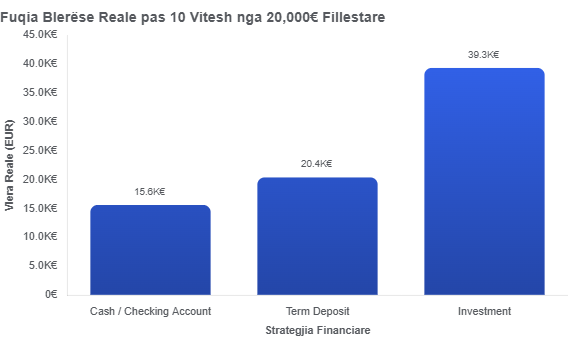
If you keep €20,000 in an interest-free bank current account , after 10 years its purchasing power will drop to around €15,624 due to an average inflation of 2.5%.
This means that your money will lose almost €4,376 of real value , although the number on the bank screen will remain the same.
To understand how this scenario changes depending on your financial decisions, here’s a strategic comparison of three possible paths:
Comparison of 3 Scenarios after 10 Years
| Selected Scenario | Nominal Value (Figure) | Real Value (Purchasing Power) | Real Loss or Gain |
|---|---|---|---|
| 📉 Current Account (0% Interest) | 20,000€ | 15,624€ | -€4,376 (Loss) |
| 🏦 Term Deposit (3% Gross Interest) | 26,106€ | 20,394€ | +394€ (Value preservation) |
| 📈 Investment (9.5% Nominal Profit) | 49,565€ | 39,343€ | +19,343€ (Capital increase) |
Concentration Risk and Speculation Warning
Before considering high-risk or concentrated assets (like cryptocurrencies or single stocks), you should be aware of the risk of total loss of capital . To protect your wealth, use a diversified framework and invest only the excess that you don’t need for short-term emergencies.
Detailed Options Analysis
- Cash Option (Current Account): It’s great for instant liquidity, but it works like an “invisible tax.” Every year inflation erodes the value of your money.
- Term Deposits: If you use a deposit (e.g. at Banka Ekonomike ), the gross interest of about 3% is reduced by a 10% withholding tax. This option does not make you rich, but it serves as a good shield to preserve the real value of money. [ 1 ]
- Index Funds (e.g. S&P 500): Historically, the stock market has generated about 7% real (inflation-adjusted) returns. After 10 years, your €20,000 could almost triple in nominal value .
Step-by-Step Execution Plan
- Phase 1 (Month 1): Set aside an Emergency Fund of 3 to 6 months of living expenses and keep it in a checking or savings account with quick access.
- Phase 2 (Month 2): Pay off any toxic debt or high-interest loans if you have any.
- Phase 3 (Month 3 onwards): Divide the remaining capital (e.g. €15,000) between a term deposit for safety and a long-term investment account (diversified global ETFs) for capital growth.
If you would like us to customize this analysis, let me know:
- Do you have existing debts that need to be paid?
- What is the purpose of this money after 10 years (buying a house, retirement, education)?
- How risky or conservative do you want to be with your investments?