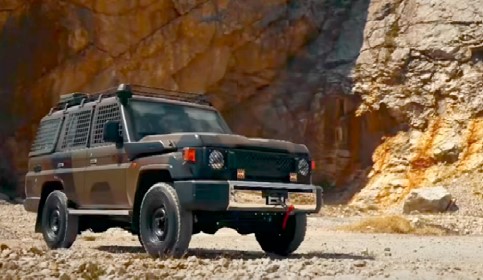
One of the biggest financial and political scandals has erupted publicly regarding the management of defense funds and procurement for the Armed Forces, Police and Civil Emergencies. At the center of this affair is the ceremonial presentation by Prime Minister Edi Rama of the first 40 tactical vehicles, which were trumpeted with great pomp as an achievement of the local industry “Made in Albania” with NATO standards, realized by the company “Timak Defense” founded by Arjeta Puca.
However, behind the scenes of this propaganda spectacle reveals a complete technical and financial truth. The vehicles advertised as Albanian production are actually Japanese Toyota Land Cruiser 70 Series vehicles (specifically the Land Cruiser 76 or HZJ76 / GRJ76 / GDJ76 model in 5-door tactical configuration). These vehicles are imported from Japan and are subject to only a few superficial visual modifications and tactical equipment, such as:
• Installing a snorkel for deep water crossing and engine protection;
• Installation of metal protective nets on windows and roof racks;
• Installation of winch bumpers, headlight guards and military camouflage paint.
On the international market, a new Toyota Land Cruiser 76 costs from $45,000 to $65,000 (€40,000 – €60,000), while a used one costs from €20,000 to €40,000. Even with all the military modifications, the maximum price of such a version reaches from $70,000 to $120,000. The false classification of these vehicles as “national production” has served as a pretext to bypass open public tenders, avoid competition and inflate bills to the detriment of the state budget.
Behind the scenes of “Timak Defence”, the sale of shares for 490 euros and the comparison with the American loan
The financial scheme behind this project was built through dubious property movements. In June 2025, Arjeta Puca sold 49% of the shares of the “Timak” company to the Israeli businessman with Albanian citizenship, Ron Yeffet, for the ridiculous price of only 490 euros.
Then, on August 4, 2025, the state-owned defense company “KAYO” (led by Ardi Veliu) established the joint venture “Timak Defence” (owned 80% by Timak and 20% by KAYO). This company was also given the building of the former “News 24” television station in Shkozë and immediately began to conclude secret contracts without a transparent procurement competition:
• 6.1 million euros for the C-UAS anti-drone system;
• 4.4 million euros for tactical vehicles.
According to State Treasury data, the last transaction alone was for 331.1 million lek (about 3.6 million euros) for Military Unit 4001. In total, over the past 10 months, the state budget has transferred over 31 million euros to the company “Timak Defence”, which constitutes an average of about 3.1 million euros per month. This figure has prompted extremely compromising comparisons with the 302 million dollar military loan signed by the Albanian government with the United States of America.
The US loan, spread over 12 years (144 months), provides for an average installment of around 2.1 million dollars per month. This means that the average monthly payments made to the company “Timak Defence” are around 1.2 million euros higher than the average monthly tranche of the US military loan itself, raising serious concerns and demands from the opposition for an immediate investigation by justice bodies such as the Special Prosecution Office (SPAK).
So in this way, the gigantic $302 million financing provided by the US risks turning into an “oasis” of benefits for government clients. Through the monopoly created with the state-owned enterprise KAYO, Edi Rama is ensuring that every dollar destined for national defense is channeled directly to the de-facto privatized company. Instead of real military modernization, taxpayers’ money and foreign credit are being used to enrich businessman Ron Yeffet with secret contracts.
This entire financial black page is hidden behind the propaganda facade of Toyota vehicles imported from Japan. These vehicles are simply repainted and camouflaged by Arjeta Puca to then be sold as secret local production. To put it bluntly, such a fraud scheme not only shows the failure of “Made in Albania”, but also turns American military financing into the biggest financial mega-theft of the decade.