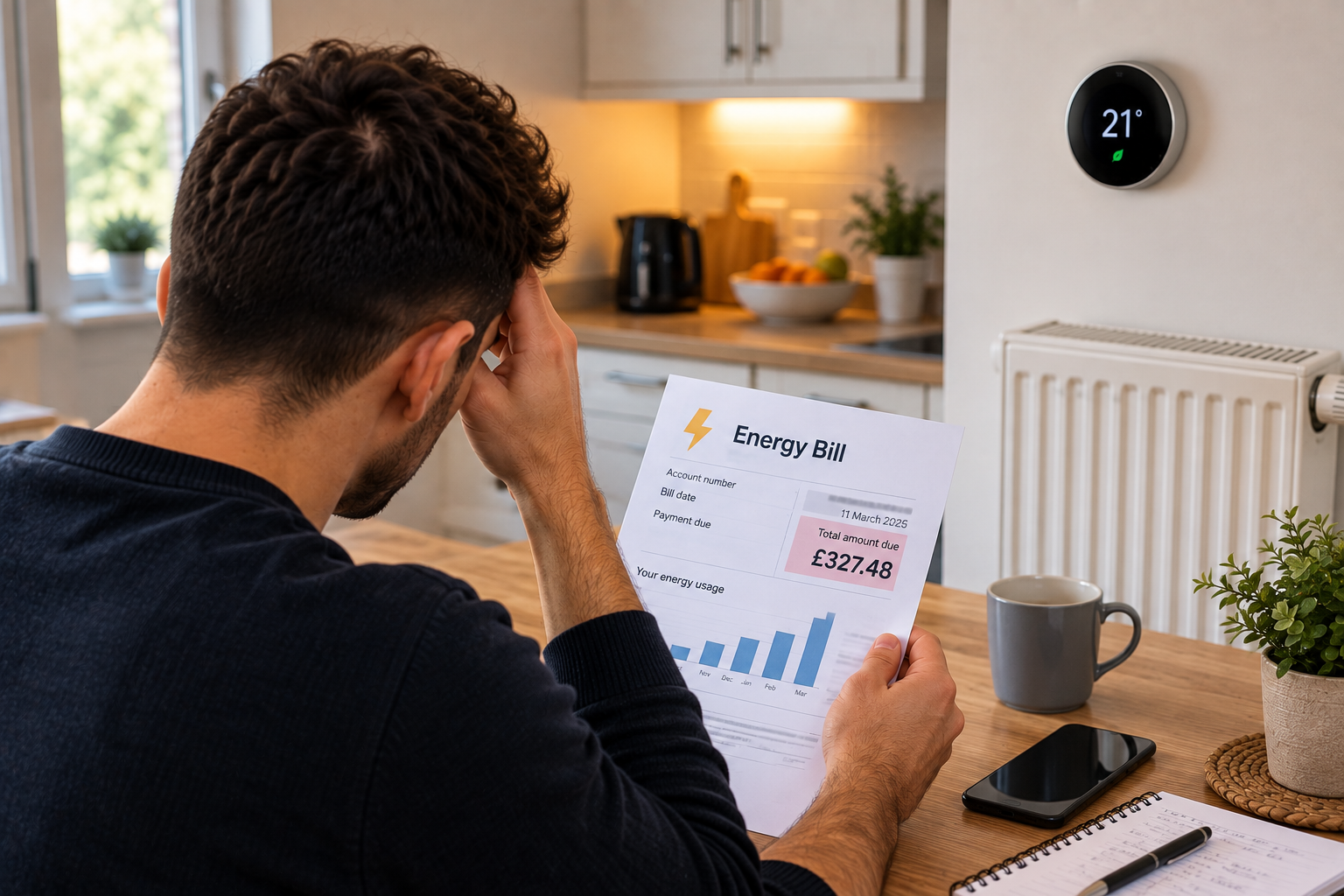
Energy Bill Too High? Check These Things in Your UK Home
You open your latest gas or electricity bill and immediately notice the difference.
Last month it was manageable.
This month, it is significantly higher.
For Albanian families living in the UK, energy can represent a substantial part of the monthly household budget, particularly during colder months. But a high bill does not always mean that one single thing is wrong.
The problem could be your heating settings, insulation, boiler, appliances, hot-water use, tariff—or even the way your meter readings have been recorded.
Before assuming there is nothing you can do, here are some of the most important things to check around your home.
1. Check Your Heating First
Heating should be one of the first places you investigate.
According to Energy Saving Trust, heating and hot water account for more than half of the energy used in a typical home.
That means relatively small changes in how your heating operates can potentially make a noticeable difference over an entire winter.
Ask yourself:
Is the heating running while nobody is home?
Does it stay on for longer than necessary?
Are you heating every room equally?
Is the thermostat set higher than you actually need?
Are the heating controls working correctly?
Energy Saving Trust says most people should set their thermostat to the lowest comfortable temperature, typically between 18°C and 21°C. It also notes that turning a thermostat from 22°C to 21°C could save an average household in Great Britain around £120 a year, although actual savings depend on the home and usage.
Don’t simply turn the thermostat up because it is colder outside.
A higher thermostat setting does not make the property heat up faster.
2. Check When the Heating Is Running
Temperature is only half the equation.
Time matters too.
Suppose everybody leaves the house at:
8:00 a.m.
and nobody returns until:
5:30 p.m.
If your heating continues operating as though everyone were home, you may be paying to heat an empty property.
A programmer or suitable smart control can help schedule heating around when you actually need it.
For example:
Morning: Heating on before everyone wakes up.
Daytime: Reduced or off when appropriate while the property is empty.
Evening: Heating returns before the family comes home.
Night: Reduced according to household needs.
The right schedule depends on the property, heating system and people living there.
The goal is simple:
Heat your home when you need it—not automatically all day.
3. Your Home May Be Losing Heat
Sometimes the heating system is not the main problem.
The house itself is.
You pay to generate heat, but that heat quickly escapes through poorly insulated parts of the property.
Potential areas include:
Roof and loft
Walls
Floors
Windows
Doors
Gaps around frames
Unused chimneys
Other openings
Energy Saving Trust says improving insulation and draught-proofing reduces heat loss, meaning the home requires less energy to remain warm.
Check Your Loft
The loft is particularly important.
If insulation is insufficient or poorly installed, heat can escape through the roof.
Don’t simply add insulation without understanding the property, particularly if there are existing moisture, ventilation, electrical or structural concerns.
Older properties can also require different approaches from modern houses.
4. Check Windows and Doors for Draughts
Stand near your windows and exterior doors on a cold day.
Can you feel cold air?
Look around:
Window frames
Door frames
Letterboxes
Keyholes
Floor edges
Loft hatches
Other gaps
Draughts can make rooms feel colder even when the heating is running.
That often leads to another problem:
You increase the thermostat.
The heating runs more.
The bill increases.
But the underlying issue—heat escaping—remains.
Appropriate draught-proofing can help reduce unnecessary heat loss.
Not every old window needs immediate replacement.
Sometimes targeted repairs or sealing can improve the situation for much less money.
5. Check Your Boiler
If you use a gas boiler, its condition and controls matter.
Watch for signs such as:
Unusual noises
Frequent pressure loss
Repeated fault codes
Radiators not heating properly
Hot water becoming inconsistent
Heating taking unusually long
Boiler repeatedly switching on and off
Unexpected increases in energy consumption
Don’t automatically replace a boiler because one bill is expensive.
First understand whether the problem is:
The boiler
Heating controls
Insulation
Household behaviour
Energy prices
or something else.
Regular appropriate servicing can also help identify problems before a complete breakdown.
Gas-related work should be handled by appropriately registered professionals.
6. Check Your Radiators
Walk through the house while the heating is operating.
Are some rooms extremely warm while others remain cold?
Are you heating rooms nobody regularly uses?
Are thermostatic radiator valves working correctly?
Heating controls can allow you to manage different rooms more effectively rather than treating the entire property identically.
For example, you may not need a rarely used spare bedroom maintained at the same temperature as your living room all evening.
Energy Saving Trust recommends effective use of programmers, room thermostats and thermostatic radiator valves to avoid heating a home more than necessary.
7. Check Your Hot-Water Use
Heating rooms is not the only major energy expense.
Hot water matters too.
Think about:
Long showers
Multiple showers each day
Baths
Hot-water taps left running
Dishwashing
Hot-water cylinder settings
Poorly insulated hot-water cylinders
Large families naturally use more hot water than someone living alone.
But inefficient use can add unnecessary cost.
If you have a hot-water cylinder, check whether it is appropriately insulated. Energy Saving Trust says improving inadequate cylinder insulation can reduce heat loss and save energy.
8. Look at Your Tumble Dryer
The tumble dryer is convenient, particularly during wet UK weather.
But frequent use adds to electricity consumption.
Imagine using it:
5 times per week
That’s roughly:
20+ cycles per month.
A household doing several loads of washing may use it even more.
When practical, consider whether some clothes can be dried another way.
Also check:
Lint filter
Dryer condition
Cycle selection
Load size
Ventilation where applicable
If clothes suddenly take much longer to dry, investigate why rather than simply running longer cycles.
9. Check Old Appliances
Older or inefficient appliances can add to household electricity use.
Pay particular attention to equipment that runs frequently or continuously, such as:
Refrigerators
Freezers
Tumble dryers
Dishwashers
Washing machines
Electric heaters
Dehumidifiers
Electric ovens
You may also have appliances you barely use.
For example, some families replace their kitchen refrigerator and move the old one into the garage.
Now the household is powering two refrigerators 24 hours a day.
Ask:
Do we actually need every appliance that is running?
10. Be Careful With Portable Electric Heaters
Portable electric heaters can be useful for specific situations.
But if several are being used for long periods, electricity consumption can increase quickly.
Don’t assume a small appliance means a small energy cost.
What matters is:
Power consumption × time used × electricity price.
If your central heating is off but three electric heaters are running for many hours every day, the bill may still be substantial.
Use heating equipment safely and according to manufacturer instructions.
11. Check Whether Your Bill Is Based on Actual Usage
This is extremely important.
Before blaming the boiler or refrigerator, look at the bill itself.
Check:
Meter readings
Billing period
Gas usage
Electricity usage
Unit rates
Standing charges
Whether readings are actual or estimated
If your supplier does not have accurate readings, estimates can affect what you are billed.
Ofgem advises that regular meter readings can help bills reflect actual usage, while smart meters operating correctly can automatically send readings to suppliers.
Compare kWh, Not Just Pounds
Suppose:
January bill: £180
February bill: £240
Don’t compare only:
£180 vs £240
Compare how many kilowatt-hours (kWh) you actually used.
If usage increased dramatically, investigate what changed in the home.
If usage remained similar but the amount due changed, examine:
Unit rates
Standing charges
Billing period
Tariff
Other charges
This gives you a much clearer picture.
12. Use Your Smart Meter Data Properly
A smart meter does not magically reduce your bill.
Its value comes from helping you understand your consumption.
Ofgem says smart meters can provide near-real-time information about energy use and support more accurate billing by automatically sharing readings when operating correctly.
Use the in-home display to experiment.
Turn on a high-energy appliance and observe what happens.
Compare:
Morning
Evening
Weekdays
Weekends
Heating on
Heating off
This can help identify when your household uses the most energy.
If your smart meter has stopped sending readings automatically, Ofgem says it should still record usage accurately, and manual readings can still be taken while you contact your supplier about the communication issue.
13. Check Your Tariff
Sometimes your home is not using dramatically more energy.
The price you pay for that energy may have changed.
Check:
Electricity unit rate
Gas unit rate
Daily standing charge
Payment method
Tariff type
Contract details
Ofgem notes that unit rates and standing charges can vary according to factors including region and payment method.
Don’t assume your current arrangement is automatically the cheapest available option for your circumstances.
But compare tariffs carefully.
Look beyond an attractive monthly Direct Debit estimate and understand the actual unit rates, standing charges and contract conditions.
14. Don’t Confuse Direct Debit With Actual Energy Cost
Suppose your supplier collects:
£180 per month by Direct Debit.
That doesn’t necessarily mean you used exactly £180 of energy that month.
Some suppliers spread expected annual costs across regular monthly payments.
During warmer months you may build credit.
During winter you may use more than your monthly payment.
Ofgem explains that credit balances can build when customers pay a fixed amount while actual energy use varies through the year.
So when reviewing your account, distinguish between:
Monthly payment
and
Actual energy charges.
15. Compare With the Same Period Last Year
Don’t compare a cold January with a warm September.
Instead, look at:
January this year vs January last year.
February this year vs February last year.
Then compare actual consumption.
Suppose:
January last year: 2,000 kWh gas
January this year: 2,850 kWh gas
That’s a significant increase.
Ask what changed.
Perhaps:
More people live in the property.
Someone now works from home.
The thermostat is higher.
The heating runs longer.
The boiler has a problem.
The winter was colder.
Hot-water use increased.
The property is losing more heat.
Historical comparisons can help narrow down the cause.
A £60 Monthly Increase Adds Up
Imagine your energy costs increase by:
£60 per month
If that continued for 12 months:
£60 × 12 = £720
An extra:
£100 per month
would equal:
£1,200 per year
That is why an unexplained increase deserves investigation.
It may be caused by higher prices or unavoidable seasonal usage.
But if part of it comes from unnecessary energy consumption, identifying the problem can protect your household budget.
Start With the Cheapest Checks
Don’t immediately spend:
£10,000
on new windows.
Don’t immediately replace the boiler.
Don’t immediately install solar panels.
Start with the simple questions:
Is the meter reading correct?
How much energy am I actually using?
Has my tariff changed?
Is my heating running unnecessarily?
Is the thermostat too high?
Are there obvious draughts?
Are radiators controlled properly?
Is the boiler functioning normally?
Is the loft adequately insulated?
Are high-energy appliances running more than necessary?
Once you understand the problem, you can decide whether a larger investment makes financial sense.
The Bottom Line
If your UK energy bill suddenly seems too high, don’t look only at the final amount.
Investigate the whole picture.
Start with:
Heating and thermostat settings
Heating schedule
Boiler
Radiators
Insulation
Windows and doors
Hot-water use
Tumble dryer and appliances
Meter readings
Tariff and unit rates
Then compare your actual kWh consumption with previous bills.
For Albanian families living in the UK, reducing unnecessary energy use doesn’t mean sitting in a freezing house.
It means understanding where your money is going and making sure you’re not paying to heat an empty house—or allowing expensive heat to escape through an inefficient one.
A high bill is a number.
Finding out what is causing that number is where you can start making better financial decisions.
Disclaimer: This article provides general educational information only and does not constitute personalised financial, energy, electrical, gas or property advice. Energy costs and potential savings vary according to the property, household, tariff, location and heating system. Gas and electrical faults should be inspected by appropriately qualified professionals.