# Albanians Paying a Mortgage in the UK: What Happens When Your Current Deal Ends?
If you have a mortgage in the UK, there is one date you should know without checking your paperwork:
**When does your current mortgage deal end?**
Many homeowners take a two-year, five-year or another fixed-rate mortgage and then stop thinking about the interest rate because their monthly payment remains predictable.
But the fixed deal does not necessarily last for the entire mortgage.
When it ends, your interest rate—and therefore your monthly payment—can change.
For Albanians living in the UK with a mortgage, understanding what happens before that date could make a major difference to the household budget.
## 1. Your Mortgage Does Not End When the Fixed Deal Ends
This is the first important distinction.
Imagine you have a:
**25-year mortgage**
with a:
**5-year fixed-rate deal.**
After five years, you haven’t finished paying the mortgage.
Only the initial interest-rate deal has ended.
You could still have another:
**20 years**
of mortgage payments remaining.
During your fixed period, your interest rate generally stays the same, which keeps your scheduled monthly mortgage payments predictable.
When that deal ends, something else needs to happen.
## 2. If You Do Nothing, You May Move Onto the Lender’s SVR
This is where homeowners need to pay attention.
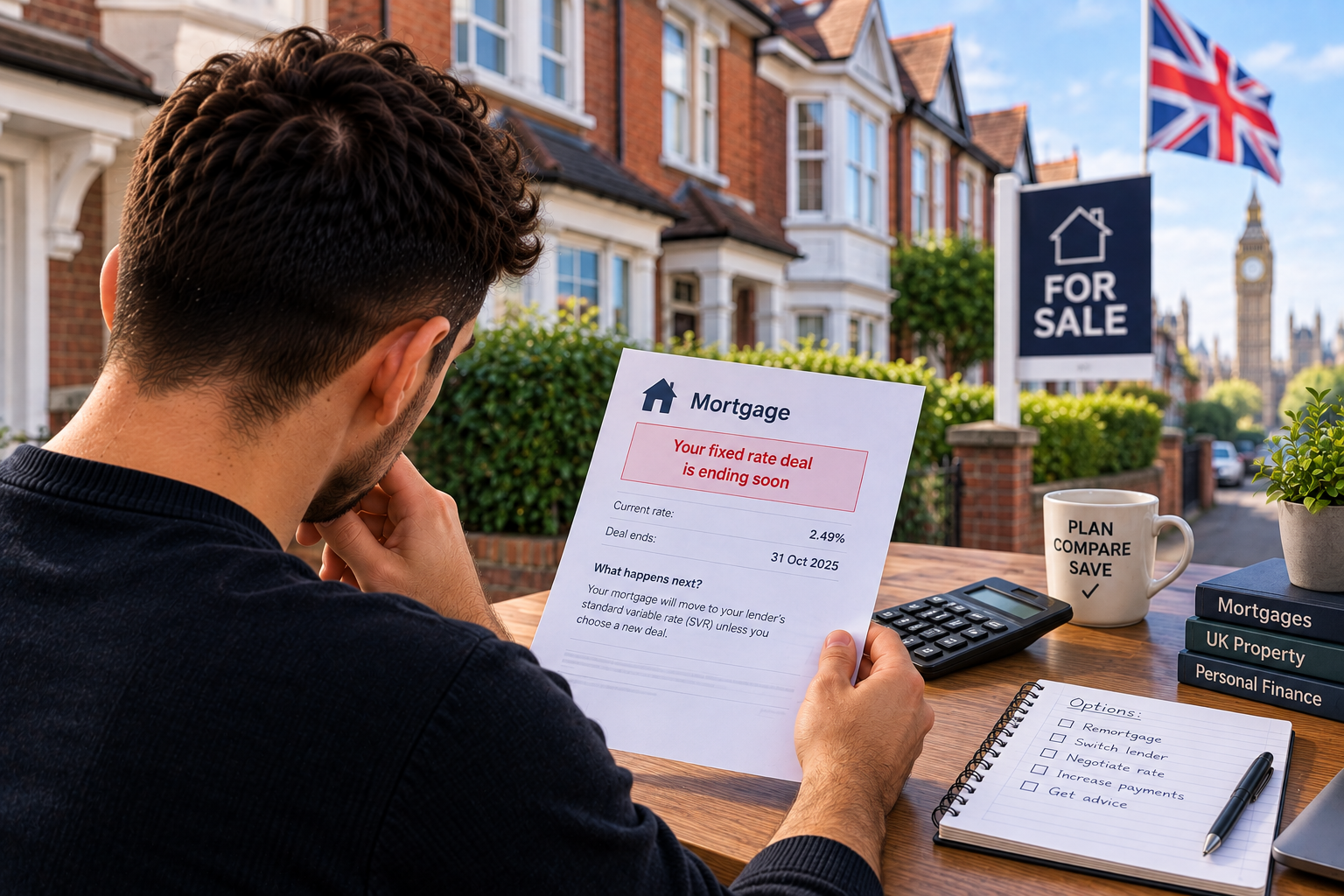
MoneyHelper says that when a fixed-rate deal ends, borrowers will generally move onto their lender’s **Standard Variable Rate (SVR)** unless they arrange another deal or remortgage.
An SVR is set by the lender and can change.
It is also typically more expensive than other mortgage deals available from that lender.
So doing nothing can potentially result in a higher monthly payment.
### Hypothetical Example
Imagine you have:
Mortgage balance: **£200,000**
Remaining term: **20 years**
For illustration, suppose your old rate was:
**3%**
A £200,000 repayment mortgage over 20 years at 3% would have principal-and-interest payments of roughly:
**£1,109 per month**
Now suppose the replacement rate were 5%.
The approximate payment would become:
**£1,320 per month**
Difference:
**£211 per month**
Over 12 months:
**£2,532 more**
This is only an illustrative calculation. Actual mortgage payments depend on your balance, term, mortgage type, lender, fees and available interest rate.
But it demonstrates why the end date matters.
## 3. You Don’t Necessarily Have to Stay on the SVR
You generally have several possibilities.
One is accepting the lender’s reversion rate.
Another is arranging a new mortgage product with your existing lender.
Another may be remortgaging with a different lender.
The right choice depends on your circumstances.
### Staying With Your Existing Lender
Your current lender may offer another mortgage deal.
Moving from one mortgage product to another with the same lender is commonly called a:
**Product transfer.**
This can sometimes be simpler than moving the mortgage to an entirely different lender.
MoneyHelper notes that a current lender may offer a new deal through a product transfer, while moving the mortgage to another lender is generally referred to as remortgaging.
Don’t assume your existing lender’s offer is automatically the best one, however.
Compare the complete cost.
## 4. You Could Remortgage to Another Lender
Remortgaging means replacing your current mortgage with a mortgage from another lender while remaining in your property.
Why would someone do that?
Potential reasons include:
A more attractive interest rate
Different mortgage features
Different fees
A deal that better suits future plans
Changing the mortgage term
Other personal financial reasons
But a lower advertised interest rate does not automatically mean a cheaper mortgage.
You need to consider the whole package.
MoneyHelper specifically warns that fees, charges and interest rates all need to be considered when deciding whether switching is worthwhile.
## 5. Don’t Compare Only the Interest Rate
Imagine these two hypothetical offers.
### Deal A
Rate: **4.60%**
Product fee: **£1,499**
### Deal B
Rate: **4.80%**
Product fee: **£0**
Which one is cheaper?
You cannot reliably answer from the interest rate alone.
It can depend on:
Mortgage balance
Mortgage term
Length of the deal
Product fees
Valuation costs
Legal costs where applicable
Cashback or incentives
Other charges
How long you expect to keep the mortgage
A slightly lower interest rate with a large fee isn’t automatically the better deal, particularly on a relatively small mortgage balance.
Calculate the total cost over the period you expect to keep the product.
## 6. Start Looking Before Your Current Deal Ends
Don’t wait until the final week.
MoneyHelper recommends starting to shop around around **six months before** your existing fixed or discounted deal moves onto the lender’s SVR.
There is another important protection in 2026.
Under the UK government’s Mortgage Charter, customers approaching the end of a fixed-rate deal with participating lenders can have the opportunity to lock in a new deal **up to six months in advance**. Eligible borrowers can also request a better like-for-like deal from their lender before the new deal begins if one becomes available, subject to the Charter’s conditions.
So if your mortgage deal ends in six months, this is not necessarily too early to start investigating.
It may be exactly the right time.
## 7. Your Property’s Value Can Matter
When considering a new mortgage, another important number is your:
**Loan-to-value ratio (LTV).**
Suppose your mortgage balance is:
**£240,000**
and your property is worth:
**£300,000**
Your approximate LTV is:
**80%.**
Now suppose several years later your balance has fallen to:
**£210,000**
and the property is worth:
**£350,000**
Your approximate LTV becomes:
**60%.**
A lower LTV can potentially give you access to different mortgage products because you’re borrowing a smaller percentage of the property’s value.
But property values can also fall.
If the value falls enough, remortgaging to another lender can become more difficult because a new lender assesses borrowing against the property’s current value. MoneyHelper notes that negative equity can reduce a borrower’s ability to shop around, although a product transfer with the existing lender may still be worth discussing.
## 8. Your Financial Situation May Have Changed
When you originally took your mortgage, perhaps you had:
Two full-time incomes
Low credit-card debt
No children
Stable employment
Lower monthly expenses
Several years later, things can be different.
Perhaps:
You changed jobs.
You became self-employed.
Your income changed.
You accumulated debt.
You had children.
Your partner stopped working.
Your credit history changed.
You want additional borrowing.
These changes can matter if you’re applying for a new mortgage with another lender because affordability and eligibility may need to be assessed.
That’s another reason not to leave everything until the last minute.
## 9. A Product Transfer Can Be Different
There can be an important distinction between taking a new deal with your existing lender and making a completely new mortgage application elsewhere.
The 2026 Mortgage Charter says borrowers who are up to date with payments can be supported to switch to a new mortgage deal at the end of an existing fixed-rate deal without another affordability check in qualifying circumstances. The Charter notes this applies across most of the mortgage market where the customer isn’t seeking additional borrowing or changing certain fundamental mortgage terms.
That does not mean every borrower or every mortgage change automatically qualifies.
Check directly with your lender.
## 10. Be Careful With Early Repayment Charges
Starting your research six months early doesn’t necessarily mean you should leave your current mortgage six months early.
Your existing deal may contain an:
**Early Repayment Charge (ERC).**
This can apply if you repay or switch away from certain mortgage deals before the agreed period ends.
MoneyHelper notes that fixed-rate mortgages can have charges for leaving the deal early.
Before switching, check:
When your current deal ends
Whether an ERC applies
How much it is
When it reduces or disappears
Whether your new mortgage can start when the old deal finishes
The objective is to prepare early—not unnecessarily trigger an expensive fee.
## 11. What If Interest Rates Fall After You Choose a New Deal?
This is another concern homeowners often have.
Imagine you secure a mortgage product several months before your current deal expires.
Then rates improve.
For borrowers covered by the Mortgage Charter, participating lenders have committed to allowing customers approaching the end of a fixed deal to request a better like-for-like deal with that lender before the new term begins, if one is available and subject to the relevant conditions.
Check your lender’s specific process and deadlines rather than assuming a switch will happen automatically.
## 12. What If You Can’t Afford the New Payment?
This is where early action becomes especially important.
Suppose you’re currently paying:
**£1,200 per month**
and the options you’re seeing would increase the payment to:
**£1,500.**
Don’t wait until you’ve already missed several payments before contacting your lender.
The FCA says simply speaking with your lender about your concerns does **not** itself affect your credit file, although some formal payment arrangements or reduced-payment options can be reported differently. Your lender should explain the implications of any support option.
The 2026 Mortgage Charter similarly encourages borrowers who are worried about payments to contact their lender as early as possible.
Depending on eligibility and circumstances, support can include options such as temporarily switching to interest-only payments or extending the mortgage term.
These options can reduce the immediate monthly payment, but they can also increase the total cost of the mortgage over time.
So they should not be viewed as “free savings.”
## 13. Extending the Mortgage Term Has a Trade-Off
Imagine you have:
**15 years remaining**
but the monthly payment feels too high.
Extending the mortgage to:
**20 or 25 years**
may reduce the monthly payment.
That sounds attractive.
But you would generally be repaying the debt for longer, which can increase the total interest paid.
For example, reducing your payment by £150 per month today doesn’t automatically mean you’ve saved money overall.
You may simply have spread repayment across more years.
Always compare:
**Monthly affordability**
against:
**Total lifetime borrowing cost.**
## 14. Don’t Forget Overpayments
If your finances have improved since you originally took the mortgage, you may be considering paying extra.
Overpayments can reduce the mortgage balance and potentially reduce future interest.
But check your existing deal first.
Some mortgages limit how much you can overpay without triggering a charge during the fixed period. MoneyHelper notes that many fixed-rate mortgages permit some overpayment without a fee, but the exact allowance depends on the product.
Never assume your limit.
Check your mortgage agreement or ask your lender.
## 15. Calculate the New Payment Before It Happens
Suppose your current household budget is:
Take-home income: **£4,200**
Mortgage: **£1,250**
Council Tax: **£190**
Energy/water: **£250**
Food: **£600**
Car/transport: **£550**
Insurance: **£150**
Phone/internet: **£90**
Debt/other commitments: **£300**
Other spending: **£450**
Total expenses:
**£3,830**
Remaining:
**£370**
Now imagine the new mortgage payment becomes:
**£1,500**
That’s an additional:
**£250 per month.**
Your remaining monthly buffer falls from:
**£370 to £120.**
That changes the household finances considerably.
This is why you should calculate the impact before the new rate starts.
## A Simple Timeline to Follow
If your fixed mortgage deal is approaching its end, a practical process could look like this:
**Around six months before:** Check the exact end date, outstanding balance, current property value, early repayment charge and deals available from your lender.
**Next:** Compare your lender’s product-transfer options with appropriate alternatives elsewhere.
**Before choosing:** Compare interest rate, fees, monthly payment, mortgage term and total cost—not only the headline rate.
**Before the old deal ends:** Make sure you understand exactly when the new product starts and what happens if you take no action.
**If affordability looks difficult:** Contact your lender early rather than waiting for a missed payment.
## Questions to Ask Before Choosing Your Next Mortgage
Before accepting a new deal, know the answers to these questions:
**What is the interest rate?**
**Is it fixed, tracker or variable?**
**How long does the deal last?**
**What will my monthly payment be?**
**What product fees apply?**
**Can fees be added to the mortgage, and what would that cost over time?**
**Are there early repayment charges?**
**How much can I overpay?**
**What happens when this new deal ends?**
**What is the total cost over the deal period?**
**Could changing the mortgage term significantly increase my total interest?**
Understanding those numbers is more important than choosing the mortgage with the most attractive advertisement.
## The Bottom Line
For Albanians paying a mortgage in the UK, the end of a fixed-rate deal should not come as a surprise.
If you do nothing, you will generally move onto your lender’s reversion rate—often its Standard Variable Rate—which can be higher than the rate you were paying.
Instead, start preparing early.
Know:
**Your fixed-deal end date**
**Your remaining mortgage balance**
**Your current interest rate**
**Your estimated property value and LTV**
**Any early repayment charge**
**The new deals offered by your lender**
**The cost of alternatives from other lenders**
**Your expected new monthly payment**
Most importantly, don’t compare mortgages only by the headline interest rate.
A mortgage is a long-term financial commitment.
**A difference of £100, £200 or £300 per month can become thousands of pounds over several years.**
And if you’re worried that the new payment may be unaffordable, contact your lender early. Current UK protections specifically encourage borrowers to seek help before the situation becomes a missed-payment problem.
*Disclaimer: This article is for general educational purposes only and does not constitute personalised mortgage, financial, tax, legal or investment advice. Mortgage rates, fees, eligibility and support options vary by lender and borrower. Consider speaking with your lender or an appropriately authorised mortgage adviser before making significant mortgage decisions.*