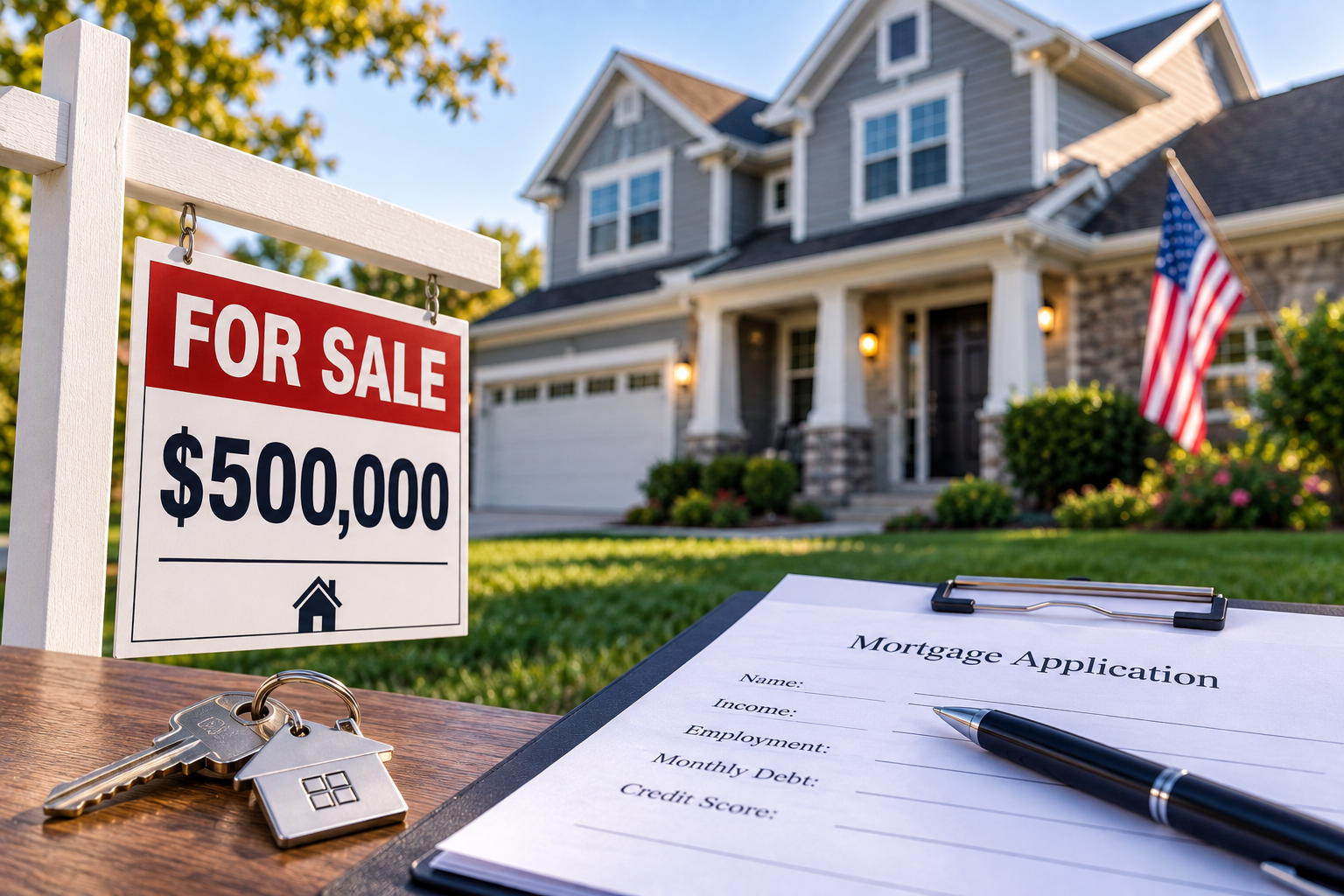
$500,000 Home in the U.S.: How Much Income Might You Need to Afford It?
A $500,000 home sounds straightforward.
You know the purchase price.
You know how much money you have saved.
So you might think the next question is simply:
“Can I qualify for a $500,000 house?”
But that’s not necessarily the right question.
A better question is:
“How much income would my household need to comfortably afford the total monthly cost of owning a $500,000 home?”
For Albanians living in America, this calculation can be especially important before beginning the mortgage process.
Because the true monthly cost isn’t just the mortgage principal and interest.
You may also have:
Property taxes
Homeowners insurance
Mortgage insurance
HOA fees
Utilities
Maintenance and repairs
And your required income can change dramatically depending on your down payment, mortgage rate and existing debts.
Let’s look at the numbers.
Start With the $500,000 Purchase Price
Suppose the home costs:
$500,000
The first major variable is your:
Down payment.
20% Down
Down payment:
$100,000
Mortgage:
$400,000
10% Down
Down payment:
$50,000
Mortgage:
$450,000
5% Down
Down payment:
$25,000
Mortgage:
$475,000
The house costs exactly the same in all three examples.
But the amount you’re borrowing is very different.
That changes the monthly payment.
It can also change mortgage-insurance requirements and other loan costs.
The CFPB notes that borrowers putting less than 20% down will often need mortgage insurance, which increases the cost of the loan.
Scenario 1: $100,000 Down
Let’s start with a substantial:
20% down payment.
Home price: $500,000
Down payment: $100,000
Mortgage: $400,000
For illustration, we’ll use a 30-year fixed mortgage at:
6.76%
That was the U.S. weekly average reported by Freddie Mac for September 10, 2026. Your actual rate could be higher or lower depending on credit, loan type, down payment, points, lender and market conditions.
On a:
$400,000 mortgage
at 6.76% for 30 years, the approximate principal-and-interest payment would be:
$2,597 per month
But we’re nowhere near finished.
Add Property Taxes
Property taxes vary enormously across the United States.
For illustration only, suppose property taxes equal:
$7,500 per year
That’s:
$625 per month
Our estimated housing payment becomes:
Principal + interest: $2,597
Property taxes: $625
Subtotal:
$3,222/month
Add Homeowners Insurance
Suppose homeowners insurance costs:
$2,400 per year
That’s:
$200/month
Now:
Principal + interest: $2,597
Property taxes: $625
Insurance: $200
Estimated total:
$3,422/month
The CFPB specifically warns buyers to calculate their total monthly home payment, including principal, interest, property taxes, homeowners insurance and applicable mortgage insurance rather than looking only at principal and interest.
What Income Could Support $3,422 Per Month?
There is no single income number that guarantees mortgage approval.
Lenders use different requirements, and your debts and financial profile matter.
However, one commonly cited mortgage budgeting rule of thumb is keeping total monthly housing obligations around:
28% of gross monthly income.
The CFPB’s homebuying worksheet presents 28% as a rule of thumb while explicitly noting that lenders may approve more or less depending on the borrower’s overall financial situation.
Using that simply as a budgeting benchmark:
$3,422 ÷ 0.28 = approximately $12,221 gross monthly income
Annual income:
$12,221 × 12 = approximately $146,650
So under these assumptions, a household income around:
$147,000 per year
would place this hypothetical $3,422 housing obligation around 28% of gross income.
That is not a required salary or an approval threshold.
It’s a planning example.
Scenario 2: Only 10% Down
Now suppose you don’t have:
$100,000
for a down payment.
Instead, you put:
10% down.
Home price: $500,000
Down payment: $50,000
Mortgage:
$450,000
At the same illustrative 6.76% 30-year rate, approximate principal and interest would be:
$2,922/month
Now assume the same hypothetical:
Property taxes: $625/month
Homeowners insurance: $200/month
That gives:
$3,747/month
before mortgage insurance.
Because the down payment is below 20%, mortgage insurance may apply depending on the loan.
Suppose, purely for illustration, mortgage insurance adds:
$175/month
Estimated monthly housing payment:
$3,922
Using the same 28% budgeting benchmark:
$3,922 ÷ 0.28 = $14,007 gross monthly income
Annualized:
About $168,100 per year
Notice what happened.
Same:
$500,000 house
But because you put less money down, the hypothetical income needed to keep the housing obligation around the same percentage of income increased significantly.
Scenario 3: 5% Down
Now imagine:
Home price: $500,000
Down payment: $25,000
Mortgage:
$475,000
At the illustrative 6.76% rate:
Principal + interest would be approximately:
$3,084/month
Add hypothetical:
Property taxes: $625
Homeowners insurance: $200
Mortgage insurance: $250
Estimated monthly payment:
$4,159
Using the same 28% planning benchmark:
$4,159 ÷ 0.28 = approximately $14,854 gross/month
Annualized:
About $178,250 per year
Again, this doesn’t mean:
“You legally need to make $178,250 to buy a $500,000 house.”
You might qualify with less.
You might need more.
The actual result depends on the mortgage product, taxes, insurance, interest rate, debt, credit profile, down payment and lender.
But it demonstrates why asking only:
“How much does the house cost?”
doesn’t tell you whether you can afford it.
Your Existing Debt Can Change Everything
Now imagine two Albanian families in America.
Both earn:
$150,000 per year.
Gross monthly income:
$12,500
Both want the same:
$500,000 home.
But their finances look very different.
Family A
Car payment: $400
Credit-card minimums: $100
Student/personal loans: $0
Existing monthly debt:
$500
Family B
Car payments: $1,300
Credit-card minimums: $600
Personal/student loans: $500
Existing monthly debt:
$2,400
Same income.
Same house.
Potentially very different mortgage situation.
Why?
Because lenders consider your:
Debt-to-income ratio — DTI.
The CFPB defines DTI as your monthly debt payments divided by your gross monthly income and notes that different lenders and loan products can have different DTI limits.
Example of DTI
Suppose:
Gross monthly income: $12,500
Proposed housing payment: $3,500
Other monthly debts: $500
Total monthly debt obligations:
$4,000
DTI:
$4,000 ÷ $12,500 = 32%
Now suppose other debts are:
$2,400
Total:
$3,500 + $2,400 = $5,900
DTI:
$5,900 ÷ $12,500 = 47.2%
Same salary.
Same mortgage.
Very different DTI.
This is why a household earning:
$130,000
with very little debt can sometimes be in a different financial position from a household earning:
$170,000
with substantial monthly debt.
For many mortgage products, lenders must consider and verify income or assets and debts and evaluate DTI or residual income when determining ability to repay.
Your Credit Score Can Affect the Calculation Too
Suppose you have:
$100,000 down
and:
$150,000 household income.
That still doesn’t tell us what mortgage rate you’ll receive.
Your credit profile matters.
A stronger credit profile may help you qualify for more favorable borrowing terms.
A weaker profile may result in a higher rate or different options.
And on a:
$400,000 mortgage
even a relatively small rate difference matters.
$400,000 Mortgage at Different Rates
For illustration:
5.75%
Principal + interest:
About $2,334/month
6.75%
Principal + interest:
About $2,594/month
7.75%
Principal + interest:
About $2,866/month
Difference between 5.75% and 7.75%:
About $532 every month
Annual difference:
About $6,384
That’s before considering taxes and insurance.
The CFPB identifies the interest rate as one of the major factors determining how much home a buyer can afford.
Don’t Forget Closing Costs
If you have:
$100,000
saved, don’t automatically assume:
“Great, I can put the entire $100,000 down.”
Buying a home involves other upfront expenses.
Depending on the transaction, you may have:
Lender costs
Title-related costs
Appraisal
Prepaid interest
Initial homeowners insurance premium
Escrow deposits
Inspection
Other closing expenses
The CFPB notes that mortgage closing can include upfront loan costs as well as prepaid insurance and initial escrow funding for future taxes and insurance.
So if you have exactly:
$100,000
in the bank, using every dollar as a 20% down payment could leave you without enough cash for closing and reserves.
And Don’t Empty Your Emergency Fund
Imagine:
Savings before purchase:
$130,000
You spend:
Down payment: $100,000
Closing/moving costs: $15,000
Money remaining:
$15,000
Then two months after moving in:
HVAC repair: $4,500
Plumbing problem: $2,000
Car repair: $1,500
Suddenly:
$8,000
of the remaining savings is gone.
Homeownership doesn’t eliminate emergencies.
It can create new ones.
The CFPB specifically advises buyers not to sacrifice savings simply to purchase a larger house and to budget for repairs, maintenance, emergencies and other financial priorities.
The Mortgage Payment Is Not the Entire Cost
Suppose your official monthly mortgage payment is:
$3,422
You may still need to pay:
HOA: $200
Utilities: $400
Maintenance reserve: $300
Landscaping/pest control: $100
Now the real monthly household cost associated with the property could approach:
$4,422
depending on the home.
The CFPB advises homebuyers to budget separately for maintenance, repairs and utilities in addition to the total mortgage payment.
This is why:
Mortgage approval ≠ comfortable affordability.
What If You Earn $100,000?
Suppose household gross income is:
$100,000/year
Average gross monthly income:
$8,333
A hypothetical housing payment of:
$3,422
would equal approximately:
41% of gross income
before considering:
Car loans
Credit cards
Student loans
Health insurance
Retirement contributions
Income taxes
Food
Utilities
Children
Transportation
Savings
Repairs
That could create a much tighter household budget.
It doesn’t automatically mean a lender would deny the application.
But from a personal affordability perspective, you should carefully examine how much money remains after all obligations.
The CFPB emphasizes that the amount a lender is willing to lend you can be different from the amount you can comfortably afford.
What If You Earn $150,000?
Gross monthly income:
$12,500
Using the hypothetical 20%-down payment:
$3,422/month
Housing represents approximately:
27.4% of gross income.
That’s much closer to the 28% planning benchmark.
But again, consider existing debt.
If you have:
Car: $900
Credit cards: $400
Student loan: $500
That’s another:
$1,800/month
before normal living expenses.
Income alone doesn’t determine affordability.
What If Household Income Is $200,000?
Gross monthly income:
$16,667
A:
$3,422
housing payment represents approximately:
20.5% of gross income.
That provides more room on paper.
But even a $200,000-income family can become financially stretched if it has:
Two expensive cars
Large credit-card balances
Childcare
Private-school costs
Student loans
High healthcare costs
Other properties
Lifestyle spending
Income is only one side of the equation.
Cash flow is what determines how the household actually feels each month.
Two Incomes Can Make a Major Difference
Suppose one spouse earns:
$85,000
and the other earns:
$70,000
Combined household income:
$155,000
Average gross monthly income:
About $12,917
That can make a $500,000 home look more manageable than trying to support it with one:
$85,000 salary.
But ask another question:
What happens if one income disappears temporarily?
Job loss.
Pregnancy.
Childcare.
Illness.
Career change.
Family responsibilities.
A mortgage can last:
30 years.
Your budget should have some resilience.
Don’t Let Preapproval Decide Your Budget
Imagine a lender tells you:
“You’re preapproved for $550,000.”
That doesn’t mean:
“You should spend $550,000.”
A lender is evaluating whether your application meets its lending criteria.
You are deciding whether the payment fits your:
Lifestyle
Savings goals
Family plans
Emergency fund
Retirement
Transportation needs
Travel
Children
Other priorities
The CFPB explicitly advises borrowers to focus on what they can afford rather than simply how much they qualify to borrow.
That’s one of the most important distinctions in home buying.
Property Location Can Completely Change the Answer
A:
$500,000 house
in one state can have very different ownership costs from a:
$500,000 house
somewhere else.
Why?
Property taxes can vary.
Insurance costs can vary.
HOA fees can vary.
Flood or other supplementary insurance may be necessary.
Utility costs can vary.
Maintenance needs can vary.
The CFPB notes that property taxes, homeowners insurance, supplementary insurance, HOA fees, utilities and maintenance all need to be considered when determining affordability.
So there is no universal:
“$500,000 house = $X per month.”
You need the numbers for the specific property.
A Better Way to Calculate Affordability
Before making an offer on a $500,000 home, calculate:
Home price: $500,000
Down payment: $_____
Mortgage amount: $_____
Interest rate: _____%
Principal + interest: $_____/month
Property taxes: $_____/month
Homeowners insurance: $_____/month
Mortgage insurance: $_____/month
HOA: $_____/month
Then separately estimate:
Utilities
Maintenance
Repairs
Emergency savings
Now compare the complete number with your:
Take-home income
not only your gross salary.
One Practical Example
Suppose an Albanian family in America earns:
$160,000/year
Gross monthly income:
$13,333
They buy:
$500,000 home
Down payment:
$100,000
Mortgage:
$400,000
Illustrative principal + interest:
$2,597
Taxes:
$625
Insurance:
$200
Housing payment:
$3,422
Add:
HOA: $150
Maintenance reserve: $300
Utilities: $400
Approximate broader housing-related cash flow:
$4,272/month
Then they also have:
Car payment: $600
Other debt: $300
Now you can see why simply saying:
“We make $160,000, so we can afford a $500,000 house.”
doesn’t answer the question.
The family needs a complete budget.
The Down Payment Changes More Than You Think
Compare our simplified examples:
20% Down
Down payment:
$100,000
Loan:
$400,000
Approximate P&I at 6.76%:
$2,597
10% Down
Down payment:
$50,000
Loan:
$450,000
Approximate P&I:
$2,922
Difference:
$325/month
And the 10%-down borrower may also have mortgage insurance.
5% Down
Down payment:
$25,000
Loan:
$475,000
Approximate P&I:
$3,084
Difference versus 20% down:
$487/month
Again, potentially plus mortgage insurance.
A larger down payment can reduce the amount borrowed and the loan-to-value ratio. The CFPB notes that LTV can affect loan eligibility, interest rates and mortgage-insurance requirements.
So How Much Income Might You Need?
For a hypothetical:
$500,000 home
with:
20% down
$400,000 mortgage
6.76% 30-year fixed rate
$625/month property taxes
$200/month homeowners insurance
we estimated a total mortgage-related payment around:
$3,422/month.
Using a 28% gross-income budgeting benchmark, that corresponds to approximately:
$147,000/year in household gross income.
With only:
10% down
and hypothetical mortgage insurance, our example moved toward:
$168,000/year
to keep the housing payment near the same 28% benchmark.
With:
5% down
the example approached:
$178,000/year.
But these are illustrations—not required incomes and not mortgage-approval predictions.
A household with low debt could have a different result.
A household with substantial debt may need much more financial room.
Taxes and insurance can change the calculation dramatically.
Your mortgage rate can change it again.
The Bottom Line
If you’re an Albanian living in America and considering a:
$500,000 home
don’t start by asking:
“Can the bank approve me?”
Start with:
“What will this house actually cost my family every month?”
At current illustrative rates, a $500,000 house with 20% down can mean a mortgage of:
$400,000
and principal-and-interest payments around:
$2,600 per month
before taxes and insurance.
Once hypothetical property taxes and insurance are added, our example reached approximately:
$3,422 per month.
And once you include maintenance, utilities and possible HOA costs, the true monthly cost can be considerably higher.
Your required financial capacity depends on:
Income
Down payment
Mortgage rate
Existing debt
Credit profile
Property taxes
Insurance
Mortgage insurance
HOA
and:
Your family’s other financial priorities.
The CFPB’s guidance makes an important distinction: how much a lender will let you borrow is not necessarily how much you can comfortably afford.
A $500,000 house can be affordable for one family and financially stressful for another family earning the same salary.
The purchase price tells you what the house costs. Your complete monthly budget tells you whether you can afford it.
Disclaimer: This article is for general educational purposes only and does not constitute personalised mortgage, financial, tax, insurance, investment or legal advice. Mortgage rates change frequently, and the 6.76% rate used above is the Freddie Mac U.S. weekly average for a 30-year fixed-rate mortgage as of September 10, 2026—not a rate guaranteed to any borrower. Property taxes, insurance, mortgage insurance, closing costs and lender requirements vary significantly by borrower, property and location.