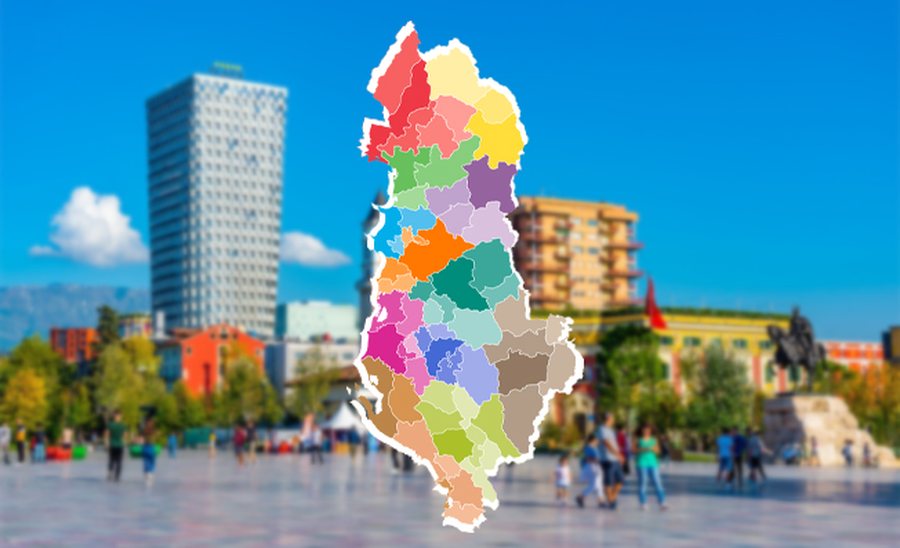
After a session accompanied by debates, opposition and controversy, the Parliament approved the law on the new Territorial Map after midnight. The initiative received 85 votes in favor and brings significant changes to the organization of local government in the country.
According to the new division, the current 28 municipalities are consolidated into 13 larger municipalities. As a result, Albania will have a total of 46 municipalities, 71 constituent cities and 387 administrative units.
The model maintains the municipality as the sole unit of local self-government, with a mayor, a municipal council, an administration, and a common budget. In total, 13 municipalities with a population of about 225,000 inhabitants will merge with neighboring units.
In the Tirana Region, the capital city does not undergo any changes in its structure, while Kavaja and Rrogozhina merge into a single municipality. Another innovation is the creation of the administrative unit of Rinas, which will be part of the Municipality of Tirana.
The new Rinas unit will include the village of Rinas, currently part of the Municipality of Krujë, as well as Bërxulla and Domje from the Municipality of Vorë. In this way, the territory of the “Mother Teresa” International Airport and the economic zone around it will be included in a single administrative unit.
The Lezha region is not affected by the reorganization. In Shkodër, meanwhile, Fushë-Arrëzi merges with Puka.
Significant changes are foreseen in the Berat region, where the number of municipalities is reduced from five to three. Berat merges with Poliçan and Dimal, while Kuçova and Skrapar continue to function as separate municipalities.
The Elbasan Region will also have fewer municipalities. Përrenjas merges with Librazhd, a decision that has been opposed by some residents of the area. Meanwhile, the Elbasan Municipality expands to include Belshi and Cërriku. Peqin and Gramshi maintain their current status.
In the Fier Region, the Municipality of Fier expands by merging with Patos. Lushnja, on the other hand, merges with Divjaka, extending its territory to the coast.
In Dibër, the change consists of the merger of Klos with Mati.
The reorganization also significantly affects the Gjirokastra Region. Tepelena joins Memaliaj, Përmet joins Këlcyra, and Libohova joins the Municipality of Gjirokastra.
In the south of the country, Vlora expands to include Selenica. While in the Korça Region, Maliqi joins Korça, despite the opposition that has accompanied the proposal.
The Kukës region remains unchanged. It will continue to consist of the three current municipalities: Kukës, Has and Tropojë.
In drafting the new map, according to the proponents, not only demographic and financial indicators were taken into consideration, but also distances, road connections, geographical continuity, the presence of minorities and the identity characteristics of the areas.
For this reason, municipalities such as Pusteci, Finiqi, Dropulli, Tropoja, Hasi, Skrapari and Konispoli maintain their status and are treated as special cases, regardless of the number of residents or economic indicators.