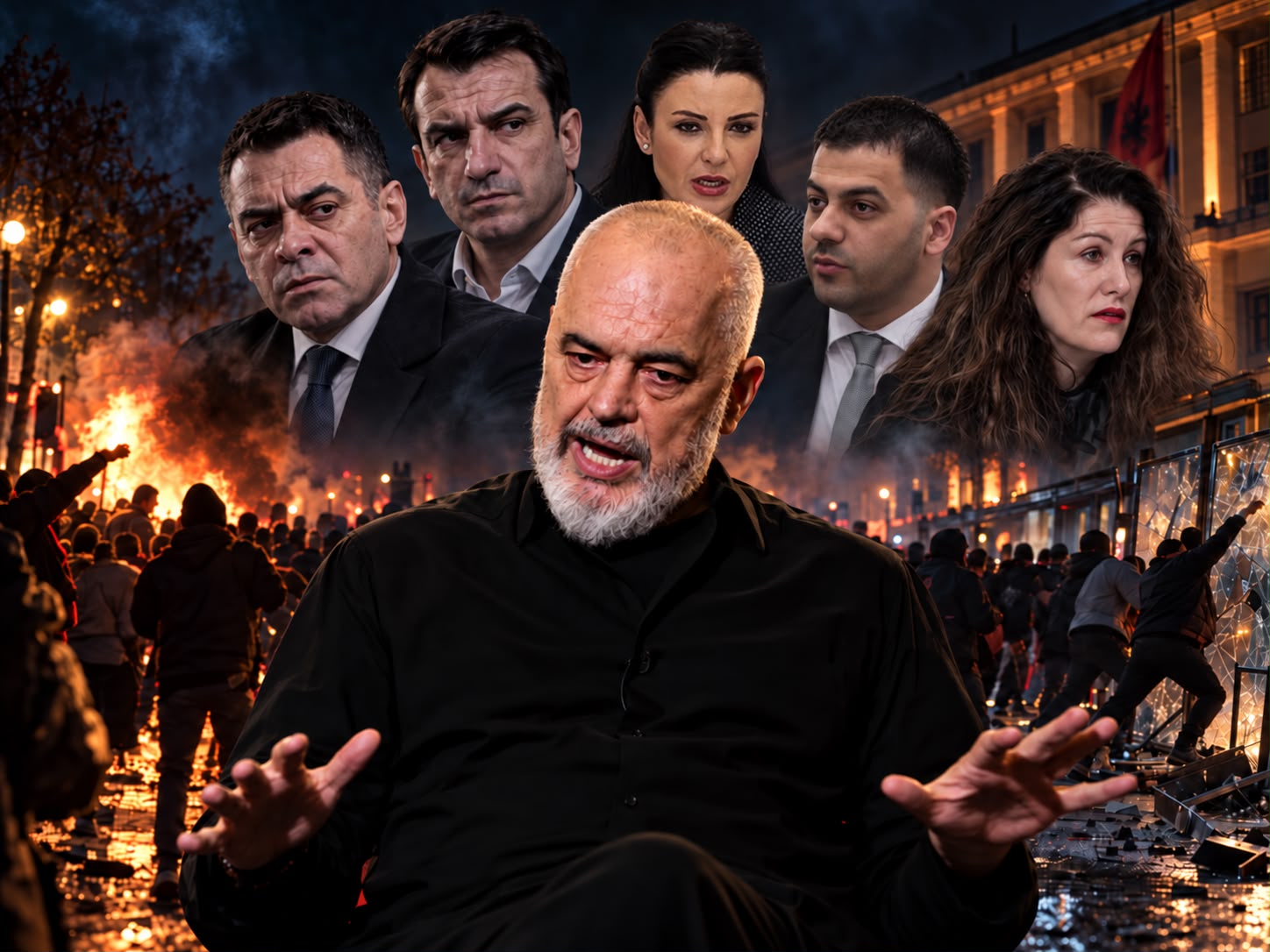
Violence, looting of businesses and destruction of public property cannot be justified. But neither can street violence be used to avoid the more important question of why thousands of young people have taken to the streets and what political response are they receiving?
The protests of these days did not start today, but have been building for months, culminating in March, when the government amnestied Belinda Balluku’s corruption.
The protest began with the cancellation of a project in Zvërnec, but once again the citizens’ voices were silenced. Then the protesters demanded the resignation of Prime Minister Rama, not for his personal faults, but for the criminal, corrupt and abusive governance scheme that he had set up in Albania, by his own people.
It is enough to mention Ahmetaj, Veliaj, Agas, Ilir Beqaj, SHISH Head Vlora Hyseni, arrested MPs like Jurgis Çyrbja, and even the untouchable Belinda Balluku.
This is the main reason, not to mention the fact that it created a repressive justice system, with mass incarcerations in recent years, comparable to those of the justice system.
Some of the protesters today are already demanding the removal of Edi Rama, while the prime minister has declared that he will not resign and that he is ready to discuss education reforms.
The problem for Rama is that today’s anger did not arise overnight. It has accumulated over the years and is burdened by a series of criminal cases that have affected important figures in power, the Socialist Party, or institutions run by government appointees.
Ahmetaj, former number two in the government, today a defendant and wanted
Arben Ahmetaj was not a peripheral official. He was a minister for years and then deputy prime minister under Edi Rama.
Today, SPAK has sent him to trial for nine episodes of passive corruption, money laundering, and concealment or failure to declare assets. He has been abroad for years and has an unexecuted security measure.
Criminal responsibility is personal and will be decided by the court. But political responsibility is another matter.
When the person you promoted to the position of Deputy Prime Minister ends up in such a file, this cannot be treated as if it were a person completely foreign to the system of government.
Veliaj, the mayor of Tirana, in prison
Erion Veliaj, one of the leading figures of the Socialist Party and former minister in the Rama government, continues to be under “prison arrest”.
SPAK has sent him to trial on 13 charges, including nine counts of passive corruption, money laundering, failure to declare assets, and abuse of office. Veliaj denies the charges and is presumed innocent until a final decision.
Here too, Rama is not criminally responsible for what the prosecution claims Veliaj did. But politically, when one of the main figures of the majority ends up in detention for such a file, the citizen has the right to ask whether we are dealing with isolated cases or with a broader problem of the system of power.
Ergys Agasi and the dossier that affected the institutions
Even the case of Ergys Agas is much more serious than an ordinary criminal story.
Agasi was not a member of the government, but his file has taken on an institutional dimension.
He has been arrested and is being investigated, among other things, for illegal competition through violence, illegal deprivation of liberty, violation of equality in tenders, active corruption, money laundering, and structured criminal group.
The political importance of the case lies in the fact that Agasi created a parallel state, appointed heads of institutions and indirectly benefited from millions of euros from public tenders of the National Agency for the Protection of Children and Youth.
Vlora Hyseni, the blow to the heart of SHISH
The case of former SHISH director Vlora Hyseni is perhaps symbolically one of the most serious.
In September, the GJKKO imposed “house arrest” and suspension from duty on her, while SPAK is investigating her for “supporting the perpetrator of the crime” and “disclosure of secret acts or data.” The investigation is specifically related to the alleged contacts with Agas.
To legally say that Hyseni “destroyed SHISH” would be more than what has been proven so far.
But politically it is impossible to deny that the investigation and suspension of the head of the secret service constitutes a serious institutional and reputational blow to the SHISH.
And Vlora Hyseni was a choice made by the current government.
Balluku, the case that continues to get worse
Then there is Belinda Balluku. She was one of the most powerful people in Rama’s cabinet, Minister of Infrastructure and Energy and Deputy Prime Minister, until her dismissal in February 2026.
SPAK has charged her with violating equality in tenders, while the investigation has been expanded to include suspicions of passive corruption and laundering of proceeds of crime. The prosecution has also seized two villas that it claims are in her indirect ownership.
Despite SPAK seeking authorization for her arrest, Balluku was not arrested. The issue has been a major source of political tension during the year and has fueled previous anti-government protests.
Rama may not have criminal responsibility, but there is a question of political responsibility
Here, a distinction must be made that is often lost in the Albanian debate.
No one can automatically hold Edi Rama criminally responsible for the actions that the prosecution attributes to Ahmetaj, Veliaj, Balluk or other persons.
Criminal responsibility is individual, but there is also political responsibility. Who elected the ministers? Who supported them? Who promoted them? Who built the administration and the political system in which these people took power?
After more than a decade in government, it is increasingly difficult for every scandal to be presented solely as someone else’s personal mistake.
In this sense, Ahmetaj, Veliaj, Balluku and the crises that have affected institutions like SHISH constitute a political cost for the Rama government, regardless of the final outcome that the courts will give in each file.
Rama is right to condemn the burning of institutions, attacks on the police, looting of businesses, and destruction of public property. But this is only half the problem. Stopping the violence does not mean that you have solved the reasons that produced the protest.
The student who complains about fees, the young person who sees no job prospects, the family who faces the cost of living, and the citizen who sees a series of corruption files at the top of power all demand a political response.
The real challenge for Edi Rama today is not just to restore order to the streets of Tirana.
It is to convince an increasingly angry part of society that after all these scandals, the system can be corrected and that political responsibility does not always end with the subordinate who appears in the next file./ VOXNEWS