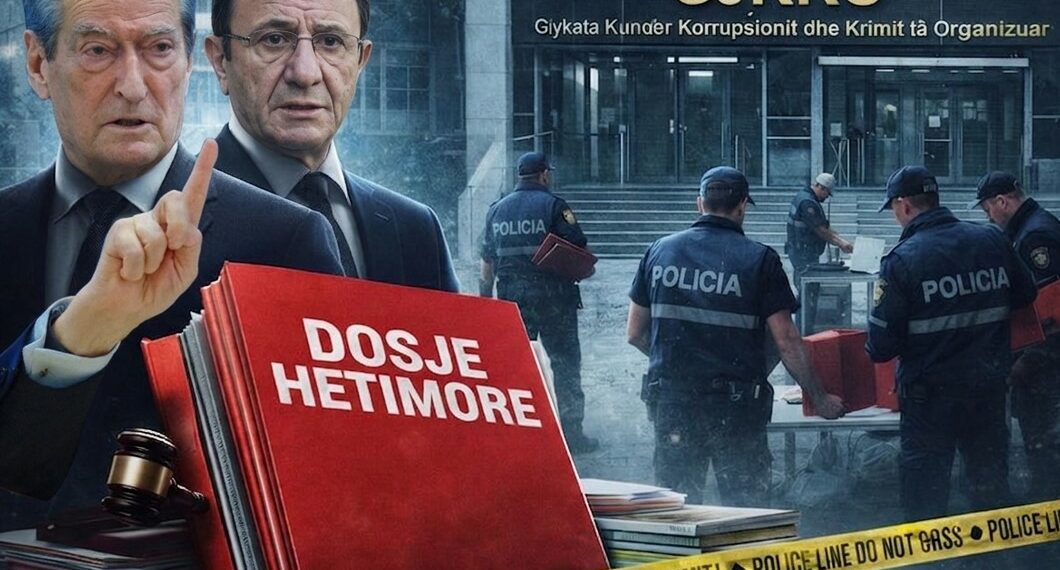
Untold from the hearing in the Special Court for the “Partizani” affair, Genc Ruli “washes his hands” of responsibility and sinks Sali Berisha, here is the testimony of the former minister that shakes the positions of the leader of the DP
The next hearing for the “Partizani” file was held yesterday in the Special Court (SCC), where the leader of the Democratic Party, Sali Berisha, and his son-in-law, Jamarbër Malltezi, are accused. In this hearing, the former Minister of Economy, Genc Ruli, who had a key role in the privatization of the former Partizani complex, gave testimony. During his testimony, Ruli stated that he obeyed the government’s program that planned to return the properties to their owners. However, beyond this political reasoning, the former minister has chosen to “wash his hands” of direct responsibility, strongly shaking the positions of former Prime Minister Sali Berisha. Ruli stated that the property should be privatized quickly as it was degraded, but he credited the final decision-making to former Defense Minister Fatmir Mediu.
Faced with difficult questions from the prosecutor of the Special Prosecution Office (SPAK) Enkeleda Millonai, he openly distanced himself from the scandal of the papers and the verifications of the legal criteria. “The state does not even have its own properties registered today, I am the minister and I do not do the verifications,” said Ruli, leaving the blame to the subordinate structures. Further, he appeared unclear about the changes to the 2007 sports law that prohibited privatization, saying that he did not remember the details of that time. This testimony is seen as a serious blow to Berisha’s defense, as his associate implied that everything was dictated by the government dome. The positions of the leader of the Democratic Party, Sali Berisha, have now been seriously shaken, while the process in the GJKKO regarding the “Partizani” affair is taking on quite dramatic proportions for the accused. Below we are reflecting part of Mr.’s testimony. Ruli, as we clarify, every person is presumed innocent until proven guilty by a final court decision.
Genc Ruli’s testimony:
SPAK Prosecutor, Enkelda Millonai: When were you Minister of Economy?
Former Minister of Economy, Genc Ruli: 2005-2012. The Ministry of Economy is the representative of the state, the civil owner. No contract related to state property can be signed except by the Ministry of Economy. It has the competence to supervise privatization procedures.
Millonai: For the Partizani sports club, how many processes have there been? Were there one club or two?
Genc Ruli: I have just heard in the media that there are two clubs. As politicians, we obey the government’s program. The Democratic Party had made a commitment that the owners of state properties would be seen. After ’91 and after ’97, the process was not exhausted and we had the priority of giving the owners opportunities. The property was known. They had the right of pre-emption. In recent months, the government could not carry out privatizations. Privatization was being carried out, but without considering the interests of the owners. I told the owners that we would not move quickly, because there were procedural complications. Therefore, the period 2006-2008 is a period when a series of changes to legal and sub-legal acts were made.
Millonai: How many Partizani clubs were there?
Genc Ruli: One.
Millonai: How did you know that the owners had won it?
Genc Ruli: From the owners, but also from interested parties. The owners Begeja and Bekteshi or many others. There are many in the letters. I remember these surnames from the letters. Even the owner of the club at the time, Albert Xhani. I have told him twice that this process will go in favor of the owners. I have told him that I know that you had started the procedure before, but it will go to the owners. You, Xhani, will also get a building plot. The meetings were held in the office. There was an employee of mine who was always present. Possibly Moza Vokshi.
Millonai: Are we talking about two clubs, the football one and the multi-sport one?
Genc Ruli: I remember that Sportklub Partizani was mentioned. I have not heard two names. Since the first month of government in 2005, I wrote a letter to all ministries to submit the inventory of state properties they had, as well as the documents and claims of private individuals on them, so that we could start the process of returning the properties. Mediu was the first to respond. The decision was made by the ministry that owned the property, and we continued with the procedure.
Millonai: Minister Mediu responded in November 2005, while you approved it in 2007. Why this long time?
Genc Ruli: There were a multitude of different procedures and decisions. Today, there may be satellite-like rhythms, while in our time it took years. We had a program to return it to the former owners.
Millonai: Have you had any communication with the Ministry of Culture about the Sports Palace? Have you proposed to the Council of Ministers to approve the structure and salary levels for several institutions?
Genc Ruli: Regarding the problems of the privatization process. We had promised to move quickly, but it was complicated and I requested that the institutions have an employee to follow them. As for the proposal, the Ministry of Finance had it.
Millonai: VKM 195 of 1998. Was the activity carried out by these clubs interrupted?
Genc Ruli: I don’t remember. We were not the head of the church in the privatization process. We took for granted what they sent us. Something successful and functional would not be sent for privatization. We trusted the ministry that sent the file.
Millonai: Were these properties registered as state property?
Genc Ruli: The state does not even have its properties registered today. Only a small portion may have been mortgaged.
Millonai: Did you verify if these properties were registered?
Genc Ruli: I am the minister. I don’t do the verifications. I believe I had good employees who should have done the verifications.
Millonai: Do you remember the privatization procedures?
Genc Ruli: In any case, a proposal had to come from the ministry that owned the property and that judged that it should be privatized. That property had been degraded and destroyed and we wanted to speed up the process so that even the little value it had was preserved. We set up an evaluation commission that would evaluate the value of the property. This was in cases where the right of pre-emption was reserved. I received a letter that it had been approved.
Millonai: Subsequently, there was a change in the law on sports, which stipulated that sports facilities could only be provided through concessions, they could not be privatized.
Genc Ruli: I don’t remember. It should have been done in 1995, because the sports properties had to be privatized.
Millonai: The law was changed in October 2007 to allow concessions without changing the destination. In 2008, you approved privatization when the law prohibited it. Since the witness does not remember…
Genc Ruli: It wouldn’t be an obstacle. It would be given to the owners on an emphyteusis basis.
Millonai: The Ministry of Finance was asked to inform whether the sports facilities still had the status?
Genc Ruli: I don’t remember. It must have been done at the directorate level. It was the Ministry of Defense that took it for privatization.
Millonai: In 2008, Pango requested opinions on amending the sports law. Do you remember the amendments to Article 31?
Genc Ruli: From what I read today, what was changed was done late. It should have been changed earlier. I say it was done late.
Millonai: In December 2008, you submitted a draft decision to the Council of Ministers on changing the payment for privatized facilities. Do you remember?
Genc Ruli: If it’s the bonds, we’re still late. Since 1991, the state had all the public property. There were a lot of expropriated people, there were persecuted people who were demanding compensation, and the state created securities and privatization bonds. Privatization bonds also benefited ordinary citizens, who were considered contributors to public property. Privatization with bonds increased the value of properties by up to 180%. We had an electoral and governmental promise that we would return the treasury bonds and that the former owners would have priority.
Millonai: Why was it done in 2008?
Genc Ruli: Because then the opportunity was created. In the history of government there are always coincidences, but it does not mean that there is something behind it. In 1995 it was 100% with treasury bills. The Minister of Finance wanted it to be with cash and therefore it was agreed that 30% would be cash and the rest with treasury bills.
Millonai: The Ministry of Labor has issued an order and the Minister of Defense has issued an order for the capitalization of state buildings, enterprises and institutions until the development of construction. Have you had any communication with the Ministry of Labor? Regarding the Property Restitution Agency. You have proposed that it be subordinate to the Prime Minister and appointed by the Council of Ministers upon the proposal of the Prime Minister. Working groups have been created to amend this law. Have you participated in the drafting of legal acts to provide your opinion?
Genc Ruli: I don’t remember. It must have been something under the direction of the Ministry of Justice.
Millonai: Olldashi proposed to be subordinate to the Minister of Justice. Why did you want him to be subordinate to the Prime Minister?
Genc Ruli: There should be more centralized structures.
Millonai: When did you meet the defendants?
Genc Ruli: I have known Sali Berisha since December 1990. I have an idea that I have fixed on Jamarber among the students of December. I know Xhimi as a Tirana boy. I know Andia Pustina who was an employee at the Ministry of Construction. I have met her in the corridors. I initially addressed all the ministries in the first days of September, because one of the tasks of the program was privatization and we had to give them priority. We had to know what their status was and who the owners were. I received a letter from Mediu that the Partizani club was outside the distribution plan, but he gave us a decision. I said: you have the authority whether to keep it or not. Mediu then replied that they would privatize it.