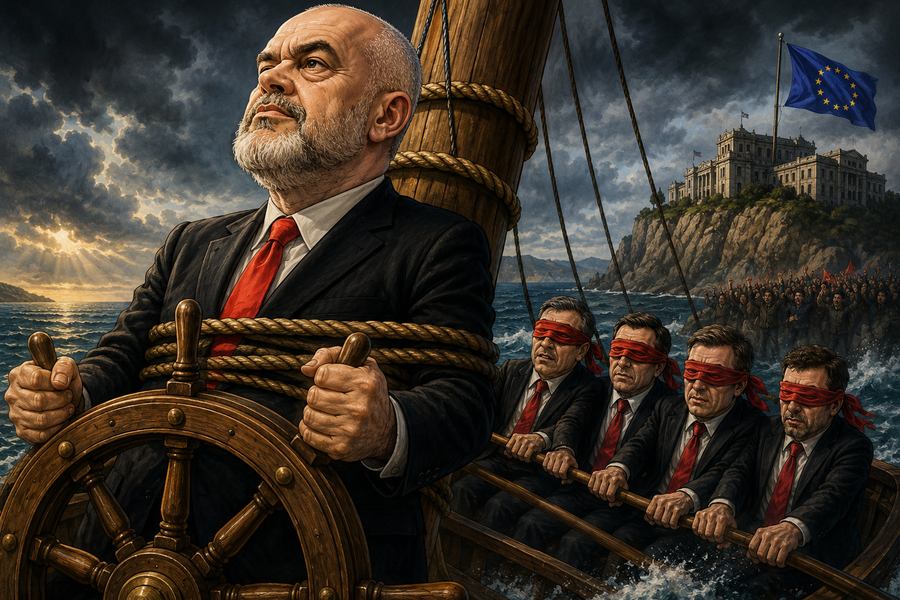
With the metaphor of Odysseus, Rama was not talking to the socialists, but to his real opponents. Between the carrot for Spiropali and the lobbying against Berlin, the prime minister is signaling that he has no intention of leaving the ship without sinking with it.
The use of the fable of Odysseus in the Iliad, who is tied to the mast of the ship with a rope so as not to hear the sirens, while his companions have their ears covered so that they cannot hear anything, was an interesting finding.
Because, in truth, in the Socialist Party there is no one who listens or speaks without a plan or order from the big boss.
In fact, anyone who dares to step outside the choir is immediately declared an enemy.
He made this clear in his long and awkward speech that lasted more than an hour.
If you look closely at that speech, in addition to paying attention to style, language, metaphors, and symbolism, Edi Rama has politically reclaimed an old figure, used years ago by Ilir Meta.
Meta, at the time he was President of the Republic, told the Americans that he would sacrifice himself like Salvador Allende in Chile if they attempted to remove him from the Presidency.
This did not happen.
But everyone remembers how his political adventure ended after leaving the Presidency.
Edi Rama, with the metaphor of Odysseus tied to the mast until reaching his final destination, Italy, was not talking to the socialists.
He was communicating with those he considers to be the true organizers of the movement demanding his removal from power.
Namely with the big fish of the European Union and especially with the Germans, who according to him are at the center of this political battle.
Speaking to those he believes support the protests against him, Rama has sent a clear message:
He won’t leave the ship.
Unless she drowns with him.
In other words, he is repeating one of the most well-known vices of autocratic leaders, who believe that their departure brings disaster.
It is the same logic that is summarized in the famous phrase attributed to Louis XV:
“After me, the deluge” — not meje, qameti.
Sali Berisha used the same philosophy when he told Boston Globe journalist Peter Lukas that his departure would bring destabilization.
In a more refined and literary form, Edi Rama is saying the same thing today.
If they want to get rid of him, they have to sink the ship.
So he is responding to efforts to divide the Socialist Party, through internal critics and demands for his removal.
As happened recently with Fatos Tarifa.
Meanwhile, after attacking some of his critics, Rama also made a direct offer to Elisa Spiropali.
When he mentioned the “Agreement for Albania,” which she had floated as an idea on social media, he signaled that he is willing to negotiate.
He said that he has never seen such a document before.
Which in political translation means that the door remains open.
So I’m using the carrot.
Meanwhile, with the Europeans, and especially the Germans, who according to him are behind this political battle, Rama has entered a phase of intensive lobbying.
The interview with Zvërnec in the Frankfurter Allgemeine Zeitung was not just an interview.
It was a powerful lobbying movement.
Because to get there, influential intermediaries in German financial and political circles are needed.
And most likely, his contacts in Israel are also being used in this game.
On the other hand, Trump’s Americans have not yet moved.
The American president has his own problems in the USA.
Just a few days ago, at the inauguration ceremony of the Obama Presidential Center in Chicago, figures such as Bush, Clinton, and Biden were seen together, as well as Angela Merkel and Matteo Renzi from Europe.
A combination that indicates the existence of a broad political front against Trump.
Therefore, the chances of Edi Rama receiving any decisive help from the Trumpist camp seem small.
Meanwhile, European factors seem increasingly united in supporting any factor that could weaken or overthrow it politically in Albania.
But the game has not yet entered its decisive phase.
On the contrary.
It seems we are still in the first act./Pamphlet