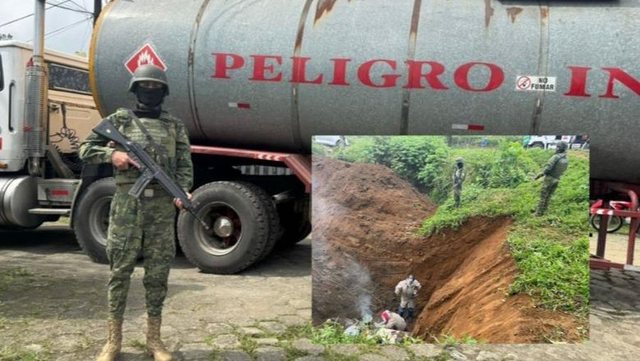
Ecuadorian authorities are investigating a suspected criminal network accused of setting up a sophisticated scheme to steal fuel from state pipelines. According to the Prosecutor’s Office, the organization has links to the Albanian mafia, while the file also raises suspicions of collaboration with police officers.
The investigation involves 16 people and reveals an activity that differs significantly from that for which Albanian groups have traditionally been investigated in Ecuador. If previously their name was mainly associated with international cocaine trafficking and money laundering, this time it is about the theft and illegal trading of hydrocarbons.
The court file, made public in July 2026, describes an organized structure that allegedly directly interfered with the pipelines of the state-owned company Petroecuador and then transported the stolen fuel with heavy vehicles.
Damage estimated at $127 million
According to investigation data, the criminal activity is suspected of causing damage to the Ecuadorian state amounting to approximately $127 million.
The Quito–Santo Domingo–Esmeraldas line alone is suspected of accounting for more than 60% of the total value of the thefts. By mid-July, authorities estimated that the network had managed to illegally obtain around 50,000 barrels of fuel.
The mechanism used required technical intervention in state infrastructure. Members of the group are suspected of opening illegal points in pipelines, which they called “operations” in their communications.
At these points, special connections, known to the group as “puppets,” were installed through which the fuel was diverted. The hydrocarbons were then pressurized through hoses and ended up in tankers mounted on heavy trucks.
Six episodes led investigators to the network.
The prosecution has reconstructed at least six episodes that are considered part of the same scheme.
The first case was recorded on January 16 in Quinindé, where police stopped a convoy of three vehicles and 11 tankers. Inside, over 11,000 liters of gasoline suspected of being illegally obtained were found.
During the operation, the drivers of the two trucks, Darwin Mora and Marco Pérez, were arrested, as well as Eddy Morales and José Ponce, who according to investigators coordinated the movement of the vehicles.
Another blow came on March 25 in the rural area of Esmeraldas. During an operation codenamed “Metanos,” police intervened just as a group was allegedly opening an illegal connection to the pipeline. Three people ended up in handcuffs.
Just two days later, in Quinindé, Miguel Calle and Danny Herrera were caught with two trucks carrying around 22,730 liters of gasoline.
One of the most dangerous episodes occurred on May 2 in La Unión. A failed intervention in a pipeline caused a massive leak, creating a column of fuel that reached about 30 meters in height. Due to the danger, the intervention of the army was also requested.
On May 9, authorities used a drone to uncover another suspected fuel smuggling site. Five days later, six abandoned vehicles were found, which investigators linked to the same activity.
Suspicions of corrupt police officers
One of the most serious elements of the case is the suspicion that the organization had managed to secure protection even within police structures.
Among those prosecuted is Mario Quintero, known by the nickname “Sargento.” He had been in the police force for about 20 years and is suspected of providing intelligence information to members of the network.
Telephone intercepts, according to the Prosecution, show that the organization had also created a payment system to avoid controls during fuel transportation.
Investigators claim that $1,000 was paid for the passage of a tanker truck, $1,500 for heavy “mule”-type trucks, and $500 for smaller vehicles.
In one of the intercepted conversations, it is alleged that, after stopping three loaded trucks, some Judicial Police agents demanded 2 thousand dollars in exchange for not formalizing the seizure and releasing the transporters.
Suspected connection to the Albanian mafia
Ecuadorian investigators link the structure to Albanian criminal networks that have been under surveillance in the country for years for cocaine trafficking and money laundering.
Also mentioned in this context is Dritan Gjika, known as “Tony”, previously accused of running a structure that used agricultural export companies and mining businesses to hide criminal activity and launder tens of millions of dollars.
Gjika was arrested in Abu Dhabi on May 26, 2025, and extradition proceedings have been initiated against him.
The new investigation suggests that criminal networks linked to Albanians may have diversified their activity, moving from drug trafficking and money laundering to the illegal hydrocarbon market.
16 people under indictment
On July 17, Judge Renán Andrade ordered the detention of 16 people involved in the case.
The prosecution considers Martín Quiñónez, known as “Quiño,” and José Ponce as suspected leaders of the organization. The other fourteen defendants are accused of having had various roles in the structure.
Among them are Eddy Morales, known as “Pato”, and Adrián Peña, nicknamed “Adri”, who, according to the indictment, were responsible for organizing the logistics and security of the operations.
The defense has contested some of the charges and security measures. Lawyers for some of the defendants claim that their clients have previously been convicted for similar episodes and argue that the new trial could constitute a double trial.
Marco Pérez, for example, was sentenced on February 20 to 24 months in prison, while Danny Herrera and Miguel Calle were sentenced for the March 27 episode in Quinindé.
Lawyers have also raised questions about the financial evidence presented by the prosecution, claiming that sufficient banking data and technical documentation from Petroecuador are missing.
The investigation continues, as Ecuadorian authorities try to determine the full extent of the network, its links to organized crime, and the role that corrupt officials may have played in the operation of the scheme.