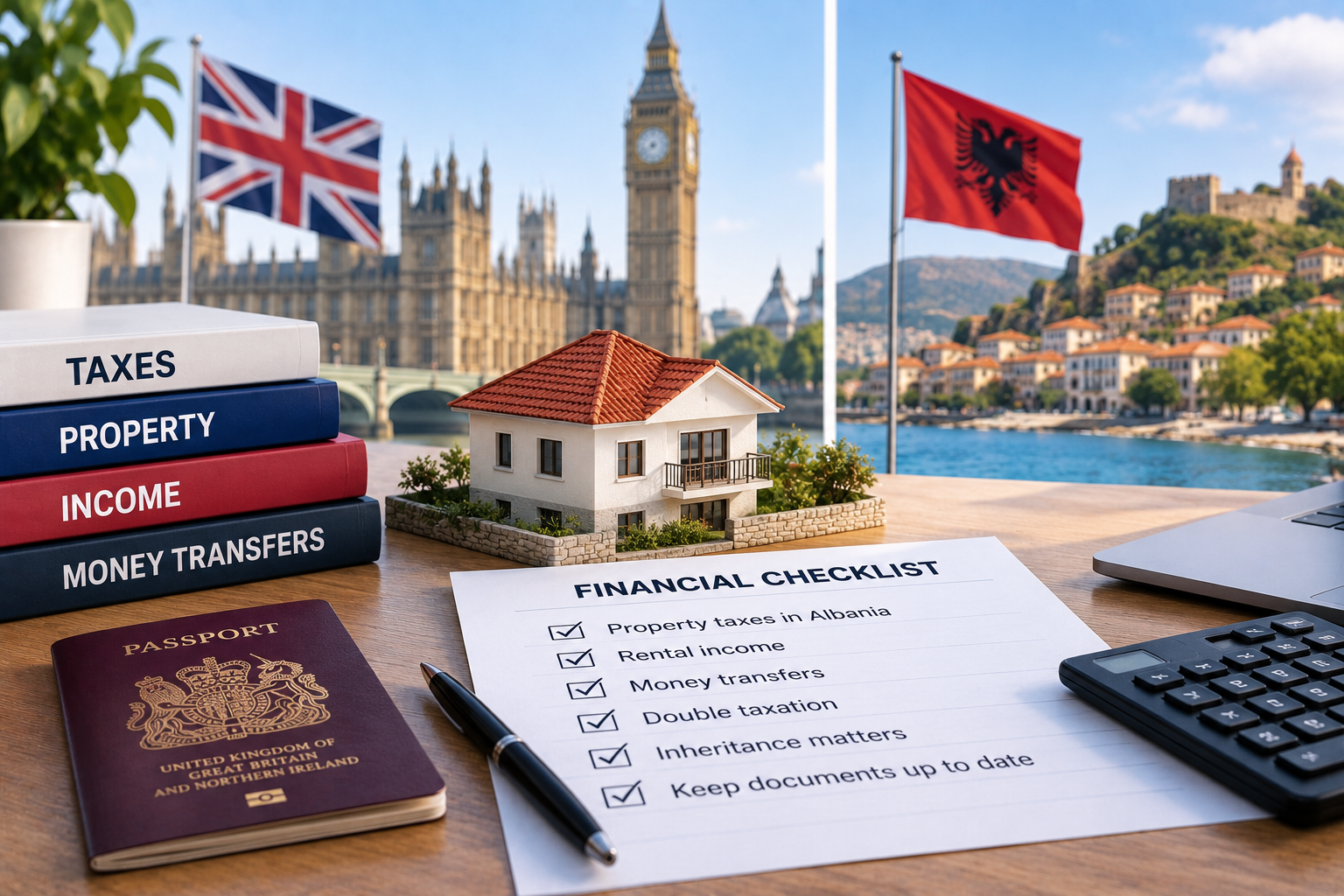
Thousands of Albanians living in the UK still have financial ties to Albania.
You might own:
A family apartment in Tirana
A house in your hometown
Land inherited from your parents
A holiday property on the Albanian coast
An apartment that you rent to someone else
Or property that you plan to sell in the future.
Owning property abroad isn’t automatically a problem.
But if you’re living in the UK, particularly if you’re **UK resident for tax purposes**, there are several financial and tax questions worth checking.
One of the biggest mistakes is assuming:
**“The property is in Albania, so it has nothing to do with my UK taxes.”**
That is not necessarily correct.
Depending on your UK residence status, how the property is used, whether it produces income and whether you eventually sell it, UK tax rules may become relevant.
Here’s what Albanian property owners living in the UK should understand.
## 1. First, Determine Your UK Tax Residence Status
Before asking how your Albanian property is taxed in the UK, you need to understand your UK residence status.
UK tax residence is determined under specific rules.
Simply having an Albanian passport, owning a house in Albania or thinking of Albania as your permanent home does not automatically make you non-UK resident for tax purposes.
Factors can include:
How many days you spend in the UK
Where you work
Where your homes are
Family and other UK ties
Your circumstances during the relevant tax year
This matters because UK residents will generally be subject to UK tax rules on foreign income, subject to available reliefs and special rules.
## 2. Renting Out Your Albanian Property Can Create Foreign Income
Suppose you own an apartment in Tirana.
You rent it for:
**€600 per month**
If it is occupied throughout the year, gross rent could be:
**€600 × 12 = €7,200 per year**
That income doesn’t necessarily become invisible to HMRC simply because:
The tenant is Albanian
The property is in Albania
Rent is paid into an Albanian bank
You don’t transfer the money to your UK current account
If you’re UK resident, foreign rental income can potentially fall within the UK tax system, depending on your circumstances and any applicable relief.
The key issue is not simply where the money is physically sitting.
## 3. Gross Rent Is Not Necessarily the Same as Taxable Profit
Imagine your Albanian apartment generates:
**€9,000 gross annual rent**
But you also have legitimate property-related costs.
Depending on the applicable UK tax rules, certain allowable expenses may be relevant when calculating taxable property profit.
These could potentially include qualifying costs associated with managing, maintaining or operating the rental property.
However, not every expense is automatically deductible.
Buying furniture, improving a property, making repairs and paying financing costs can all have different tax treatment.
Keep detailed records rather than simply calculating tax on whatever amount enters your bank account.
## 4. Keep Records of Rental Income
If you rent property in Albania while living in the UK, create a proper paper trail.
Keep records of:
Monthly rent received
Rental agreements
Bank transfers
Property-management fees
Repair invoices
Maintenance expenses
Insurance
Local property-related taxes and charges
Professional fees
Dates the property was rented
Periods when it was empty
The exchange rates used for UK tax reporting where relevant
Good records become particularly valuable if HMRC later asks how you calculated your foreign property income.
## 5. What If the Rent Stays in an Albanian Bank Account?
This is an important question.
Imagine your tenant pays:
**€700 every month**
into your Albanian bank account.
You never transfer those euros to Britain.
It can be tempting to think:
**“If I don’t bring the money into the UK, it doesn’t count.”**
Do not automatically assume this.
The UK rules for foreign income depend on your residence status and circumstances, and the taxation of foreign income changed significantly from April 2025.
Some qualifying new UK residents can potentially benefit from the **Foreign Income and Gains (FIG) regime**, subject to its conditions.
But you should not assume foreign rent is tax-free merely because it remains outside Britain.
## 6. New UK Residents Should Check the FIG Rules
The UK changed its taxation of foreign income and gains from **6 April 2025**.
This is particularly relevant for people who recently moved from Albania to the UK.
Qualifying individuals in their first years of UK tax residence after a sufficient period of non-UK residence may potentially claim relief for certain foreign income and gains under the current rules.
However, eligibility conditions matter.
Don’t assume:
**“I’m Albanian, therefore foreign income is exempt.”**
Nationality is not the test.
Your residence history and individual tax circumstances are much more important.
## 7. You May Need to Report Foreign Rental Income
Depending on your circumstances, foreign income can create a UK reporting obligation.
This can mean dealing with **Self Assessment** rather than relying entirely on PAYE from your UK employment.
PAYE normally deals with employment income paid through your employer.
It does not automatically mean HMRC has fully dealt with unrelated rental income you’re receiving from an apartment in Albania.
For example:
UK salary: **£40,000**
plus
Albanian rental income: **foreign property income**
The fact that tax is deducted from your £40,000 salary does not automatically settle the tax treatment of the Albanian property.
Treat the two income sources separately when checking your obligations.
## 8. What If You Already Pay Tax in Albania?
This is where international tax becomes more complicated.
The same rental income can potentially interact with the tax rules of more than one country.
That does not necessarily mean you’ll simply pay full tax twice.
Depending on the circumstances, double-taxation rules and **Foreign Tax Credit Relief** can potentially provide relief where income has been taxed abroad and is also taxable in the UK.
But don’t calculate this yourself by simply subtracting one tax rate from another.
The amount of relief available can depend on the income, taxes actually paid, applicable treaty rules and UK tax calculations.
Keep evidence of any Albanian tax paid.
## 9. Keep Albanian Tax Documents
If you’re paying tax, property charges or other relevant amounts in Albania, save the documentation.
That can include:
Tax receipts
Rental declarations
Payment confirmations
Official assessments
Invoices
Property documents
Bank statements
Contracts
If you need to claim foreign tax relief in the UK, documentation can become extremely important.
Saying:
**“I remember paying tax in Albania several years ago”**
is much less useful than having the actual records.
## 10. What If the Property Doesn’t Produce Income?
Suppose you own your parents’ old house in Albania.
Nobody rents it.
You use it for three weeks every summer.
There is no rental income.
Simply owning a foreign property doesn’t automatically mean you’re receiving taxable rental income.
But ownership can still become financially important later.
For example, issues can arise if you:
Start renting it
Sell it
Gift it
Transfer ownership
Inherit another share
Use it in estate planning
So even a property producing no current income deserves proper documentation.
## 11. Selling Your Albanian Property Can Have UK Tax Consequences
This is one of the most important points in the entire article.
Suppose you bought an apartment in Albania years ago for the equivalent of:
**£80,000**
You later sell it for the equivalent of:
**£150,000**
At first glance, the difference is:
**£70,000**
But that does not mean £70,000 is automatically the exact taxable capital gain.
The proper calculation can involve acquisition costs, disposal costs, qualifying capital expenditure, exchange-rate issues and available reliefs.
Most importantly:
If you’re UK resident when you dispose of overseas property, **UK Capital Gains Tax can potentially apply to the gain**.
The fact that the building is physically in Albania does not automatically remove it from UK CGT rules.
## 12. Currency Exchange Rates Can Matter
This is an issue many foreign property owners overlook.
Your Albanian property may have been:
Bought in Albanian lek or euros
Improved using euros
Sold years later in euros
But UK tax calculations are generally made in sterling.
Exchange-rate movements can therefore affect the UK tax calculation.
Imagine you bought a property many years ago when the pound-to-euro relationship was very different from the rate when you sold it.
You cannot always simply calculate the euro profit and convert the final number once.
International property capital-gains calculations can become complicated.
Keep the original dates and amounts for:
Purchase
Major improvements
Legal expenses
Sale
Other relevant transactions
## 13. Was the Albanian Property Ever Your Main Home?
This can also matter.
Different tax treatment may potentially apply when a property has genuinely been your main residence compared with a straightforward investment property.
For example, suppose you lived in your Albanian house for many years before permanently moving to Britain.
Later, you sell it.
Depending on your circumstances, residence history and applicable conditions, **Private Residence Relief** could become relevant.
But don’t assume:
**“It was my family house, so there’s no Capital Gains Tax.”**
The rules contain detailed conditions, particularly for overseas properties.
Get the calculation right before selling.
## 14. Inherited Property Needs Good Records Too
Many Albanians don’t purchase their Albanian property.
They inherit it.
For example:
Your father owns a house.
You inherit it.
Years later, while living in England, you decide to sell it.
Keep documents showing:
When you inherited it
The ownership transferred to you
Its relevant value at that time
Your ownership percentage
Subsequent improvement costs
The eventual sale price
These figures may become important when calculating a later capital gain.
## 15. What If You Own Only Part of the Property?
Albanian family properties are frequently shared.
For example:
You own **50%**
Your brother owns **25%**
Your sister owns **25%**
If the property produces rental income or is eventually sold, your beneficial ownership percentage can matter.
Don’t automatically report 100% of the property’s economics as yours if you legally and beneficially own only part.
At the same time, don’t assume income doesn’t need consideration simply because another relative collects the rent for you.
Make sure ownership and payment arrangements are clearly documented.
## 16. Sending Rental Money From Albania to the UK
Suppose you’ve accumulated:
**€20,000**
in an Albanian bank account from property income.
You then transfer it to your UK account.
Your UK bank might ask questions about the **source of funds**.
That doesn’t automatically mean you’ve done something wrong.
Banks have anti-money-laundering and financial-crime obligations.
Be prepared to show documentation such as:
Property ownership records
Rental agreements
Bank statements
Tax documents
Sale agreements, if the money came from selling property
Inheritance documents, where applicable
Keeping records makes legitimate international transfers much easier to explain.
## 17. Buying a Home in the UK With Money From an Albanian Property
This is particularly relevant for Albanian families.
Suppose you sell an apartment in Albania and receive:
**€100,000**
You want to use the money as a deposit on a UK home.
Your:
Mortgage lender
Solicitor
Bank
or another regulated professional
may ask where the deposit came from.
You might need evidence showing the complete chain:
**You owned the property → property was legally sold → buyer paid you → money entered your bank → money was transferred to the UK.**
Don’t wait until two days before completing a UK property purchase to find these documents.
## 18. Inheritance Tax Can Also Become Relevant
Inheritance planning for people with assets in multiple countries deserves special attention.
The UK changed its Inheritance Tax rules from **6 April 2025**, moving toward a residence-based system for overseas assets.
Under current rules, individuals who meet the definition of a **long-term UK resident** can potentially have overseas assets brought within the scope of UK Inheritance Tax.
That could include property outside the UK.
Therefore, someone who has lived in Britain for many years should not automatically assume:
**“My Albanian house can never be relevant to UK Inheritance Tax.”**
Your residence history can matter significantly.
## 19. Make Sure Your Will and Ownership Documents Work Together
If you own property in both the UK and Albania, estate planning can become complicated.
You might have:
A UK house
An Albanian apartment
UK bank accounts
An Albanian bank account
Workplace pensions
Investments
Children living in different countries
A spouse
Other heirs
Don’t assume a simple handwritten instruction will solve every cross-border inheritance issue.
UK and Albanian succession, tax and property laws can interact in complicated ways.
Consider obtaining appropriate professional advice in both jurisdictions, particularly if the assets are substantial.
## 20. Keep a “Foreign Property File”
One of the smartest things you can do is create a dedicated folder for your Albanian property.
Keep:
**Purchase contract**
**Ownership certificate**
**Inheritance documents**
**Property valuation**
**Purchase price**
**Improvement invoices**
**Rental agreements**
**Annual rental income records**
**Albanian tax payments**
**Bank statements**
**Legal fees**
**Property-management costs**
**Insurance records**
**Sale documents when eventually sold**
Keep digital backups too.
A property might be held for 20 or 30 years.
Documents that seem unimportant today could become extremely important when you eventually sell it.
## Example: Albanian Family Living in England
Consider a hypothetical example.
An Albanian couple lives and works in England.
They own an apartment in Albania worth approximately:
**€150,000**
They rent it for:
**€700 per month**
Annual gross rental income:
**€8,400**
They also have:
UK employment income
A workplace pension
A UK mortgage
An Albanian bank account
The mistake would be thinking:
**“Our UK employer already deducts tax, so everything is sorted.”**
Instead, they should ask:
Are we UK resident for tax purposes?
Does the Albanian rent need to be reported in the UK?
What allowable property expenses can be claimed?
Are we paying tax in Albania?
Can foreign tax relief apply?
What records should we keep?
What happens if we sell the apartment?
How will the proceeds be documented if we transfer them to Britain?
Could the property eventually be relevant to our estate and inheritance planning?
Those questions provide a much more complete financial picture.
## Seven Things Worth Checking
If you live in the UK but own property in Albania, review these seven areas:
**1. Your UK tax residence status**
This determines how foreign income and gains can be treated.
**2. Rental income**
Don’t assume foreign rent is irrelevant to HMRC.
**3. Albanian taxes**
Keep evidence of tax paid and investigate potential double-tax relief.
**4. Property expenses**
Maintain records of legitimate costs associated with the property.
**5. Capital Gains Tax**
Check the potential UK consequences before selling an overseas property.
**6. Source-of-funds documentation**
Especially important if you plan to move substantial property money into Britain.
**7. Estate and inheritance planning**
Long-term UK residence can make overseas assets increasingly relevant.
## The Bottom Line
Owning property in Albania while living in the UK can be an excellent financial asset.
It might provide:
Rental income
A future retirement home
Family security
Long-term capital value
Or money for a future UK house deposit.
But cross-border ownership also creates responsibilities that shouldn’t be ignored.
For a UK tax resident, the most important lesson is:
**“Foreign property” does not automatically mean “outside the UK tax system.”**
Rental income can potentially need reporting.
Selling the property can potentially create a UK Capital Gains Tax issue.
Tax already paid abroad may need to be considered through double-taxation rules.
Long-term UK residence can also affect how overseas assets are treated for Inheritance Tax.
And if you eventually transfer a large amount of money from Albania to Britain, having clear evidence showing where that money came from can be extremely valuable.
So if you live in Britain but still own a house, apartment or land in Albania, don’t wait until the property is sold to organise your finances.
**Check the tax position, keep the documents, understand your ownership and plan before moving or selling the money.**
*Disclaimer: This article provides general educational information only and does not constitute personalised UK or Albanian tax, legal, investment, property or estate-planning advice. Cross-border taxation depends heavily on residence status, ownership, dates, income, gains and individual circumstances. Tax rules can change. Consider obtaining advice from appropriately qualified professionals familiar with both UK and Albanian rules before selling, transferring, gifting or restructuring substantial property assets.*