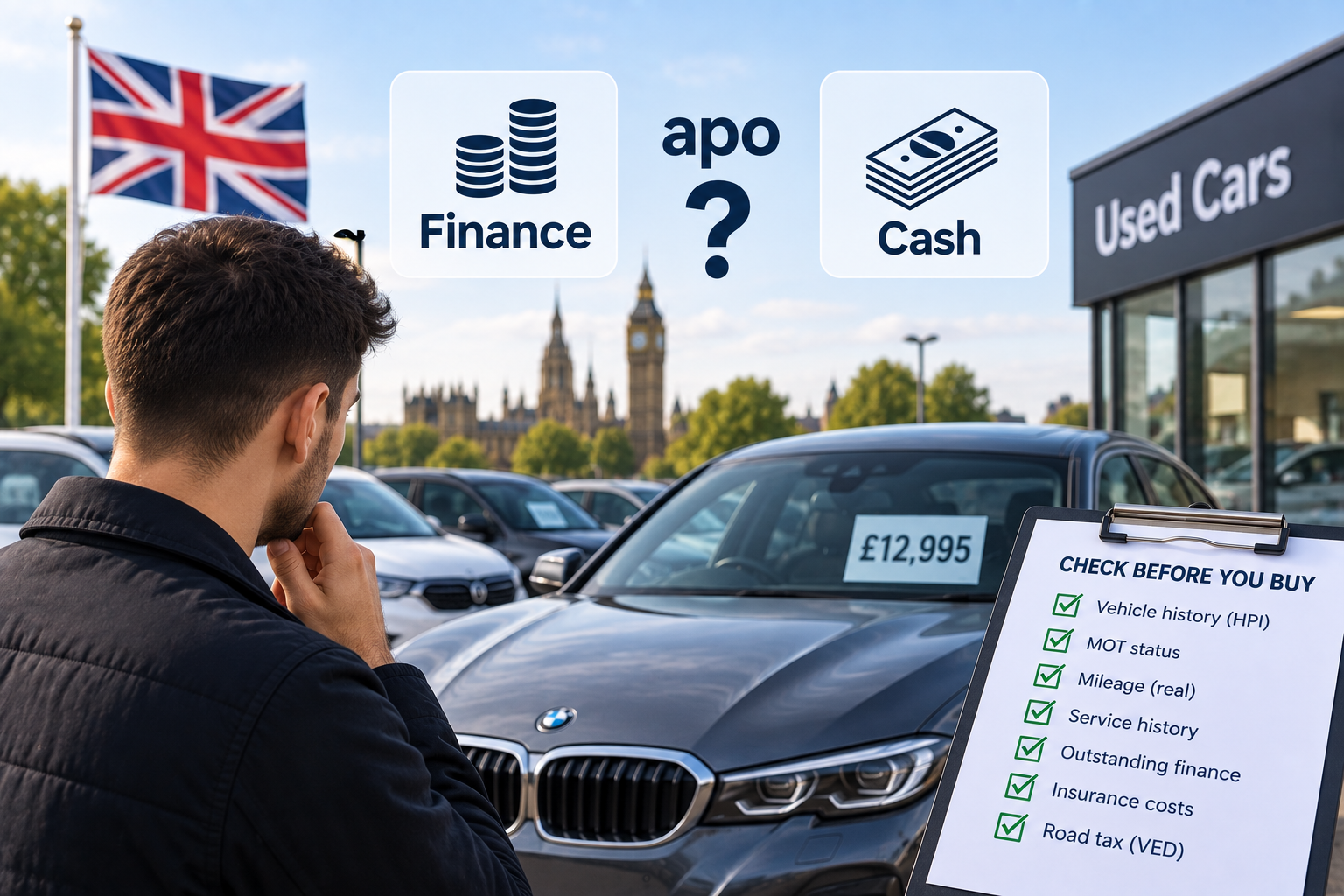
# Finance or Cash? What to Check Before Buying a Car in England
Buying a car in England can be one of the biggest financial decisions you make after housing.
For many Albanians living and working in the UK, the first question is often:
**Should I buy the car with cash or use car finance?**
A £15,000 car can look affordable when a dealer advertises a manageable monthly payment. But the monthly payment alone does not tell you how much the vehicle will really cost.
Interest, deposit, insurance, road tax, servicing, repairs, fuel, depreciation and possible final payments can dramatically change the numbers.
Before signing a car finance agreement or transferring your savings, here’s what you should check.
## 1. Start With the Total Price of the Car
Don’t start with:
**“How much can I afford per month?”**
Start with:
**“How much does this car actually cost?”**
Imagine a used car is advertised for:
**£18,000**
That is your starting point.
If you’re buying with cash, the calculation can be relatively straightforward. You negotiate the purchase price and pay for the vehicle without taking out a car-finance agreement.
With finance, however, £18,000 isn’t necessarily what you’ll ultimately pay.
Interest and other costs can increase the total.
This is why comparing a £300 monthly finance payment with an £18,000 cash price doesn’t tell you which option is cheaper.
## 2. Understand the Difference Between Cash and Finance
Buying with **cash** generally means using money you already have.
For example:
Car price: **£18,000**
Cash payment: **£18,000**
Finance interest: **£0**
You may still have other costs associated with buying and owning the car, but you’re not paying interest on a car loan or finance agreement.
With **finance**, you usually pay some amount upfront and borrow or finance the rest.
You then make repayments according to the agreement.
That gives you the ability to obtain the vehicle without paying the entire purchase price immediately.
But borrowing has a cost.
## 3. Don’t Look Only at the Monthly Payment
This is perhaps the biggest mistake car buyers make.
A dealer might advertise:
**“Drive away for only £299 per month.”**
£299 sounds affordable.
But ask:
For how many months?
How much deposit is required?
What is the APR?
Is there an optional final payment?
What is the total amount payable?
Are there mileage restrictions?
Are there additional fees?
Suppose one deal costs:
**£299 × 48 months = £14,352**
But you also paid a:
**£4,000 deposit**
You’re already at:
**£18,352**
And depending on the type of agreement, there may still be another payment or decision at the end.
Always look beyond the headline monthly figure.
## 4. Understand APR Before Taking Finance
One of the most important numbers when comparing borrowing is the **APR — Annual Percentage Rate**.
APR is designed to help consumers compare the cost of credit by reflecting interest and certain charges under standard assumptions.
Generally, a higher APR means more expensive borrowing, all else being equal.
Imagine two finance offers for the same car.
### Offer A
Monthly payment: **£350**
Lower APR
### Offer B
Monthly payment: **£320**
Higher APR but longer term
Offer B appears cheaper because the monthly payment is lower.
But extending the repayment period can mean you pay more overall.
The important number is not simply:
**Monthly payment**
It is:
**Total amount payable**
## 5. Ask for the Total Amount Payable
Before signing, find this figure.
Suppose:
Cash price: **£20,000**
Deposit: **£3,000**
Total amount eventually paid under finance: **£23,800**
The difference between the cash price and overall finance cost can be substantial.
That doesn’t automatically make finance a bad choice.
Keeping some savings available can be valuable.
But you should know exactly how much convenience and borrowing are costing you.
Never sign a multi-year agreement without understanding the total amount payable.
## 6. Understand Hire Purchase — HP
**Hire Purchase (HP)** is a common form of car finance.
With HP, you normally pay a deposit and then make monthly payments over an agreed period.
The finance company generally remains the legal owner of the vehicle during the agreement.
Once you’ve made the required payments and satisfied the agreement’s conditions, ownership can pass to you.
A simplified example might look like:
Car: **£16,000**
Deposit: **£2,000**
Amount financed: **£14,000**
Then monthly repayments plus applicable interest and charges.
HP can be easier to understand than some more complicated arrangements because the objective is typically to own the vehicle at the end.
But always check the agreement itself.
## 7. Understand PCP Before Signing
Another popular option is **Personal Contract Purchase (PCP)**.
PCP can produce attractive monthly payments because you aren’t necessarily paying down the entire expected value of the car through those monthly payments.
Typically, you’ll have:
An initial deposit
Monthly payments
An optional final payment if you want to own the car
At the end, depending on the agreement and circumstances, you may have options such as returning the car, paying the final amount to keep it, or potentially using the vehicle toward another arrangement.
The crucial point is:
**A low PCP monthly payment does not mean the car is cheap.**
Look at the entire agreement.
## 8. Pay Attention to the PCP Final Payment
Imagine you see:
Deposit: **£3,000**
Monthly payment: **£280**
Term: **48 months**
You might think:
“After four years, the car is mine.”
Not necessarily.
There could be a substantial optional final payment if you want to become the owner.
Suppose that payment is:
**£8,000**
That changes your financial planning significantly.
Before taking PCP, ask:
What is the final payment?
Can I realistically afford it?
What happens if I return the car?
What mileage limit applies?
What condition standards apply?
Are there potential excess-mileage or damage charges?
Don’t wait until month 48 to discover the answers.
## 9. Mileage Limits Can Matter
Mileage is particularly important with PCP and some other agreements.
Suppose your agreement assumes:
**8,000 miles per year**
But you actually drive:
**15,000 miles per year**
That difference can become important when the vehicle is returned, depending on the terms of the agreement.
Before choosing an annual mileage allowance, think realistically about:
Daily commute
Weekend travel
School runs
Family visits
Work-related driving
Trips around the UK
Don’t deliberately choose an unrealistically low mileage figure just because it makes the advertised monthly payment look better.
## 10. Cash Can Save Interest—but Don’t Empty Your Savings
Suppose you’ve saved:
**£22,000**
and want an:
**£20,000 car**
Technically, you could pay cash.
But after buying the car, you’d have only:
**£2,000**
left.
Is that a comfortable financial position?
What happens if:
Your boiler breaks?
You lose your job?
You need an emergency flight?
The car requires a major repair?
Your rent increases?
You face an unexpected family expense?
Avoiding finance interest can be valuable, but using almost every pound of emergency savings for a depreciating asset can also create risk.
## 11. Consider a Larger Deposit Carefully
If you choose finance, a larger deposit can reduce the amount you need to finance.
For example:
Car price: **£20,000**
### Option A
Deposit: £2,000
Amount remaining before finance costs: **£18,000**
### Option B
Deposit: £7,000
Amount remaining before finance costs: **£13,000**
Financing less money can reduce borrowing costs, depending on the terms.
But again, don’t empty your emergency fund simply to maximise the deposit.
Balance borrowing costs against financial security.
## 12. Check Your Credit Profile Before Applying
Your credit history can influence access to car finance.
Lenders can consider:
Credit history
Income
Existing debt
Affordability
Recent credit applications
Payment history
Other information
If you have missed payments, defaults or a limited UK credit history, you may find that available finance is more expensive or harder to obtain.
For Albanians who recently moved to Britain, limited UK credit history doesn’t necessarily mean poor financial behaviour.
It can simply mean there isn’t much UK credit information available yet.
## 13. Avoid Applying Everywhere at Once
If you’re searching for finance, don’t submit formal applications to numerous lenders without understanding how their searches work.
Formal credit applications can result in **hard searches** appearing on your credit report.
Several applications within a short period can potentially affect how lenders view your credit profile.
Where available, use eligibility checks or quotation tools that clearly state they use a **soft search** before making a full application.
## 14. Car Insurance Can Completely Change Affordability
You find the perfect car.
Price:
**£14,000**
Monthly finance:
**£260**
You think:
“Easy. I can afford £260.”
Then you request an insurance quote.
The premium is much higher than expected.
Now your affordable car doesn’t look so affordable.
Insurance prices can vary significantly depending on factors including:
Driver
Age and driving history
Location
Vehicle
Usage
Annual mileage
Coverage
Claims history
Other underwriting factors
Always get realistic insurance quotes **before committing to the vehicle**.
## 15. Don’t Forget Vehicle Tax
Check the applicable **Vehicle Excise Duty (VED)** for the specific vehicle.
Don’t assume every car costs the same to tax.
The amount can depend on factors such as the vehicle’s registration date, emissions, list price and applicable UK rules.
Two similarly priced cars can have different annual tax costs.
Check the specific registration before buying.
## 16. Fuel Is a Monthly Cost Too
Imagine Car A costs:
**£15,000**
and Car B costs:
**£17,000**
Car A looks cheaper.
But what if Car A uses significantly more fuel?
If you drive thousands of miles per year, fuel efficiency can change the long-term ownership cost.
Estimate:
Annual mileage
Realistic fuel economy
Current fuel consumption
Expected monthly fuel spend
Don’t choose a car based only on the price displayed in the dealership window.
## 17. Repairs and Servicing Matter
Used cars can create unpredictable expenses.
Budget for:
Routine servicing
MOT
Tyres
Brakes
Battery
Oil and fluids
Mechanical repairs
Unexpected breakdowns
A car with a low purchase price but a poor maintenance history could eventually cost more than a slightly more expensive vehicle in better condition.
Review the service history where available.
## 18. Check the MOT History
Before buying a used vehicle in England, check its MOT history.
The UK government provides an official online service where you can review information such as:
MOT results
Mileage recorded at tests
Failures
Advisories
Test dates
This can reveal useful information about the car’s history.
For example, repeated advisories for tyres, suspension or corrosion deserve attention.
An MOT pass doesn’t guarantee that a car is mechanically perfect, but the history can provide valuable clues.
## 19. Check the Vehicle’s History
Before handing over thousands of pounds for a used car, investigate its history.
Depending on the checks you perform, you may want to identify whether there are concerns such as:
Outstanding finance
Insurance write-off history
Mileage inconsistencies
Theft records
Registration problems
Other historical issues
This is particularly important when buying privately.
A car that looks perfect in Facebook Marketplace photos can still have financial or mechanical problems.
## 20. Depreciation Is a Real Cost
Cars usually lose value over time.
Suppose you buy a car for:
**£25,000**
Several years later, it is worth:
**£14,000**
You’ve lost:
**£11,000**
in market value.
You didn’t receive an £11,000 invoice.
But economically, depreciation is still a cost of ownership.
This is especially important when financing expensive or relatively new vehicles.
Don’t ask only:
**“Can I afford the monthly payment?”**
Ask:
**“How much will this vehicle likely cost me to own?”**
## 21. Calculate the Real Monthly Cost
Here’s a hypothetical example.
Car finance: **£320/month**
Insurance: **£150/month**
Fuel: **£180/month**
Vehicle tax equivalent: **£20/month**
Maintenance reserve: **£70/month**
Total:
**£740 per month**
And that still might not fully capture depreciation, parking, tolls, cleaning, unexpected repairs or other expenses.
The advertised:
**“Only £320/month”**
has become a much larger financial commitment.
## 22. Compare the Car Cost With Your Take-Home Pay
Suppose your monthly take-home pay is:
**£2,400**
Your real car-related expenses are:
**£740 per month**
That means more than:
**30% of your take-home income**
is being absorbed by the vehicle.
Then you still need to pay:
Rent or mortgage
Food
Utilities
Council Tax
Phone
Savings
Family expenses
Other debt
Whether that car is affordable isn’t determined by whether the lender approves you.
**Approval and affordability are not the same thing.**
## 23. Example: Cash vs Finance
Imagine a vehicle has a cash price of:
**£18,000**
### Cash Option
Purchase price: **£18,000**
Finance interest: **£0**
But £18,000 immediately leaves your savings.
### Finance Option
Deposit: **£3,000**
You finance the remainder under an agreement.
Your monthly payments may feel easier to manage, but interest and applicable fees can increase the overall cost.
Finance preserves more cash today.
Cash can avoid borrowing costs.
Neither answer is automatically correct.
The better option depends on:
Your savings
Emergency fund
Interest rate
Total finance cost
Monthly cash flow
Other debts
Financial goals
## 24. Questions to Ask Before Signing Car Finance
Before accepting any agreement, ask:
**What is the cash price?**
**How much is the deposit?**
**What is the APR?**
**What is the monthly payment?**
**How many payments will I make?**
**What is the total amount payable?**
**Is this HP, PCP or another type of finance?**
**Is there a final payment?**
**Will I own the car automatically at the end?**
**Are there mileage restrictions?**
**What happens if I want to end the agreement early?**
**Are there additional fees?**
If the salesperson can’t clearly explain the answers, don’t rush.
## 25. Never Buy Based on Emotion Alone
Cars are emotional purchases.
You see the interior.
You hear the engine.
You imagine driving it home.
Suddenly:
**£399 per month**
doesn’t seem expensive.
This is exactly when you need to slow down and calculate.
A four- or five-year finance agreement can outlast the excitement you felt during a 30-minute test drive.
Go home.
Review the numbers.
Compare insurance.
Check the vehicle.
Read the finance agreement.
Then decide.
## Cash or Finance: Which Could Be Better?
**Cash may make more sense when:**
You have enough savings after the purchase.
You want to avoid interest.
You don’t want another monthly debt commitment.
You value owning the car outright.
**Finance may make more sense when:**
Paying cash would seriously reduce your emergency savings.
You need to spread the cost.
The finance terms are competitive.
The monthly commitment comfortably fits your budget.
You fully understand the agreement.
Neither method is automatically superior for everyone.
The numbers matter.
## The Bottom Line
For Albanians living in England, buying a car should involve much more than asking:
**“Cash or finance?”**
The better question is:
**“What will this car actually cost me from the day I buy it until the day I sell it?”**
Before buying, check:
**Purchase price**
**Deposit**
**APR**
**Total amount payable**
**PCP or HP terms**
**Final payment**
**Mileage limits**
**Insurance**
**Vehicle tax**
**Fuel**
**MOT history**
**Servicing and repairs**
**Depreciation**
**Your emergency savings**
and most importantly:
**Your real monthly take-home income.**
A £300 monthly car payment does not mean you own a £300-per-month car.
Once insurance, fuel, tax, maintenance and other expenses are included, the real cost could be much higher.
So don’t let a low monthly payment make the decision for you.
**Compare the total cost, understand the finance agreement and make sure the car fits your budget—not just the lender’s approval criteria.**
*Disclaimer: This article is for general educational purposes only and does not constitute personalised financial, credit, legal or investment advice. Car-finance rates, APRs, insurance premiums, vehicle taxes and lender criteria vary and can change. Always review the specific finance agreement and current UK rules before signing a contract.*