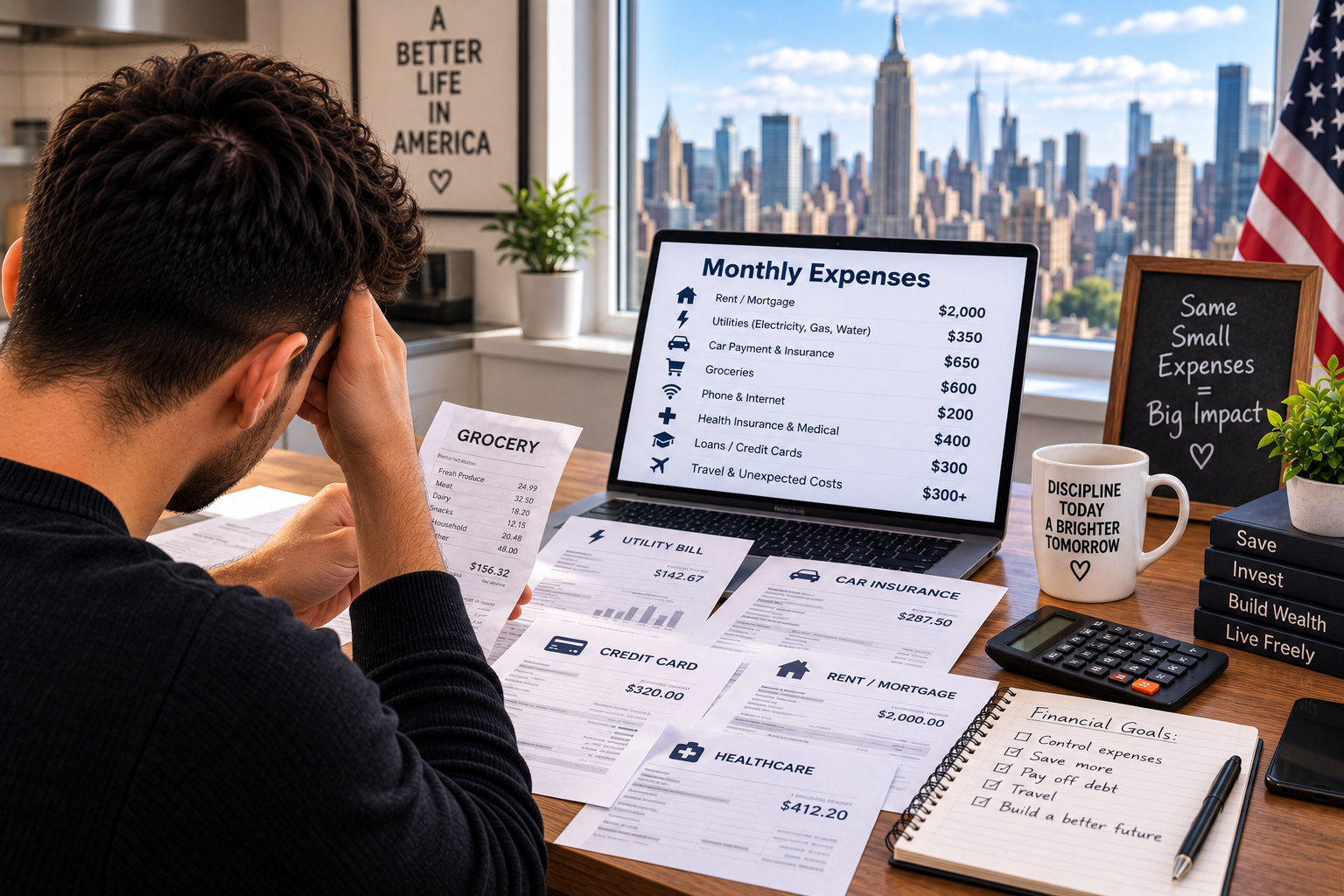
Albanians in the U.S.: 8 Expenses That Could Be Costing You Hundreds of Dollars Every Month Without You Noticing
Your paycheck arrives, the major bills get paid, and then something strange happens:
The money seems to disappear.
You know how much your mortgage or rent costs. You know your car payment. You probably know roughly how much you spend on groceries.
But what about all the smaller expenses happening throughout the month?
A few subscriptions. Food delivery. Bank or credit-card interest. Insurance add-ons. Extra shopping. Phone plans. Convenience purchases.
Individually, they may not look serious.
Combined, they can potentially consume hundreds of dollars every month.
For Albanians living and working in the United States, here are eight spending categories worth checking.
1. Subscriptions You Barely Use
Start with recurring subscriptions.
You might have:
Streaming services
Music
Cloud storage
Gaming memberships
Premium apps
News subscriptions
Gym memberships
Software
Delivery memberships
Other online services
One subscription costing $10 or $15 doesn’t look important.
But consider this hypothetical household:
Streaming service: $23/month
Second streaming service: $18/month
Music: $12/month
Cloud storage: $10/month
Gym: $40/month
Gaming: $20/month
Software/apps: $25/month
Other membership: $15/month
Total:
$163 per month
Annual cost:
$1,956
The problem isn’t necessarily that subscriptions are bad.
The problem is paying for subscriptions you no longer use.
Open your bank and credit-card statements and look for recurring charges.
Ask:
“Did I actually use this during the last month?”
2. Food Delivery, Restaurants and Work Lunches
Groceries are easy to identify.
Convenience food is harder.
Imagine you spend:
Coffee/snack: $7
Lunch: $15
Food delivery: $35
Restaurant dinner: $70
None of these purchases destroys a monthly budget by itself.
But repetition changes everything.
Suppose you buy a $15 lunch three times each week.
That’s:
$45/week
Across 52 weeks:
$2,340 per year
Now add coffee, delivery fees, tips and restaurants.
Food spending can quietly become one of the largest flexible categories in the household budget.
The latest Consumer Expenditure Survey from the U.S. Bureau of Labor Statistics reported average household spending of $10,169 on food in 2024, including $3,945 for food away from home.
That doesn’t mean your household should spend exactly that amount. Household size, location and lifestyle vary enormously.
It shows why food deserves its own detailed review.
3. Your Car Costs More Than the Monthly Payment
Ask someone:
“How much does your car cost?”
They may answer:
“$450 per month.”
Usually, they’re talking only about financing.
But the real cost can include:
Car payment
Insurance
Gas
Maintenance
Repairs
Registration
Parking
Tolls
Tyres
Car washes
Depreciation
Imagine:
Payment: $450
Insurance: $180
Gas: $200
Maintenance reserve: $75
Parking/tolls: $60
Total:
$965 per month
Annualised:
$11,580
And that example still doesn’t capture every possible ownership cost.
Transportation is a major household expense nationally. BLS reported average transportation expenditures of $13,318 per consumer unit in 2024.
Two Cars Can Change the Entire Household Budget
If a family needs two vehicles, the combined expense can easily become one of its largest monthly commitments.
Before buying a more expensive vehicle, don’t ask only:
“Can I afford the $550 payment?”
Calculate:
“What will this vehicle really cost me every month?”
4. Credit-Card Interest
This expense can be particularly easy to underestimate because you’re not buying anything new when the interest appears.
You’re paying for money you already borrowed.
Suppose your credit card has a:
$6,000 balance
and you’re carrying that balance from month to month.
Your statement may contain:
Purchases
Minimum payment
APR
Interest charged
Fees
If you’re making only small payments while continuing to use the card, the balance can remain expensive for a long time.
The Consumer Financial Protection Bureau recommends paying credit-card bills on time and notes that paying the balance in full each month can help consumers avoid interest on purchases when the card has a grace period.
Check the Interest Line
Open your latest statement.
Find:
Interest charged this period
Then check the previous 12 months.
If you paid an average of:
$100 per month
in credit-card interest, that’s:
$1,200 per year
without buying a single additional product with that $1,200.
5. Phone, Internet and Device Payments
Telecommunications bills can become surprisingly complicated.
You may be paying for:
Phone service
Device financing
Extra data
Phone insurance
Premium services
Home internet
Equipment
Additional family lines
Streaming bundles
Suppose a family pays:
Two phone lines/devices: $170
Home internet: $80
Phone insurance/add-ons: $30
Other related services: $20
Total:
$300 per month
That’s:
$3,600 per year
Review each line on the bill.
Perhaps every service is necessary.
But perhaps you’re paying for:
A device that’s nearly paid off
More data than you use
An add-on you forgot about
Insurance you no longer want
A premium plan you don’t need
The objective isn’t automatically to switch providers.
It’s to understand exactly what you’re paying for.
6. Insurance You Haven’t Reviewed
Insurance can be essential.
But that doesn’t mean you should stop reviewing it.
A household might pay for:
Auto insurance
Homeowners insurance
Renters insurance
Life insurance
Health insurance
Pet insurance
Other coverage
Rates and household circumstances can change.
For auto insurance, for example, changes involving your vehicle, drivers, location, mileage, coverage, deductibles and insurer pricing can affect what you pay.
When renewal arrives, review:
Premium
Coverage limits
Deductibles
Drivers
Vehicles
Optional coverages
Discounts
Don’t reduce important protection simply to save money.
And don’t compare two policies unless the coverage is genuinely comparable.
A cheaper premium with dramatically less protection isn’t necessarily a better deal.
7. Convenience Spending
This category rarely appears on a bill labelled:
“Convenience spending — $400.”
Instead, it appears as dozens of transactions.
For example:
Gas-station snacks
Coffee
Delivery fees
ATM fees
Last-minute convenience-store purchases
Small online orders
Impulse purchases
Ride-share trips
Parking
App purchases
Suppose you spend an average of:
$12 per day
on miscellaneous convenience purchases.
Across 30 days:
$360 per month
Across a year:
$4,320
Again, this doesn’t mean you should eliminate every coffee or convenience purchase.
But you should know the annual cost of habits that look insignificant daily.
8. Buy Now, Pay Later and Small Monthly Payments
This is another category that can make expensive purchases feel cheap.
Instead of seeing:
$1,000
you see:
“Only $100 per month.”
Then you do it again.
Furniture: $120/month
Phone: $45/month
Electronics: $80/month
Other instalment purchase: $65/month
Total:
$310 per month
Now add:
Car finance
Credit cards
Personal loan
Mortgage or rent
The household has gradually committed a large percentage of future income before the next paycheck even arrives.
The CFPB has warned that Buy Now, Pay Later borrowers can hold multiple simultaneous loans and that the products should be understood as a form of credit rather than free money.
Before taking another instalment plan, calculate all your existing monthly obligations together.
The “Only $20” Problem
One of the most dangerous phrases in personal budgeting is:
“It’s only $20.”
Consider five expenses:
Unused subscription: $20
Extra phone add-on: $20
App/services: $20
Convenience purchases: $20
Unnecessary membership: $20
Total:
$100 per month
Over one year:
$1,200
Over five years:
$6,000
That’s before considering what the money could have been used for elsewhere.
Small recurring costs become large because they repeat.
Look at Annual Cost, Not Just Monthly Cost
Companies often advertise monthly payments because the number looks smaller.
Instead of thinking:
$79/month
calculate:
$79 × 12 = $948/year
For:
$149/month
the annual cost is:
$1,788
For:
$299/month
the annual cost is:
$3,588
This simple calculation can completely change how you evaluate a purchase.
Ask:
“Would I pay the annual amount for this?”
A Hypothetical Household Audit
Imagine a family discovers:
Unused subscriptions: $80/month
Extra restaurant/delivery spending: $200/month
Unnecessary car-related spending: $100/month
Credit-card interest: $90/month
Phone/internet extras: $50/month
Insurance savings after reviewing comparable coverage: $40/month
Convenience spending: $100/month
Unnecessary instalment purchases: $80/month
Combined:
$740 per month
Annualised:
$8,880
This does not mean every American household can cut $740 per month.
These are hypothetical numbers.
Some households may discover $50 of unnecessary spending. Others may discover several hundred dollars.
The important part is doing the audit.
Don’t Cut the Wrong Things
Saving money doesn’t mean cancelling everything.
Some expenses protect you.
Others build your future.
Be careful about cutting:
Essential insurance
Retirement contributions
Necessary healthcare
Important home maintenance
Minimum debt payments
Essential transportation
Instead, start with expenses that provide little value.
For example:
Unused subscriptions
Duplicate services
Unnecessary fees
Expensive debt interest where a responsible repayment strategy is possible
Repeated impulse purchases
Plans or memberships you no longer use
Budgeting should make your finances stronger—not create new risks.
Create a “True Monthly Cost” for Your Car
Here’s one useful exercise.
Write down:
Car payment: $_____
Insurance: $_____
Average fuel: $_____
Registration ÷ 12: $_____
Expected maintenance ÷ 12: $_____
Parking/tolls: $_____
Other: $_____
Then total everything.
Do the same for your home, subscriptions and debt.
This exposes costs that are normally scattered across several bank statements.
Don’t Forget Annual and Irregular Bills
You might say:
“I usually have $500 left every month.”
But what happens when you need:
$1,200 car repair
$2,000 home repair
$900 insurance bill
$1,500 holiday expenses
$3,000 trip to Albania or Kosovo
Those costs aren’t monthly.
But they’re still real.
Suppose irregular expenses total:
$6,000 per year
Financially, that’s equivalent to:
$500 per month
A realistic budget should reserve money for predictable irregular expenses rather than treating every one as an emergency.
Try a 30-Day Spending Audit
For one month, don’t change anything initially.
Just track.
Group every transaction into:
Housing
Utilities
Food
Car/transport
Insurance
Debt
Subscriptions
Phone/internet
Shopping
Entertainment
Children
Healthcare
Savings
Other
At the end of the month, calculate the total for each category.
You may discover that your biggest surprise isn’t the mortgage.
It might be:
$480 in restaurants.
$260 in subscriptions and apps.
$180 in credit-card interest.
$350 in miscellaneous purchases.
Now you have information you can actually use.
What Could $300 Per Month Become?
Suppose after reviewing expenses you genuinely free up:
$300 per month.
That’s:
$3,600 per year
Instead of disappearing into forgotten spending, that money could potentially be directed toward priorities such as:
Emergency savings
Credit-card debt
Retirement
A house down payment
Car-repair savings
Home maintenance
Education
Travel
Other family goals
The purpose isn’t simply:
“Spend less.”
It’s:
“Decide intentionally where your money should go.”
The 8 Expenses Worth Checking
For Albanians living in America, start with these:
1. Subscriptions — Find services you’re paying for but rarely using.
2. Restaurants and food delivery — Calculate the monthly total, including fees and tips.
3. Car expenses — Count insurance, fuel, maintenance and other costs, not only the payment.
4. Credit-card interest — Check how much borrowing is costing every month.
5. Phone and internet — Review plans, devices and add-ons.
6. Insurance — Review coverage and pricing when appropriate instead of ignoring renewals.
7. Convenience spending — Small daily purchases can become thousands annually.
8. Instalment payments — Add all “small monthly payments” together before taking another one.
Then convert everything into an annual number.
That’s when the true cost becomes easier to see.
The Bottom Line
For Albanians living and working in the United States, losing control of a budget doesn’t always begin with one enormous purchase.
Sometimes it’s:
$15 here.
$30 there.
$70 for another subscription.
$100 in interest.
$200 in delivery and restaurants.
Individually, these amounts may seem manageable.
Together, they can potentially consume hundreds of dollars every month.
Open your bank and credit-card statements.
Look at the previous 30 to 90 days.
Identify recurring charges.
Calculate the true cost of your car.
Check how much interest you’re paying.
Convert monthly payments into annual costs.
Then ask one question:
“If I had to choose again today, would I still spend my money on this?”
If the answer is no, you’ve probably found a place where your budget can improve.
Making more money helps—but keeping control of the money you already earn matters too.
Disclaimer: This article is for general educational purposes only and does not constitute personalised financial, credit, debt, tax, insurance or investment advice. Household expenses and financial circumstances vary significantly. Examples are hypothetical and do not represent guaranteed savings.